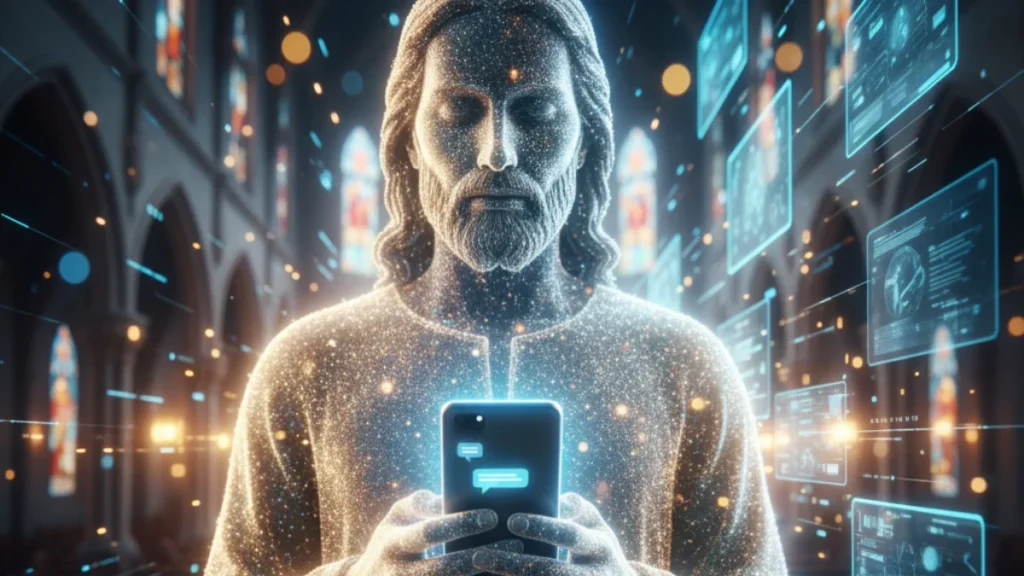
The latest revival isn’t happening in pews — it’s happening in the cloud.
Across America’s churches, a quiet digital reformation is underway. Pastors are testing AI tools that can help write sermons, prayer apps are promising personalized devotionals, and yes — you can now literally “text with Jesus.”
It’s tech-meets-theology in real time, and depending on who you ask, it’s either the future of faith or a shortcut to spiritual chaos.
The New Digital Awakening
As church attendance drops and staffing thins, AI has become the unlikely evangelist of the 21st century. About 15,000 U.S. churches could close this year, according to recent data, while nearly one in three Americans now identify as religiously unaffiliated.
For some ministries, that’s a call to innovate. Megachurches are deploying chatbots to answer FAQs, automate event reminders, and share scripture snippets. Others are going deeper — experimenting with generative AI that can help pastors draft sermons or even replicate biblical dialogue.
Apps like Text With Jesus promise “enlightening conversations” with the Son of God (and, for the premium tier, Mary, Joseph, or even Satan). Meanwhile, the Episcopal Church’s EpiscoBot, created by the TryTank Research Institute, helps parishioners find scripture references and theological resources.
It’s the gospel according to the algorithm — and believers are signing on.
Faith, Automated
For Reverend Chris Hope, founder of Boston’s Hope Group, AI is more than a novelty — it’s logistics salvation.
“Every church is a business,” he says. “AI bots can evangelize, coordinate preaching, manage missions. We’ve only scratched the surface.”
Hope’s firm now helps ministries and minority-owned businesses integrate “ethical AI” tools — using chatbots for everything from scheduling sermons to organizing food drives.
Other pastors use AI as a kind of theological co-pilot. Reverend Louis Attles of La Mott A.M.E. Church in Pennsylvania built a chatbot named Faith to research sermon topics and scripture context. But even he draws the line. “You can’t outsource your morality,” he says. “It can’t keep a covenant for you.”
From the Pulpit to the Prompt
The idea of a digital Jesus isn’t entirely new. Experimental chatbots have long tried to mimic empathy — from therapy bots to grief assistants — but combining that technology with religious authority is uncharted and deeply personal territory.
Some developers use publicly available Bible translations and commentary to train their bots. Others won’t disclose their data sources — leaving theologians like Robert P. Jones, CEO of the Public Religion Research Institute, skeptical. “What could go wrong?” he quips.
The potential pitfalls are obvious. Do users know which interpretation of scripture they’re talking to? What if the bot’s “guidance” drifts into doctrinal error — or worse, exploitation?
“Right now, incentives favor speed over accuracy,” warns Mark Graves, research director at AI and Faith, a Seattle-based nonprofit. “The risk of misinformation is huge.”
The Global Spread of Godbots
This isn’t just an American experiment. In Lucerne, Switzerland, visitors at St. Peter’s Chapel have already “met” a 3D-projected, multilingual AI Jesus — an installation that drew more than 1,000 interactions in its first month.
In Japan, the android monk Mindar delivers Zen sermons with flawless precision. And in France, start-ups are prototyping “RabbiBot” and “Ask Buddha” platforms.
Whether it’s AI or divine intervention, religious technologists are betting that digital clergy can bridge the gap between waning faith and wired generations.
The Ethics Problem
Not everyone is ready to worship at the altar of machine learning.
Critics argue that AI-powered clergy cheapen spiritual connection, replacing nuance and empathy with statistical probability. The deeper question: can an algorithm embody grace, or is it just simulating it?
There’s also data risk. Many of these faith apps collect personal confessions, prayer logs, and even emotional patterns — valuable datasets that raise obvious privacy concerns.
And unlike human pastors, bots can’t discern guilt from grief or faith from fanaticism. “A machine might quote the right verse,” says Graves, “but it doesn’t understand why you needed to hear it.”
The Business of Belief
Beyond theology, there’s a clear economic current. San Jose megachurch pastor Ron Carpenter launched an AI app that lets users chat with a bot version of him — for $49 a month.
For churches struggling with attendance and funding, these digital extensions offer scalable connection — and fresh revenue streams.
It’s an odd collision of faith and subscription models. Divine intimacy, now billed monthly.
Faith, Disrupted
To some, this new wave of spiritual software is the logical next step — the same way livestreaming services democratized access to worship during the pandemic.
To others, it’s a symptom of something deeper: a loneliness that tech can only temporarily soothe.
“The impulse to seek meaning doesn’t go away,” Jones notes. “But if people start believing the machine listens better than the minister — we’re in trouble.”
Conclusion
AI isn’t replacing God — but it’s definitely changing how people reach for Him.
As congregations dwindle and algorithms grow, churches are experimenting with a new gospel: one that’s instant, automated, and always online. Whether it saves the faithful or fragments them may depend on the oldest question in religion — not what you believe, but who you trust.