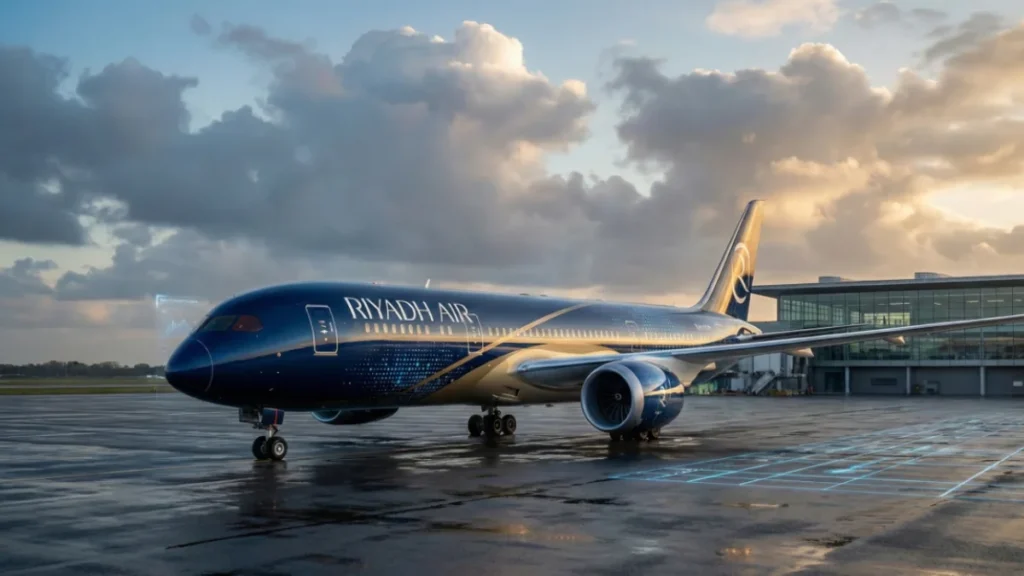
Riyadh Air wants to fly into the future without carrying the digital baggage most airlines drag behind them. And it’s doing that by becoming what it claims is the world’s first AI-native airline — a carrier built entirely around artificial intelligence, not old software patched together from the 1970s.
The company revealed the milestone at IBM Think Riyadh 2025. The message was clear: aviation doesn’t need more upgrades. It needs reinvention.
Starting From Zero — By Choice
Most airlines run on aging systems that have been updated so many times that no one can see where the original code ends. Riyadh Air decided that was a trap. So it handed IBM a blank canvas and asked the company to build a digital core with no legacy strings attached.
IBM orchestrated 59 workstreams and a network of more than 60 partners, including Apple, Adobe, Microsoft, and FLYR. All of it sits on watsonx, IBM’s suite for enterprise AI. It’s the kind of architecture tech companies brag about, but airlines rarely get the chance to deploy.
Riyadh Air executives frame this move as a conscious break from the past. If you’re starting a new airline in 2025, why recreate decades of inefficiency?
Every Employee Gets an AI Co-Pilot
The internal stack is where things get bold. Riyadh Air is rolling out a chat-first digital workplace for staff. It uses AI agents that handle HR questions, automate workflows, summarize tasks, and recommend actions in real time.
The company is preparing to double its workforce, and it sees AI as the only scalable way to do that without drowning in paperwork.
Crew members get their own tools. Mobile apps powered by IBM’s agentic systems offer suggestions on the fly — literally. Running late guests? The AI nudges staff to fast-track them. Special-needs passengers? The system flags them before the cabin crew steps onto the plane.
A lot of airlines talk about personalization. Riyadh Air wants to make it an operational reflex.
Customer Service Gets an AI Brain, Not a Script
Call centers won’t rely on classic IVR menus or static chatbots. Instead, the airline is rolling out AI voice bots and agent-assist systems that pull context from a traveler’s itinerary, past flights, membership status, and live conditions.
The goal isn’t to replace human service. It’s to cut the wait, remove the repetition, and let agents focus on conversations, not database searches.
If the tech works as promised, this could quietly become one of the most influential upgrades in global aviation.
Deepest Transformation Is Behind the Scenes
Riyadh Air’s AI-native design isn’t just about customer interaction. The real power comes from its enterprise performance platform, built to merge financial data, operational inputs, and commercial metrics under one brain.
This matters because airlines run on tight margins and unpredictable variables. Fuel prices. Delays. Crew scheduling. Demand swings.
Real-time forecasting is the holy grail, and the airline says IBM’s system gives leadership something close to it. Faster decisions. Fewer blind spots. More efficient routes. Better recovery during disruptions.
If this is accurate, Riyadh Air may have the digital equivalent of a Formula 1 pit wall running underneath its operations.
High-Tech Vision Backed by High-Level Ambition
The airline plans to reach 100+ destinations by 2030 and carry millions of passengers. It sits inside Saudi Arabia’s broader push to transform its travel and aviation landscape.
Its upcoming fleet will carry high-spec interiors, next-gen entertainment systems, and full-time connectivity tuned for digital-native travelers — the kind who treat flights as an extension of their online life.
IBM sees the partnership as proof that AI-first enterprises don’t have to be startups. Entire industries can reboot themselves if they’re willing to abandon sunk costs and start clean.
Big Swing for the Industry
Not everyone will agree with Riyadh Air’s approach. Betting this heavily on AI raises questions about resilience, transparency, and oversight. Aviation is conservative for a reason — lives depend on reliability.
But building a new airline with no digital legacy is a rare opportunity. Riyadh Air might be the only major carrier in the world able to rethink operations at this scale.
Airlines have tried to modernize for decades. Maybe the trick wasn’t modernizing. Maybe it was starting over.
What Comes Next
The airline’s first commercial flights land in early 2026. The next year becomes the real test:
Can an AI-native airline handle real-world complexity?
Can it outperform legacy carriers on cost, speed, and disruption recovery?
And if it works, will every major airline be forced to follow?
If Riyadh Air proves the model, this may be the moment aviation finally gets its long-overdue software reboot.