
At CES 2026 in Las Vegas, Lenovo wasn’t chasing spec-sheet headlines. Instead, it offered something more ambitious: a glimpse of how personal computing could evolve when artificial intelligence becomes the default layer across devices—not an add-on.
The company unveiled a lineup of proofs of concept spanning laptops, wearables, displays, and personal AI infrastructure. None are shipping products—yet. But together, they outline Lenovo’s vision for an AI era where hardware adapts to people, not the other way around.
A Laptop That Expands When Work Demands It
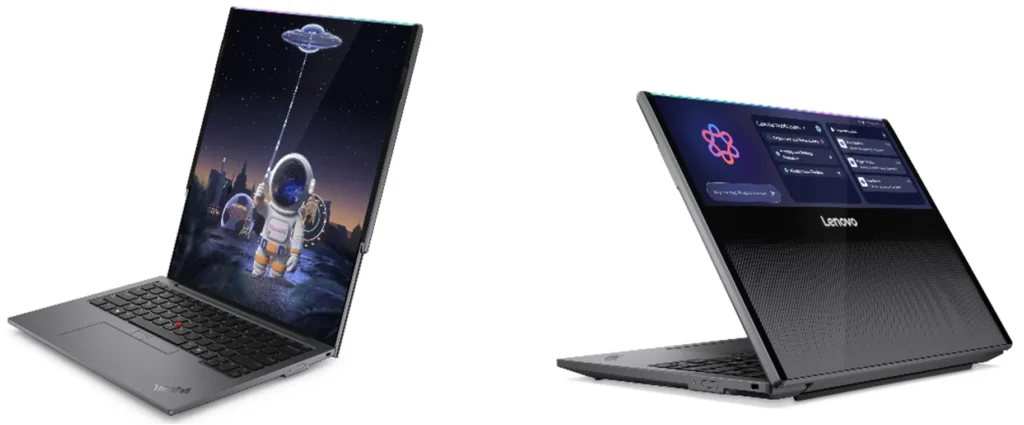
The most eye-catching reveal was the ThinkPad Rollable XD Concept, a laptop that physically changes shape. What begins as a compact 13.3-inch device can extend vertically into a nearly 16-inch display with a simple gesture, offering dramatically more workspace without increasing the laptop’s footprint.
Lenovo has experimented with foldables before, but this approach feels more pragmatic. The rollable design targets everyday productivity—multitasking, collaboration, and mobile work—rather than novelty. Touch, voice, and gesture controls reinforce the idea that interaction itself is evolving alongside form factor.
It’s a concept, but it poses a serious question: if screens can adapt on demand, does “laptop size” even matter anymore?
Project Kubit and the Rise of Personal AI Infrastructure
Another key reveal, the Lenovo Personal AI Hub Concept (internally known as Project Kubit), shifts attention away from individual devices toward something more foundational.
The hub acts as a personal, edge-based AI cloud—processing data locally rather than relying entirely on remote servers. Designed to work across phones, PCs, wearables, and smart home devices, it suggests a future where users retain tighter control over their data while still benefiting from high-performance AI experiences.
This approach aligns with growing concerns around privacy, latency, and dependence on centralized cloud platforms. Lenovo appears to be betting that “personal AI” will eventually require its own dedicated hardware layer.
AI Glasses That Prioritize Utility Over Flash
Lenovo’s AI Glasses Concept takes a quieter approach than many smart eyewear efforts. Lightweight and tethered wirelessly to a smartphone or PC, the glasses focus on practical features: hands-free calls, real-time translation, teleprompter-style prompts, and notification summaries.
Rather than pushing full augmented reality visuals, Lenovo emphasizes subtle assistance—information delivered when needed, without pulling users out of the real world. It’s a notable contrast to more immersive, and often overwhelming, AR visions.
If smart glasses are going to break through, Lenovo seems to think they’ll do so by staying out of the way.
Displays That Respond to Humans, Not Just Inputs
Lenovo also showcased AI-powered display concepts that double as intelligent hubs. These screens can automatically connect to multiple devices, support natural-language commands, and enable fluid multi-screen collaboration.
More interestingly, some concepts adapt to users themselves—adjusting brightness, color temperature, and ergonomics based on time of day, posture, and eye strain. It’s a reminder that as screens occupy more of our lives, comfort and well-being are becoming design priorities, not afterthoughts.
Accessories That Rethink the Basics
Rounding out the lineup were smarter accessories, including a customizable keyboard with adjustable keystroke resistance and a self-charging mouse powered entirely by indoor light. These concepts aim to remove small but persistent friction points—charging cables, fixed input behavior—that quietly shape daily workflows.
Why This Matters
Lenovo’s CES 2026 concepts don’t promise a single breakthrough device. Instead, they sketch a broader shift: computing that’s flexible, contextual, and increasingly personal.
None of these ideas are guaranteed to reach consumers unchanged. But taken together, they suggest Lenovo is preparing for a world where AI isn’t something you “use”—it’s something your devices quietly do, all the time.