ServiceNow is making a clear statement about where enterprise AI is headed: away from demos and into day-to-day operations.
In a new multi-year partnership, ServiceNow has named OpenAI a preferred intelligence capability across its platform—one that already powers more than 80 billion workflows every year. The goal isn’t smarter answers. It’s AI that actually does the work.
From AI experiments to AI execution
Most enterprises today are stuck in what executives quietly admit is “pilot purgatory.” AI tools exist, but they rarely connect cleanly to the systems that run the business.
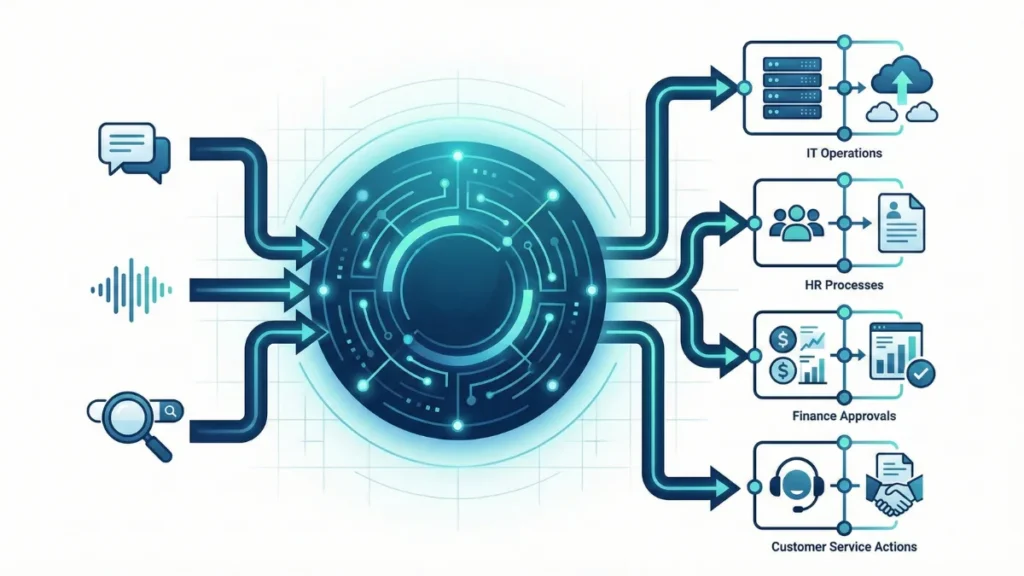
ServiceNow sits at the center of that problem—and now, potentially, the solution. Its platform stitches together IT, HR, finance, customer service, and sales workflows across sprawling enterprise systems. By embedding OpenAI’s frontier models directly into that workflow engine, ServiceNow is pushing AI beyond assistance and into execution.
This means AI that can interpret a request, understand enterprise context, respect permissions, and move tasks through approvals until they’re completed—without constant human nudging.
What GPT-5.2 changes inside ServiceNow
At the core of the partnership is deeper access to OpenAI models such as GPT-5.2. Inside ServiceNow, these models aren’t operating as standalone tools. They’re paired directly with live enterprise data and workflow logic.
An employee asking, “I need to check my benefits,” or “This customer issue needs escalation,” doesn’t just get a response. The system can retrieve the right data, trigger the correct workflow, route approvals, and close the loop.
To the user, it feels like chatting with a capable coworker. Behind the scenes, it’s AI making decisions and pushing work forward in real time.
Voice is the next frontier
Text isn’t the endgame. ServiceNow and OpenAI say they’re working toward direct speech-to-speech and native voice experiences inside the platform.
That opens the door to a more natural way of interacting with enterprise software—especially for frontline workers and executives who don’t want to live inside dashboards. Talk, type, or use visuals; the AI agent handles the rest.
This move aligns with a broader industry push toward multimodal AI, where voice and context matter as much as text prompts.
Why enterprises are paying attention
ServiceNow already serves many of the world’s largest organizations, and OpenAI’s enterprise reach continues to expand. Companies such as Accenture, Walmart, PayPal, and Morgan Stanley are part of OpenAI’s growing business customer base.
For these companies, the appeal is straightforward: fewer manual handoffs, faster resolution times, and AI that fits into existing governance and security models.
As ServiceNow executives frame it, this isn’t AI replacing workers—it’s AI taking on the operational glue work that slows everyone down.
The bigger signal to the market
This partnership reflects a larger shift happening across enterprise tech. AI is no longer being sold as a magical overlay. It’s being wired directly into systems that run payroll, manage outages, approve expenses, and handle customers.
Platforms like ServiceNow are positioning themselves as AI control towers—places where models, data, and workflows converge into something measurable and repeatable.
The companies that win this phase won’t be the ones with the flashiest demos. They’ll be the ones whose AI quietly gets work done.
Conclusion
ServiceNow isn’t betting on AI hype. It’s betting on execution.
By turning OpenAI into a built-in intelligence layer for enterprise workflows, the company is pushing AI out of experimentation mode and into the operational core of global businesses. If it works, this could be what enterprise AI finally growing up looks like.