AI agents are getting smarter—but they still fall apart when plans stretch too far into the future.
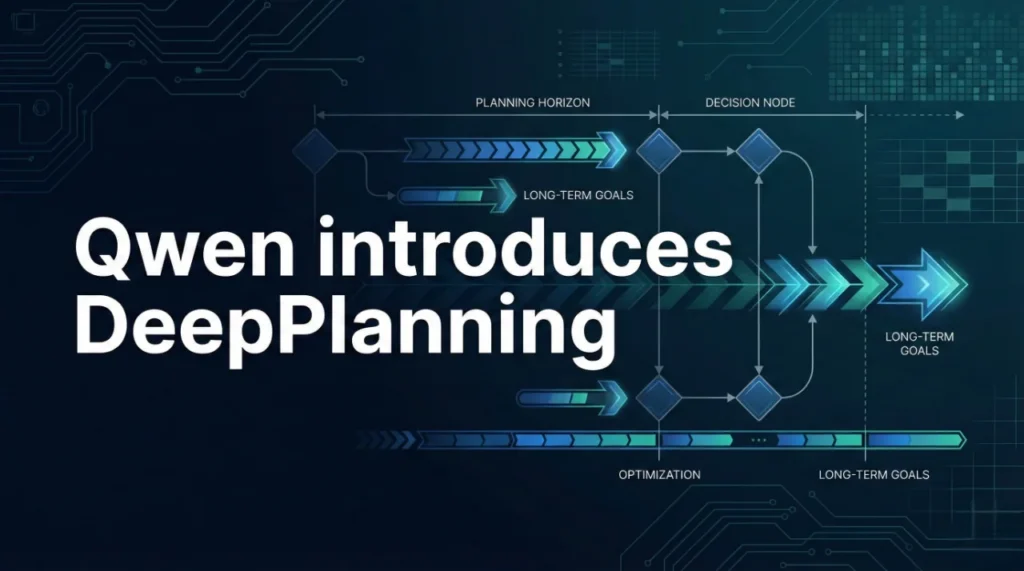
On January 27, Qwen, Alibaba’s open AI research initiative, introduced DeepPlanning, a new benchmark aimed at testing whether AI agents can hold a plan together over long time horizons in realistic conditions.
The announcement signals a shift in how agent intelligence is evaluated—away from step-by-step reasoning tests and toward outcomes that actually matter in production systems.
Why Qwen Thinks Current Benchmarks Miss the Point
Most popular AI benchmarks focus on short, local reasoning: can a model choose the correct next action?
Qwen argues that this approach fails to capture how agents behave in the real world, where decisions made early can quietly break a plan hours—or days—later. In practice, agents must juggle constraints like time limits, cost ceilings, and complex trade-offs across an entire workflow.
DeepPlanning is designed to expose those cracks.
Instead of grading individual reasoning steps, the benchmark checks whether global constraints remain valid from start to finish. A plan that looks reasonable early on but exceeds its budget or deadline later doesn’t pass.
🚀 Introducing DeepPlanning — a new benchmark for long-horizon agent planning in real-world scenarios.
— Qwen (@Alibaba_Qwen) January 27, 2026
Unlike step-by-step reasoning tasks, we focus on verifiable global constraints: time budgets, cost limits, and combinatorial optimization that must hold across the entire plan.…
What DeepPlanning Actually Measures
According to Qwen, DeepPlanning focuses on three core pressure points that commonly derail autonomous systems:
- Time budgets, ensuring plans stay within execution limits
- Cost constraints, reflecting real operational trade-offs
- Combinatorial optimization, where early choices affect downstream feasibility
This approach reframes planning as an end-to-end problem, not a chain of isolated decisions.
In other words, it’s less about how an agent reasons—and more about whether its plan actually works.
Why This Matters for AI Agents in Production
Long-horizon planning is one of the biggest unsolved problems in agent-based AI.
As companies deploy agents to manage workflows, coordinate tools, or operate autonomously, small planning errors can compound quickly. A single misjudged assumption early in a plan can invalidate everything that follows.
By making these failures measurable, DeepPlanning could influence how future models are trained and evaluated—especially for enterprise and industrial use cases where reliability matters more than clever reasoning traces.
A Sign of Where Agent Research Is Heading
DeepPlanning also reflects a broader shift in AI research.
As agent systems move out of demos and into real products, benchmarks are evolving to mirror deployment conditions. Researchers and developers are increasingly prioritizing constraint satisfaction, robustness, and long-term coherence over short-form problem solving.
While Qwen has not yet released public leaderboards or model comparisons, the benchmark positions itself as infrastructure for the next phase of agent development—one focused on endurance, not just intelligence.
What We Still Don’t Know
Qwen has not disclosed which models have been tested on DeepPlanning, nor whether the benchmark will be released publicly with datasets or tooling.
Those details will determine how widely it’s adopted—and whether it becomes a standard reference point for evaluating autonomous agents.
For now, the message is clear: planning isn’t just about reasoning anymore. It’s about whether an AI system can stay within bounds when the stakes—and timelines—get longer.
Conclusion
DeepPlanning pushes AI evaluation closer to real-world expectations. If it catches on, future agents may be judged less on how they think—and more on whether their plans actually survive contact with reality.