Meta’s AI ambitions are no longer just about chips and models. They’re about glass, light, and distance.
The company has agreed to pay up to $6 billion to Corning through 2030 for fiber-optic cable used inside its rapidly expanding AI data centers, marking one of the clearest signs yet that artificial intelligence is now reshaping the physical infrastructure of the internet.
The deal, confirmed by Corning CEO Wendell Weeks in an interview with CNBC, ties Meta’s long-term AI roadmap to a 175-year-old glass manufacturer that quietly sits at the center of global connectivity.
AI’s bottleneck isn’t software—it’s movement
As AI models grow larger and more complex, the problem shifts from raw compute to how fast data can move between thousands of processors without burning unsustainable amounts of power.
That’s where fiber comes in.
Unlike copper, which moves electrons, fiber-optic cable moves photons—pulses of light. It’s faster, more energy-efficient, and increasingly essential as AI data centers scale from racks of servers to facilities that rival small power plants.
Corning estimates that transmitting data via fiber uses five to twenty times less power than copper. As energy constraints tighten, that efficiency edge stops being optional.
Inside Meta’s infrastructure surge
The fiber agreement fits neatly into Meta’s broader spending spree.
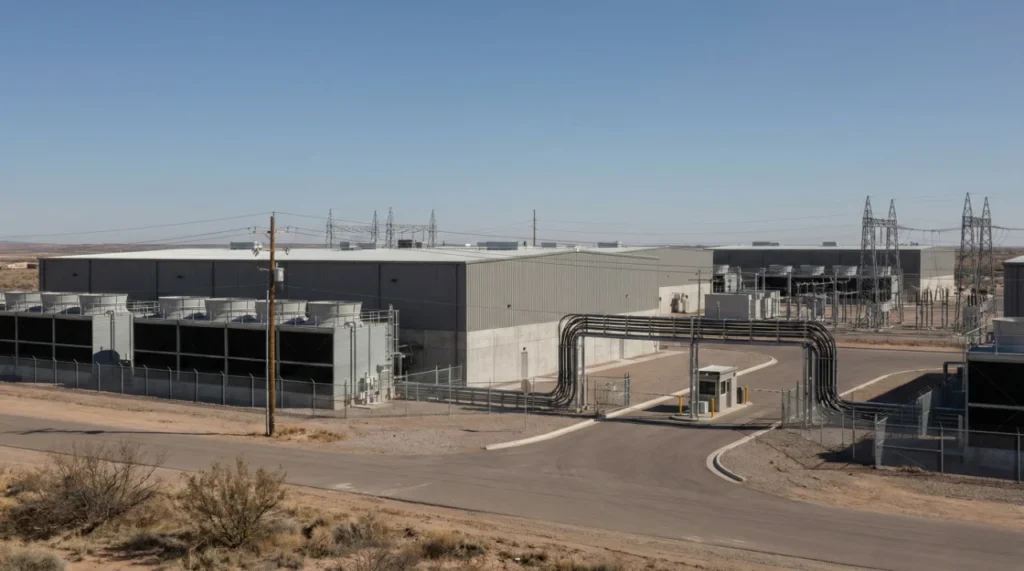
The company plans to build 30 data centers, including 26 in the U.S., as part of a domestic push to support AI workloads. Two of the largest—its one-gigawatt Prometheus site in Ohio and the five-gigawatt Hyperion site in Louisiana—will rely on Corning fiber under the new deal.
Meta executives have framed the strategy as both economic and strategic. Keeping supply chains domestic, they argue, reduces risk as AI becomes a geopolitical priority rather than just a commercial one.
Why Corning is suddenly everywhere
Corning isn’t new to tech cycles. It supplied fiber during the dot-com boom, rode the smartphone era with Apple, and now finds itself at the center of AI’s physical layer.
What’s different this time is scale.
AI data centers require significantly more fiber than traditional cloud infrastructure. In response, Corning has expanded production at its North Carolina facility, which it says will become the largest fiber-optic cable plant in the world once completed.
Weeks expects hyperscalers—companies running massive data centers—to become Corning’s biggest customers as early as next year.
A new kind of fiber, built for AI
To keep up, Corning developed a new fiber product specifically designed for AI environments, called Contour.
The cable packs twice as many fiber strands into standard conduits and dramatically reduces connector complexity. The goal: more bandwidth in the same physical space, without rewiring entire buildings.
Development started more than five years ago, long before generative AI entered the mainstream. According to Weeks, early conversations with AI researchers made it clear that data movement—not compute alone—would become the next constraint.
Markets are paying attention
Investors have taken the hint.
Corning’s stock has climbed more than 75% over the past year, driven largely by its optical communications business, which has become its fastest-growing segment. Revenue from that division jumped sharply as enterprise customers rushed to refresh networks for AI workloads.
Analysts caution that fiber demand can be cyclical, but many note that Corning today is far more diversified than it was during the dot-com crash, with steady cash flow from automotive glass, consumer electronics, and medical packaging.
The bigger picture
The Meta-Corning deal highlights a shift that’s easy to miss amid headlines about models and benchmarks: AI progress increasingly depends on physical systems that can’t scale overnight.
Glass factories, power grids, and supply chains now matter as much as algorithms.
As AI pushes closer to its infrastructure limits, companies that control the flow of light—not just code—may end up shaping the next phase of the industry.
Conclusion
AI’s future isn’t just being written in data centers. It’s being laid, strand by strand, in fiber-optic glass.
Meta’s $6 billion bet makes that unmistakably clear.