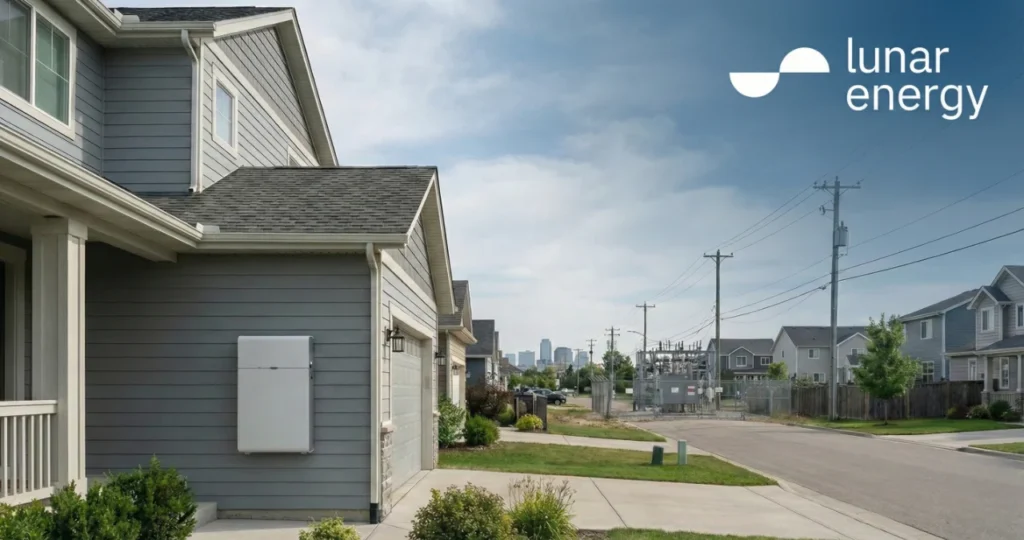
Lunar Energy just pulled in $232 million to accelerate its push into home batteries and AI-driven virtual power plants, as pressure mounts on aging power grids and electricity prices remain stubbornly high.
The California-based startup closed an oversubscribed $102 million Series D, led by B Capital and Prelude Ventures. That round follows a previously undisclosed $130 million Series C led by Activate Capital, bringing total new funding to $232 million.
The size — and timing — of the raise highlights growing investor interest in software-led solutions for grid reliability, especially those that turn everyday homes into flexible energy assets.
Batteries First, Software Always
Founded in 2020 by Kunal Girotra, Lunar Energy builds both hardware and software for residential electrification. Its home battery systems are paired with Lunar Gridshare, an AI-powered platform that links thousands of batteries together into coordinated virtual power plants (VPPs).
Instead of acting independently, these batteries can respond in real time to grid demand — charging when electricity is cheap and feeding power back when supply tightens.
That combination is increasingly attractive to utilities struggling with peak demand, extreme weather, and the rapid growth of electric vehicles and data centers.
Already Operating at Scale
Lunar’s technology is already deployed across multiple markets.
Sunrun, one of the largest residential solar providers in the US, uses Lunar Gridshare to operate distributed power plants in New England, Hawaii, and Puerto Rico. The platform is also used by California Community Choice Aggregators, as well as utilities and energy retailers in Europe and Asia.
In its first year of commercial operations, Lunar says it installed thousands of home battery systems in California, giving the company a live testing ground before expanding nationwide.
Homeowners Are Getting Paid
Beyond grid stability, Lunar is leaning heavily into consumer economics.
According to the company, homeowners using its AI-powered system earned an average of $464 last year by participating in VPP programs. They also saved about $338 more compared with standard home battery setups that don’t actively optimize usage.
At scale, Lunar Gridshare now manages roughly 650 megawatts of distributed energy devices across multiple continents — a meaningful footprint in a sector still dominated by pilot projects.
Why Investors Are Paying Attention
Virtual power plants have become one of the most closely watched areas in clean energy. Unlike traditional infrastructure, VPPs can be deployed quickly, scale modularly, and rely on existing homes rather than new power plants.
Lunar’s pitch is that neither batteries nor software alone can solve the problem.
“We believed early on that the energy transition wouldn’t be solved by hardware alone or software alone,” Girotra said in a statement, pointing to the need for tight integration between physical devices and AI-driven coordination.
That thesis appears to be resonating with investors ranging from climate-focused venture firms to strategic players like Itochu Corporation.
What Comes Next
Lunar plans to use the fresh capital to expand its home battery systems across the US, building on its California rollout. The company also intends to deepen partnerships with utilities and energy providers as grids become more decentralized and data-driven.
As electricity demand continues to climb, Lunar is betting that the future grid won’t just be managed by utilities — it’ll be quietly powered by thousands of homes working together, orchestrated by software.
Conclusion
Lunar Energy’s $232 million raise isn’t just about batteries. It’s a signal that AI-powered virtual power plants are moving from edge-case experiments to core grid infrastructure — and investors don’t want to miss the shift.