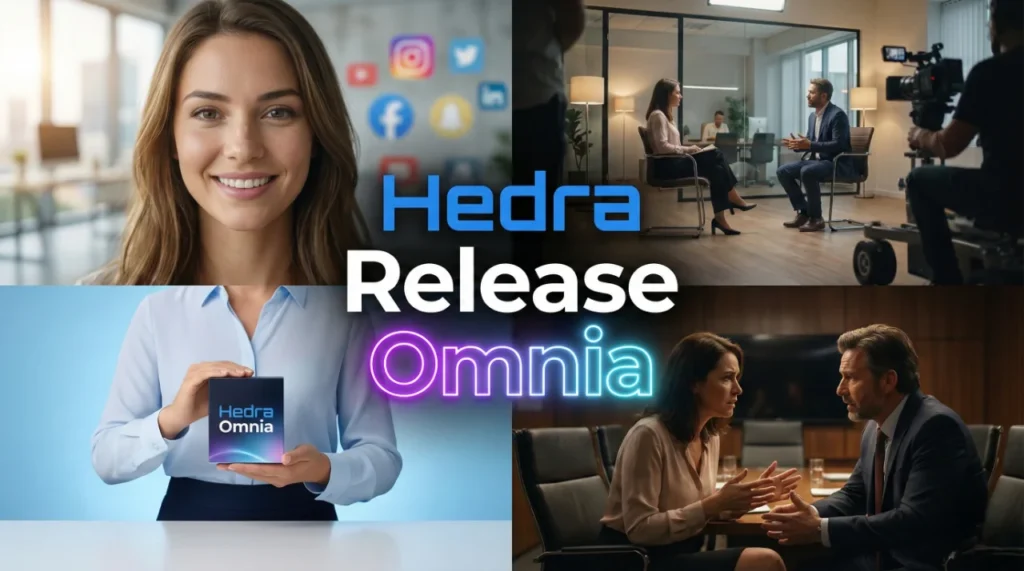
The race to make AI video feel genuinely human just took a meaningful turn. Hedra has released Omnia, a new video model designed to solve a problem creators have been quietly complaining about for years: AI video that looks sharp but feels dead.
Omnia’s debut matters because it challenges a long-standing tradeoff in generative video—choose expressive, voice-driven avatars or cinematic visuals, but rarely both at the same time.
A long-standing split in AI video finally gets addressed
Until now, the AI video market has been divided into two camps.
On one side are “talking head” systems. They do voice well, but everything else is frozen: static cameras, stiff bodies, environments that feel like wallpaper. On the other are general video generators that create dynamic scenes but treat audio as an accessory rather than a driver of performance. The result is visually impressive clips that fall apart the moment someone speaks for more than a few seconds.
Omnia was built to close that gap. Instead of stitching together separate systems for visuals, motion, and sound, Hedra engineered a single model that reasons over all three at once. The idea is simple but ambitious: if speech, movement, and camera behavior influence each other in real life, an AI model should treat them the same way.
What’s actually different under the hood
The technical shift behind Omnia isn’t about higher resolution or flashier effects. It’s about coordination.
In most AI video systems, audio comes last—used mainly to sync lips. Omnia flips that priority. Speech rhythm influences body motion. Emotional tone shapes facial expressions. Timing affects how the camera moves through a scene. The model builds an understanding of the entire performance before generating the first frame.
That approach shows up in details professionals notice immediately: natural blinking, subtle head movement between words, hands that stay stable, and logos that don’t warp or dissolve halfway through a shot. These aren’t cosmetic upgrades. They’re the cues viewers subconsciously use to decide whether a video feels authentic or artificial.
One notable choice Hedra made was to avoid chasing hyper-sharp realism. In practice, overly crisp faces with robotic motion tend to feel unsettling. Omnia prioritizes believable presence instead—continuous motion, micro-expressions, and camera behavior that responds to the subject rather than drifting aimlessly.
Camera control becomes part of the performance
One of Omnia’s more consequential features is its approach to camera direction. Instead of treating the camera as an invisible observer, the model treats it as part of the scene.
Creators can specify push-ins, pull-outs, tracking shots, or orbiting movement and expect those directions to be followed consistently. More importantly, the camera stays coherent relative to the subject. If the speaker leans forward or shifts tone, the framing adjusts in ways that feel intentional rather than random.
For anyone who has tried to create AI video with even modest cinematic ambition, this is a big deal. Camera motion has traditionally been one of the fastest ways to expose a clip as AI-generated. Omnia’s ability to maintain spatial logic suggests a move toward AI video that can be directed, not just prompted.
Where this model is likely to shine first
Omnia is optimized for short, character-driven clips—roughly eight seconds at full HD. That constraint is deliberate and revealing.
The strongest early use cases are likely to be social and brand formats where authenticity matters more than spectacle. Influencer-style videos, interview snippets, podcast clips, and conversational ads all benefit from consistent voice, natural motion, and stable visual details. In those formats, even small visual glitches can break trust.
Brand teams, in particular, may pay attention to Omnia’s handling of logos and product elements. Generative AI has struggled with brand integrity, often rendering text or marks unusable. Reliable control over those details lowers one of the biggest barriers to AI video adoption in advertising and marketing.
There’s also a quieter implication for music and performance content. Because audio timing influences motion throughout the clip, rhythm-driven material—singing, spoken word, or musical dialogue—comes across as more intentional than the usual lip-synced output.
Why this news matters beyond creators
For consumers, the shift is subtle but important. As AI video becomes more believable, audiences will encounter synthetic performers in contexts that previously required human production—local ads, explainer content, and social media storytelling. The line between filmed and generated video will blur further, raising new questions about disclosure and trust.
For businesses, Omnia signals that AI video is moving from novelty toward workflow tool. When camera control, voice consistency, and brand reliability improve, AI video stops being experimental and starts competing with traditional production for certain use cases.
And for the industry at large, the model reflects a broader trend: progress in generative AI is increasingly about coherence, not raw visual power. The models that win won’t just look better frame by frame; they’ll feel more intentional over time.
Looking ahead: what the next year could bring
Expect more pressure on AI video platforms to integrate audio, motion, and camera logic rather than treating them as separate problems. Omnia sets a benchmark that competitors will have to respond to.
There are still clear limits. Short clip lengths constrain narrative complexity, and single-subject scenes remain the safest ground. But those constraints also suggest a roadmap. As models like Omnia mature, multi-character interaction and longer scenes become more feasible.
The bigger risk is complacency. As AI video becomes more convincing, misuse and over-automation become easier. Platforms will need to balance creative power with safeguards that maintain transparency and accountability.
For now, Omnia represents a meaningful shift in priorities. Instead of asking how real AI video can look, Hedra is betting that the more important question is how real it can feel.