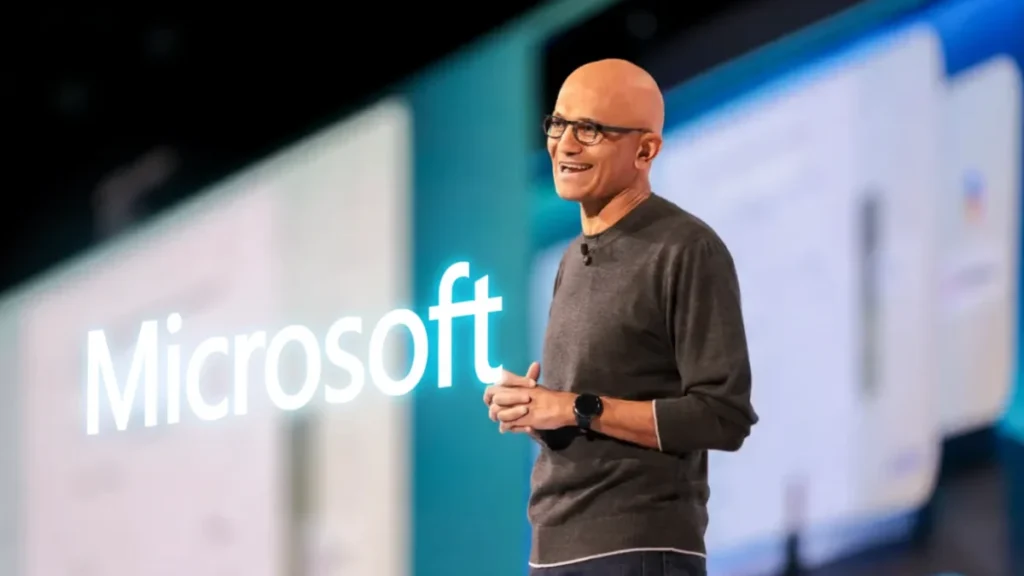
Microsoft is rewriting the software rulebook — and this time, it’s pricing for the age of AI coworkers.
CEO Satya Nadella says the company is rethinking its long-standing “per user” model, replacing it with something designed for the future of work: “per agent” pricing. In plain terms, Microsoft wants to charge not by how many humans use its software, but by how many AI agents do.
The idea sounds small — a tweak in billing semantics — but it marks a massive shift in how digital work will be valued.
“Our business, which today is an end-user tools business, will become essentially an infrastructure business in support of agents doing work,” Nadella said on a recent episode of the Dwarkesh Podcast.
That’s a bold statement from the head of the world’s second-largest software maker. It suggests Microsoft isn’t just building AI copilots for humans — it’s building a workspace for bots.
From Users to Agents
For decades, Microsoft’s empire has rested on one simple math equation: number of users × price per license = revenue.
But AI changes that equation. Copilots and autonomous agents don’t fit neatly into per-seat licenses — they don’t log in, they don’t take vacations, and they scale infinitely.
So Microsoft is moving toward metered, usage-based models that reflect how much “work” AI performs. Enterprises could soon pay for the number of agents deployed or the compute they consume, not the number of human employees with accounts.
It’s a shift that echoes what’s already happening in cloud computing — and a recognition that AI systems are no longer just tools, but actors in the workflow.
The Industry Is Moving With It
Microsoft isn’t alone here.
Companies like ServiceNow have already started experimenting with AI-usage billing, measuring how much computation or inference their systems perform. CEO Bill McDermott said earlier this year that “when it goes beyond what we can credibly afford, we have to have some kind of meter.”
Enterprise consultancies are taking notice too. Deloitte and EY have launched “agentic AI” platforms where autonomous systems analyze data, generate reports, and even talk to clients. EY executives described this as a “service-as-a-software” model — clients pay for outcomes delivered by AI, not hours worked by humans.
This new pricing logic is creeping into every corner of enterprise tech — from Anthropic’s Claude models, billed by tokens processed, to Google’s Gemini API, charged per query or compute cycle.
Why It Matters
For Microsoft, the move from “per user” to “per agent” is more than financial restructuring — it’s strategic positioning.
If the AI agent truly becomes the next digital worker, Microsoft wants to own its workspace, memory, and infrastructure.
“All the stuff we built underneath Microsoft 365 still is going to be very relevant,” Nadella said. “You need some place to store it, some place to do archival, some place to do discovery, some place to manage all of these activities, even if you’re an AI agent.”
That vision positions Microsoft 365 not just as office software but as the operating system for digital coworkers. Think of it as the SharePoint for your AI fleet.
The Future of Work: Humans + Bots
For enterprises, this pricing model could have two opposite effects.
On one hand, usage-based billing offers more flexibility: you pay only for the work AI does.
On the other, as organizations deploy hundreds of bots, costs could spiral — similar to the early days of cloud adoption when compute bills shocked finance teams.
CIOs will need new governance tools to track “bot sprawl” — how many agents are running, what they’re doing, and how much they’re costing. Licensing teams will shift from managing seats to managing swarms.
Still, the opportunity is clear. As AI handles more routine and analytical work, human teams can focus on higher-value tasks — if the economics make sense.
Conclusion
Microsoft’s “per agent” model isn’t just a billing update — it’s a philosophical reset.
It signals a future where AI systems are not accessories to human labor but participants in it.
And if Microsoft gets the pricing right, the company could cement its dominance in the next era of enterprise software — where every employee might just have a digital coworker.