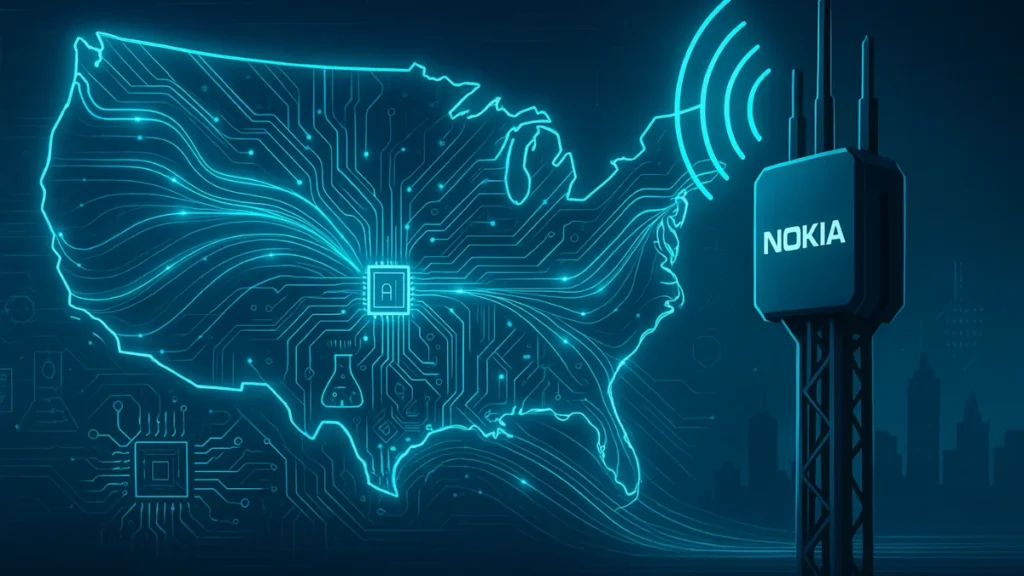
In a move that instantly shakes up the global telecom race, Nokia has committed $4 billion to supercharge its US operations, signaling one of the company’s strongest bets yet on AI-centric infrastructure.
The announcement puts Nokia in rare territory: few global network vendors are investing this aggressively in US-based R&D and manufacturing at the same time.
Nokia Makes Its Largest US Tech Bet Yet
The company detailed a sweeping plan to expand research, development, and network hardware production across several states.
Most of the money — roughly $3.5 billion — is aimed at building the next generation of network technologies: faster mobile systems, more capable fiber access, smarter IP routing, denser optical transport, and data-center-grade networking built for AI traffic.
Another $500 million is being funneled into manufacturing upgrades in Texas, New Jersey, and Pennsylvania, turning existing plants into higher-throughput, AI-aligned production centers.
Unlike prior expansions, this one is directly tied to the surge in AI computation — and the stress it’s putting on legacy infrastructure.
Why Nokia Is Moving This Fast
AI is fundamentally changing what networks need to do.
Training and inference loads are exploding, edge devices need real-time data pipelines, and enterprise systems demand ultra-low latency with zero security compromise.
Nokia is positioning itself early by focusing on:
- AI-driven automation to run networks with minimal human intervention
- Quantum-safe encryption for next-generation cybersecurity
- Optical systems engineered for massive bandwidth jumps
- Semiconductor testing and advanced materials to support new hardware designs
In short: the company wants to be the backbone for the AI era — not a vendor playing catch-up.
Why This Matters for the US
The investment comes at a moment when Washington is pushing hard for domestic technology production and greater resilience in critical infrastructure.
Officials praised Nokia’s decision, framing it as a win for both innovation and national competitiveness.
For the US, this means more secure telecom hardware produced locally, shorter supply chains, and a stronger foothold in the global AI-networking race.
A Shift in the Telecom Power Map
This expansion isn’t just Nokia scaling up — it’s Nokia repositioning itself as a long-term US innovation partner.
And it arrives as rivals face pressure to keep up with AI-optimized systems and energy-efficient architectures.
If Nokia’s bet pays off, the company won’t just modernize networks — it will help define what an AI-native network even is.
Conclusion
Nokia is making a bold strategic play: invest heavily now, reshape the infrastructure of the AI era, and become indispensable to America’s digital future.
It’s not just an upgrade.
It’s Nokia rewriting its role in the next decade of global connectivity.