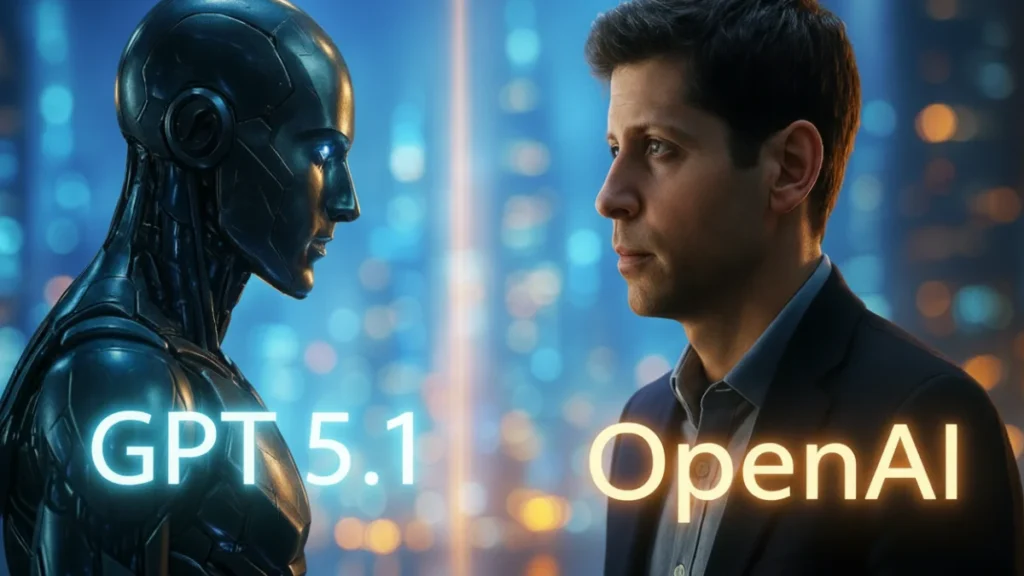
OpenAI’s GPT-5 was already a game-changer — but GPT-5.1? It’s something else entirely.
This update doesn’t just make the model smarter; it makes it feel alive.
The difference between GPT-5 and GPT-5.1 comes down to three core upgrades:
- Smarter reasoning (GPT-5.1 can decide when to “think” longer).
- More human conversation style (it feels warmer, more intuitive).
- Customizable personality (you can finally shape how your ChatGPT sounds).
Let’s break down exactly what changed — and why GPT-5.1 might be the biggest leap since the birth of ChatGPT.
The Backstory: How We Got from GPT-5 to GPT-5.1
When GPT-5 launched, it was hailed as a major leap in reasoning and accuracy.
It was capable, coherent, and miles ahead of GPT-4 in understanding context.
But users started noticing something missing — personality.
It was intelligent but often too neutral. It answered perfectly but didn’t always connect.
That’s where GPT-5.1 comes in.
Instead of just being a smarter machine, it’s designed to be a better communicator.
OpenAI’s team focused on one question:
“Can we make AI not only intelligent — but pleasant to talk to?”And the answer, it seems, is yes.
GPT-5 vs GPT-5.1 — The Core Structural Difference
Let’s break it down simply:
| Feature | GPT-5 | GPT-5.1 |
|---|---|---|
| Reasoning Model | Static — same compute for every question | Adaptive reasoning — allocates time per complexity |
| Response Tone | Neutral and direct | Warmer, more natural, empathetic |
| Variants | Instant & Thinking (early) | Improved Instant + Upgraded Thinking |
| Instruction Following | Often literal | Far more context-aware |
| Customization | Limited | Full tone & style personalization |
| Speed | Consistent | Dynamic — faster on easy, deeper on hard |
| API Models | gpt-5-chat, gpt-5-thinking | gpt-5.1-chat-latest, gpt-5.1 (adaptive) |
| Availability | Legacy dropdown | Default rollout to all paid users |
The Two Brains of GPT-5.1: Instant and Thinking
GPT-5.1 doesn’t come as one single model — it’s actually two minds in one generation.
GPT-5.1 Instant — The Conversational Pro
This is the version most users interact with inside ChatGPT.
It’s fast, natural, and surprisingly warm by default.
Think of it as the “chatty friend” version — quick to respond, lighthearted, yet useful.
Perfect for brainstorming, writing, and casual daily conversations.
Example:
“I’m stressed. What should I do?”GPT-5:
Try deep breathing or meditation.GPT-5.1 Instant:
I’ve got you — try a 4-7-8 breathing trick.
Or go for a 10-minute walk.
Want me to make you a 5-minute “reset” plan?
It’s not just giving information — it’s engaging with empathy.
GPT-5.1 Thinking — The Deep Analyst
This version is built for reasoning-heavy tasks: coding, data analysis, technical research.
It’s slower, but it thinks harder before replying.
It actually decides how long to “think” based on task complexity.
So, if you ask a simple question, it responds instantly.
But if you ask something complex, it takes more time — just like a human pausing to reason.
That’s the heart of adaptive reasoning, one of GPT-5.1’s biggest breakthroughs.
Adaptive Reasoning: The Brain That Knows When to Think
In GPT-5, all prompts were treated equally — whether you asked “What’s 2+2?” or “Explain quantum tunneling.”
GPT-5.1 fixes that with adaptive reasoning.
It decides when to pause and think deeply vs when to just respond quickly.
- For simple tasks → it’s about 57% faster.
- For complex tasks → it takes longer but delivers more precise logic and structure.
It’s like your AI finally learned how to prioritize its brainpower.
This change also makes GPT-5.1 more energy-efficient and context-aware — something developers will appreciate when scaling workloads.
Tone Matters: GPT-5.1 Feels More Human
Let’s be honest — GPT-5 was brilliant but a little cold.
GPT-5.1 fixes that with a personality overhaul.
The new model comes with built-in “style presets” — like tone templates.
You can choose between:
- Friendly: Warm, conversational, and approachable.
- Professional: Polished and precise.
- Candid: Straightforward and motivational.
- Quirky: Playful and creative.
- Efficient: Fast and minimalistic.
- Nerdy or Cynical: For techies or humor-driven tasks.
And here’s the cool part — ChatGPT can now adapt its tone mid-conversation.
If you say,
“Hey, can you sound more professional?”
it adjusts instantly — no need to start a new chat.
This is a big step toward personalized AI behavior.
It feels like the assistant is actually learning your vibe, not just your prompts.
Real-World Difference: Smart vs Human in Action
Let’s compare how GPT-5 and GPT-5.1 handle the same scenario.
Scenario:
“I spilled coffee on myself before a meeting. I think I looked like an idiot.”GPT-5:
That’s unfortunate. Most people probably didn’t notice. Don’t worry about it.GPT-5.1 Instant:
Hey, that happens to everyone.
You handled it and still showed up — that’s resilience, not embarrassment.
Honestly? Nobody even remembers. You’re fine.
The difference?
GPT-5 responds like a search engine.
GPT-5.1 responds like a friend.
That warmth — that emotional intelligence — is exactly what users have been asking for.
Instruction Following: Now It Actually Listens
One of the quiet frustrations of GPT-5 was its occasional tone-deafness.
It didn’t always follow instructions precisely.
If you said “write 50 words, no emojis,” it might still sneak one in.
GPT-5.1 is way better at this.
It listens, follows format instructions more accurately, and even sticks to content limits with precision.
This makes it ideal for:
- Content creators: who need consistent formatting and tone.
- Developers: who need structured JSON or API-safe outputs.
- Students: who need concise, rule-following answers.
It’s not just a “chatbot” anymore — it’s an obedient co-worker.
Personality You Can Control
OpenAI’s new personalization settings now extend across all chats.
That means once you set a tone, it stays that way — even in ongoing conversations.
You can fine-tune how:
- Warm or formal it sounds.
- How frequently it uses emojis.
- How long or concise replies are.
This isn’t just convenience — it’s about making AI feel consistent.
For brands, this is huge.
Imagine a business locking ChatGPT to “Friendly + Professional” tone for every employee’s use.
That ensures brand voice, every single time.
For Developers and Power Users
Developers get major upgrades too:
- API Models:
- gpt-5.1-chat-latest → fast Instant model.
- gpt-5.1 → deeper Thinking model with adaptive reasoning.
- Better Consistency: GPT-5.1 handles multi-turn instructions with less drift.
- Smarter Routing: “Auto” mode picks the best model for each query automatically.
Enterprise users even get a 7-day early-access window before GPT-5.1 becomes default.
And for three months, GPT-5 remains under a “legacy” tab so developers can compare outputs side by side.
It’s a graceful transition — something many AI companies skip.
How It Impacts Everyday Users
This update isn’t just for coders.
It affects how everyone uses ChatGPT.
- Writers: GPT-5.1 understands tone shifts, metaphor, and pacing better — fewer robotic lines.
- Students: Simpler explanations, friendlier examples, and improved fact precision.
- Businesses: Easier to deploy consistent chatbots or support systems with built-in warmth.
- Researchers: Deeper “Thinking” responses that explain reasoning more clearly.
Essentially, GPT-5.1 helps the AI meet you where you are — emotionally and cognitively.
What It Still Can’t Do (Yet)
Despite the upgrades, GPT-5.1 isn’t perfect.
Here’s what to keep in mind:
- It still hallucinates occasionally. Always fact-check critical data.
- It may sound too friendly in serious contexts — tone fine-tuning helps, but not flawless.
- Adaptive reasoning uses more tokens for hard queries — slightly costlier in API usage.
- Rollout is gradual, so you might not see GPT-5.1 in all regions yet.
Still, for most users, these trade-offs are worth the massive boost in usability and warmth.
The Bigger Picture: From Intelligence to Understanding
If GPT-4 made AI “smart,” and GPT-5 made it “capable,”
then GPT-5.1 makes AI humanly intuitive.
It’s the first time we can say an AI understands tone, emotion, and social nuance — even if it’s still mechanical underneath.
This shift points toward the future of conversational AI:
- Adaptive learning per user personality.
- Emotionally aware assistants.
- Hyper-personalized AI experiences that feel like digital extensions of ourselves.
GPT-5.1 is just the first step in that evolution.
The next few iterations — GPT-5.2 and GPT-6 — could blur the lines between “AI assistant” and “digital co-pilot” even further.
Conclusion: Who’s Smart, Who’s Human?
So, who wins — GPT-5 or GPT-5.1?
The answer: they’re both smart — but only one feels human.
- GPT-5 is the disciplined student: logical, precise, but a little stiff.
- GPT-5.1 is the conversational genius: analytical and emotionally aware.
OpenAI didn’t just upgrade a model — they upgraded the experience of talking to AI.
As AI keeps evolving, this balance between intelligence and empathy might be what defines the next decade of human–machine relationships.
Frequently Asked Questions
What is the difference between GPT-5 and GPT-5.1?
GPT-5.1 adds two tuned variants — Instant (fast, warm) and Thinking (deep reasoning) — plus adaptive reasoning and better instruction-following, so it responds faster on simple queries and more thoughtfully on complex ones.
What is adaptive reasoning?
Adaptive reasoning lets the model decide how much ‘thinking’ a query requires, speeding up simple replies while increasing internal processing for difficult problems to improve accuracy.
When should I pick Instant vs Thinking?
Use Instant for chat, content, and customer interactions. Use Thinking for debugging, research, and multi-step analytical tasks.
Does GPT-5.1 fix hallucinations?
It reduces some errors via better reasoning, but hallucinations can still happen — validate critical facts and combine the model with real-time retrieval where needed.
How do I migrate from GPT-5 to GPT-5.1?
Test both variants with real prompts, route requests by intent, monitor costs & latency, and keep GPT-5 as a legacy fallback during the transition.