Google is pushing agentic AI out of the lab and into the real world.
And today’s update may be its most aggressive move yet.
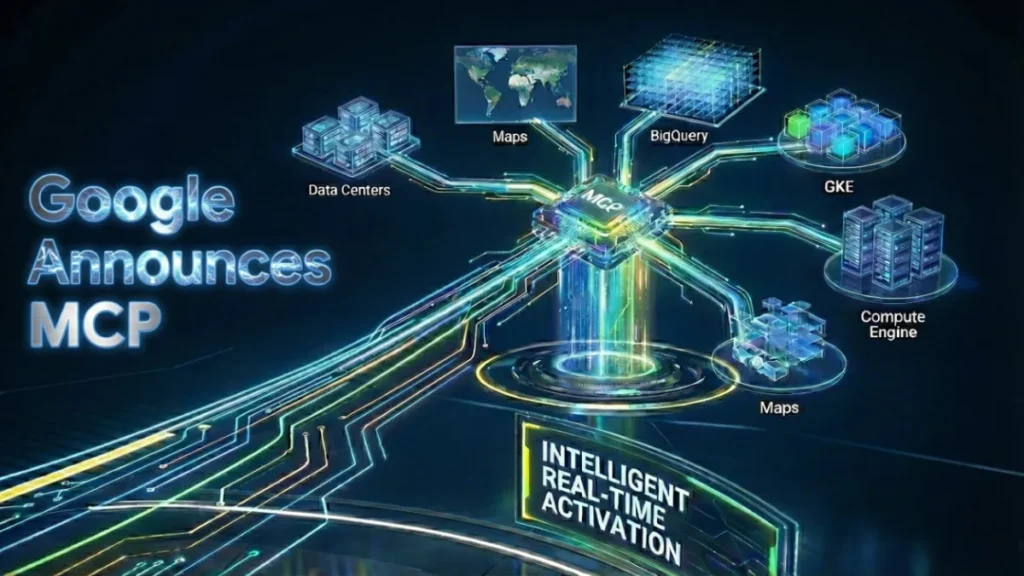
The company has rolled out fully managed Model Context Protocol (MCP) servers across key Google and Google Cloud products — a shift designed to remove the messy DIY work developers faced when wiring AI models to APIs, data, and infrastructure. MCP, often compared to a “USB-C for AI,” gives models a clean, universal way to call tools and retrieve data without brittle hacks.
Until now, most Google-focused MCP setups relied on open-source servers or local community builds. They worked, but they were fragile. They broke easily. And they put too much pressure on developers who just wanted reliable agents.
Google’s pitch today is simple:
We’ll handle the server. You focus on the agent.
Maps, BigQuery, GCE, and GKE Are First in Line
The first wave lands across products that already sit at the center of many AI workflows.
Maps: Real-World Grounding Without Guesswork
Maps Grounding Lite now lets agents pull verified geospatial data — routes, distances, nearby places, even short-term weather.
Translation: fewer hallucinations, more accurate reasoning.
This means an AI assistant can answer:
• “How far is the nearest park?”
• “What’s LA’s weekend weather?”
• “Find kid-friendly dining near my hotel.”
No scraping. No guessing. Real data, in real time.
BigQuery: Enterprise Data Without the Export Pain
The BigQuery MCP server lets agents read schemas and run queries directly.
No data exports. No context-window hacks.
It keeps sensitive information in place while enabling forecasting and analytics workflows. For enterprise teams, this may be the quiet game-changer of the entire announcement.
GCE and GKE: Autonomous Infra, For Real
Compute Engine now exposes provisioning and resizing as callable tools.
Agents can scale systems, adjust workloads, or manage day-2 operations.
GKE adds a structured Kubernetes interface that removes the old pattern of parsing CLI logs. Agents can inspect clusters, troubleshoot issues, or optimize costs — with or without human approval loops.
Infrastructure, meet autonomy.
The Enterprise Twist: Apigee Opens the Internal Toolbox
Google also announced MCP support through Apigee, its API management layer.
This means companies can turn their internal APIs — and even third-party ones — into discoverable tools for agents.
Finance systems. Inventory databases. Logistics pipelines.
All can now be part of an agent’s action surface.
It’s a move that gives enterprises control, while lowering the barrier to real automation.
Security and Governance Aren’t Afterthoughts
Google paired the launch with stronger guardrails:
- Cloud API Registry + Apigee Hub for vetted tool discovery
- IAM access controls to manage what agents can call
- Audit logs for visibility into agent behavior
- Model Armor to defend against indirect prompt injection
This is Google saying:
Agentic AI doesn’t work without trust. And trust doesn’t happen without control.
Anthropic’s David Soria Parra called the expansion a major step toward AI that integrates “seamlessly across the tools and services people already use.”
A Glimpse at How It Works
Google describes an example that feels straight out of an enterprise AI future.
A retail-planning agent can:
- Forecast revenue with BigQuery
- Cross-check competitors and foot traffic via Maps
- Validate delivery efficiency with real routing data
- Recommend ideal store locations
All without hand-coded integrations. All through managed MCP endpoints.
This is the multi-tool agent people have been talking about for two years — except now it can actually run on enterprise-grade pipes.
More Services Are Coming
Google says more integrations will follow soon, including:
- Cloud Run
- Cloud Storage
- AlloyDB, Spanner, Cloud SQL
- Looker, Pub/Sub
- Cloud Monitoring and Logging
- Security Operations
- Developer Knowledge APIs
The roadmap is wide. And it signals Google’s intent:
Every Google service becomes a tool. Every tool becomes an action. Every action becomes part of an agentic workflow.
Conclusion
Google isn’t just upgrading its APIs.
It’s turning its entire ecosystem into a plug-and-play environment for autonomous AI.
And by offering managed MCP servers, it’s giving developers something they desperately needed: reliability at scale.
Agentic AI just got a backbone.
And Google wants to be the one holding it.