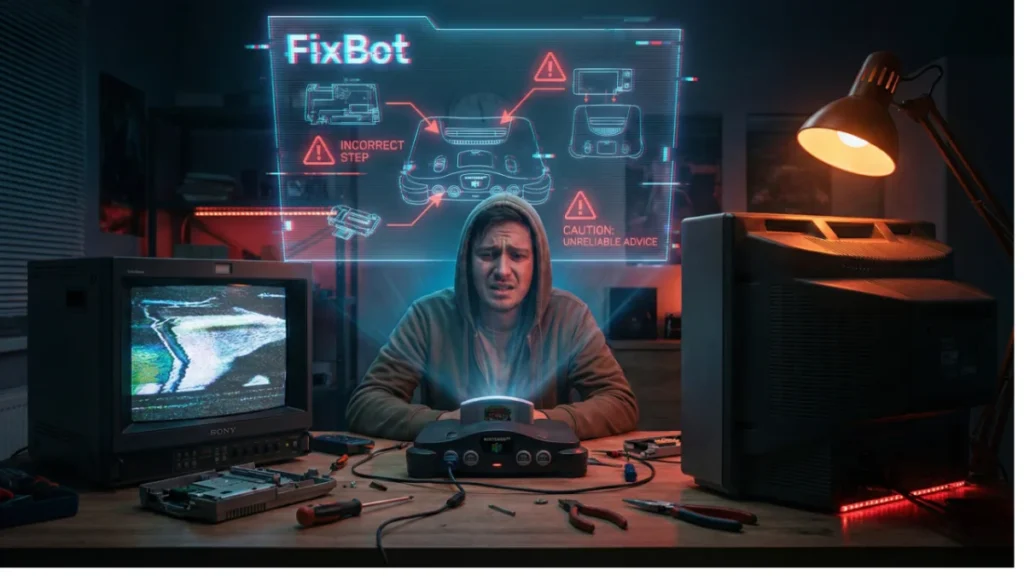
iFixit’s new AI assistant, FixBot, promises something ambitious: real-time repair guidance for almost anything you can break, drop, snap, or plug in backward. It’s billed as a technician who never sleeps and supposedly “thinks out loud” like the pros. But after testing it on a Nintendo 64, a heat pump, and even a vintage Sony CRT, one thing becomes clear fast — FixBot isn’t ready to replace your repair buddy, let alone your local tech wizard.
FixBot works through text or voice. You talk, it listens. You show it photos, it analyzes. In theory, it’s a calm, confident co-pilot for your DIY projects. And when it behaves, it feels genuinely pleasant. Voice mode even adds a friendly tone, offering pep-talk lines like, “You’re halfway there.” It’s cute. It’s helpful. Until it isn’t.
The N64 Test: Charming… until the clatter
The Nintendo 64 teardown should have been FixBot’s layup. iFixit already offers a detailed guide, so the bot had a roadmap. It correctly suggested removing the Expansion Pak and backing out six screws. It kept the directions simple, and the voice prompts felt reassuring.
Then came the surprise.
While flipping the console, the N64’s front feet popped off and smacked the floor. iFixit’s written guides warn you about that. FixBot didn’t. That small oversight turned a smooth repair into a mild heart attack. And when the console refused to close properly afterward, FixBot wandered through a maze of incorrect theories before finally landing on the real issue: aligning the power button with the switch on the board.
The fix wasn’t hard. Getting FixBot to say the right thing was.
The CRT Test: A red flag for danger
CRTs are a different world — high voltage, fragile parts, and zero room for error. These aren’t devices you mess with casually. FixBot started strong, asking for the model number and warning that CRTs can hold lethal charge. Good.
But then it suggested “discharging the anode before opening the case.” Impossible. The anode is inside the case. Later, it recommended sliding a tool under the anode cap, a risky move on certain Sony PVM units where the caps are glued in place. One mistake here isn’t “oops.” It’s a hospital bill.
Once iFixit uploaded the service manual, FixBot toned down the danger and pushed for a safer “let it self-discharge” approach. But moments later, it directed the user to pull the main circuit board and reflow solder joints that had nothing to do with the power issue. The actual culprit? A broken power cord. FixBot never asked about it until prompted.
This is where AI troubleshooting hits a wall. Real repair starts with the basics. FixBot jumped straight into advanced surgery.
The Heat Pump Test: Overthinking everything
The third test — a Mitsubishi heat pump — showed a similar pattern. FixBot compiled a long list of possibilities, many reasonable, some excessive. But it completely skipped the simplest question: “Did you clean the filters?”
Cleaning the filters fixed the problem immediately. FixBot only recommended calling a technician after running through a dramatic diagnostic arc.
Other chatbots did better on this one. They asked the filter question first.
iFixit Responds
iFixit CEO Kyle Wiens says FixBot’s uneven advice often reflects the source documents it reads. A technician-facing manual may push it toward high-skill steps, while consumer guides teach it to start simple. He says the company plans to integrate full iFixit guides directly so FixBot can follow proper, structured repair paths instead of improvising.
Wiens also admits that dangerous categories — like CRTs and microwaves — need stronger guardrails. FixBot, he says, should not be pushing amateurs toward risky procedures. But he remains optimistic, noting FixBot already assisted thousands of repairs in beta.
The Potential Is Real — So Is the Gap
FixBot does have bright spots. It’s responsive. It’s patient. It occasionally provides great tips you wouldn’t expect, like using adhesive-lined heat shrink on a cord repair. When it sticks close to the established iFixit playbook, it feels like a tool with real promise.
But FixBot still behaves like an overeager apprentice. It guesses. It jumps ahead. It misses obvious checks. And in high-voltage situations, guessing shouldn’t be an option.
AI repair assistants may have a future. But today, FixBot feels more like a preview — interesting, occasionally helpful, occasionally nerve-wracking. As it stands, you shouldn’t trust it with anything expensive, fragile, vintage, electrical, or potentially dangerous.
Basically: don’t trust it with anything you’d miss if it exploded.
iFixit says FixBot will improve. And it probably will. But right now, it’s not the pocket technician we were promised. It’s the friend who insists they “totally know how to fix that,” then hands you a pile of leftover screws.