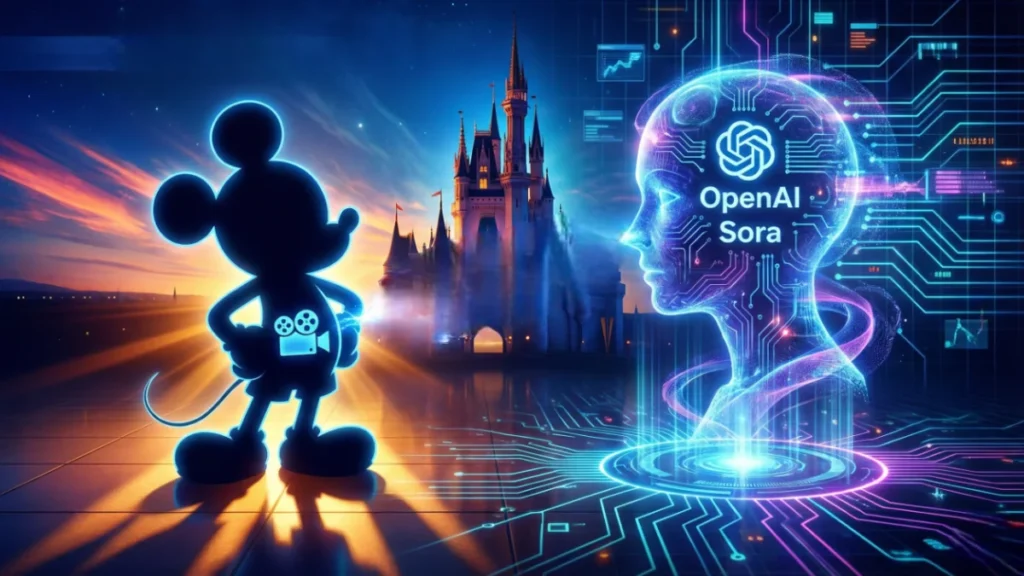
Disney just made one of the boldest AI bets in Hollywood history — and it comes with Mickey Mouse attached.
The company announced a $1 billion investment in OpenAI alongside a sweeping three-year licensing agreement that hands Sora access to more than 200 Disney, Pixar, Marvel, and Star Wars characters. Yes, that includes Mickey. And Elsa. And Yoda.
The plan: let users generate short Sora videos featuring iconic characters, then funnel the best results onto Disney+.
It’s the clearest sign yet that Disney isn’t just experimenting with AI. It’s moving in.
A Deal That Rewrites Hollywood’s AI Playbook
Disney has spent the past year fighting AI companies that repurposed its characters without permission. Cease-and-desist letters, copyright complaints, lawsuits — all of it.
Now it’s doing the opposite:
It’s licensing the characters itself.
The deal grants OpenAI the right to use a huge chunk of Disney’s character library in Sora and ChatGPT Images. Users will be able to type a prompt and instantly generate short videos featuring some of the most valuable IP in entertainment.
Disney says it won’t allow AI-generated actor likenesses or voices — a boundary the company knows is radioactive after last year’s Hollywood strikes.
But character images? Fair game.
Some of these Sora-created clips will even appear on Disney+, turning the streamer into a testbed for AI-native entertainment.
Why Disney Pivoted From “Protect Everything” to “Open the Gates”
Bob Iger framed the move as a “responsible extension” of storytelling. But the business case is obvious.
Disney needs new tools. Its streaming business is expensive. Audiences are splintered. Innovation cycles are speeding up. And generative video is moving from novelty to medium.
By investing early in OpenAI — and giving it premium IP to play with — Disney positions itself at the center of that shift instead of chasing it.
The partnership also brings OpenAI deeper into Disney’s operations. Employees will get access to ChatGPT. Product teams can build new features on top of OpenAI’s models. The tech will quietly slip into workflows across animation, marketing, and internal R&D.
Where Disney once saw AI as threat, it now sees leverage.
The Backlash Arrived Immediately
Hollywood’s unions were not amused.
The Writers Guild of America said the deal “appears to sanction” the very kind of AI training practices studios recently condemned. SAG-AFTRA said it will monitor the agreement closely to ensure likeness protections hold.
Animators raised a different alarm: If fans can generate unlimited character shorts at home, where does that leave professional creators?
And if Disney+ decides those fan-generated shorts are good enough to publish, what happens to the content pipeline built on hundreds of artists per project?
This is the tension at the center of the deal.
The future of storytelling is expanding — and potentially shrinking — at the same time.
OpenAI Gets What It’s Been Missing: Legit IP
OpenAI has spent months under pressure for how its models handle copyrighted works. The company says its training practices fall under fair use. Rights holders disagree.
This partnership gives OpenAI something clean:
Licensed, high-value IP it can use without legal fallout.
OpenAI says Sora will include guardrails to block unapproved character usage and allow rights holders to request removal. It also promises more granular controls and a developing compensation system for future video generation.
Disney’s stamp of approval — and its checkbook — shifts the optics dramatically. If the world’s most protective studio is partnering with OpenAI, others may follow.
A Huge Moment for Streaming, Whether It Works or Not
Disney+ hosting AI-generated shorts could change audience expectations. The platform has long been known for expensive, high-polish shows. What happens when users start seeing AI-generated, micro-budget character clips side-by-side with blockbuster franchises?
This could be brilliant.
Or it could dilute Disney’s brand.
Either way, it’s an experiment everyone will be watching.
Studios have explored AI quietly for years — preproduction tools, visual-effects helpers, voice prototypes. But putting iconic characters in the hands of a mass-market AI tool breaks a psychological barrier. It signals that the next era of entertainment may come from prompts, not pitches.
What Comes Next
The deal still needs board approval.
Once cleared, Sora will roll out Disney characters next year.
Disney+ will begin testing curated AI-made shorts.
Unions will likely push for new protections.
Other studios will be forced to respond — either by partnering with AI companies or doubling down on restrictions.
But the direction of travel is clear:
AI isn’t on Hollywood’s fringes anymore. It’s at the center of its strategy.
Conclusion
Disney didn’t just partner with OpenAI.
It cracked open its most guarded vault and rewrote the boundaries of who — and what — gets to tell stories.
The entertainment industry won’t be the same after this.