OpenAI has launched a new image system inside ChatGPT that aims to solve one of AI’s most frustrating problems: editing images without breaking them.
Rolling out globally today, the update introduces a redesigned ChatGPT Images experience, powered by a new model called GPT Image 1.5. The company says the system delivers faster image generation, more precise edits, and significantly better instruction-following—changes that push ChatGPT’s image tools closer to real-world creative use.
What’s Actually New This Time
The biggest change isn’t flashy visuals. It’s control.
When users ask ChatGPT to edit an uploaded image, the new system sticks closely to the request—changing only what’s specified while keeping lighting, composition, and facial details consistent across edits. Earlier versions often drifted, subtly altering faces or scenes even when users asked for small tweaks.
That problem has long limited AI image tools in professional workflows. OpenAI is now directly targeting it.
GPT Image 1.5: Faster and More Reliable
Under the hood, the update is powered by GPT Image 1.5, OpenAI’s latest image generation model.
According to the company, images now generate up to four times faster, and users can continue creating new images while others are still processing. That shift turns image generation from a slow, one-shot process into something closer to rapid iteration.
The model also follows instructions more reliably, including complex, multi-step requests that previously broke layouts or relationships between elements.
Editing Without Starting Over
GPT Image 1.5 handles a wide range of edits: adding or removing objects, blending styles, combining images, and placing subjects into new scenes.
What stands out is consistency. Across multiple edits, images hold together. Faces don’t subtly reshape. Lighting doesn’t jump. Backgrounds don’t collapse.
It’s not perfect—but it’s a clear step closer to traditional photo editing than most AI tools currently offer.
Text Rendering Gets a Quiet Upgrade
Text inside AI-generated images has been a long-running weakness. OpenAI says GPT Image 1.5 improves this significantly.
The model can now render smaller, denser text more accurately, including structured layouts like infographics, posters, and document-style visuals. In demos, it preserved formatting, tables, and typography—areas where earlier systems routinely failed.
For marketing, documentation, and educational visuals, that improvement matters.
A New Images Space Inside ChatGPT
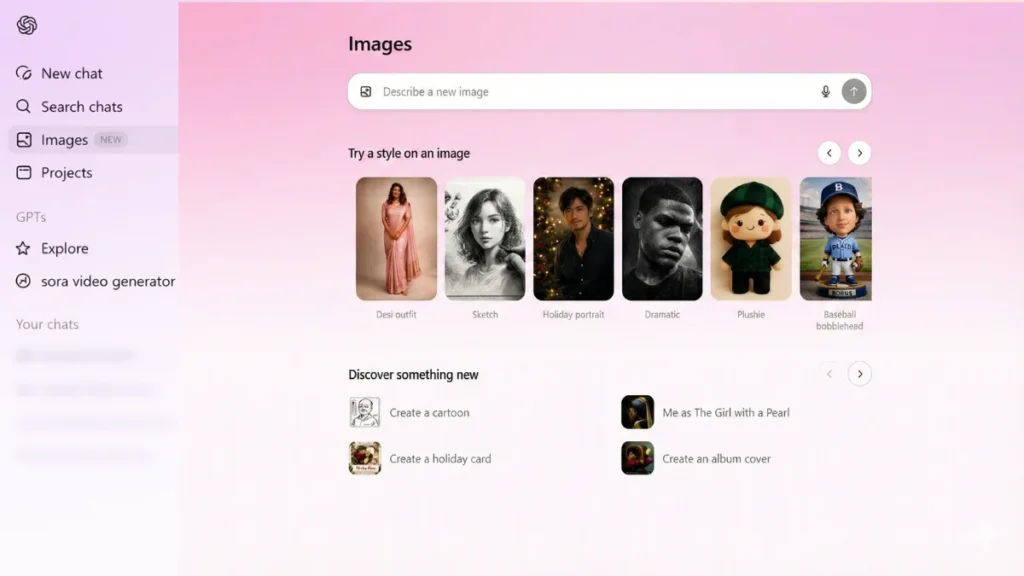
Alongside the model launch, OpenAI is rolling out a dedicated Images section within ChatGPT on web and mobile.
The space includes preset styles, trending prompts, and faster access to image creation. Users can also upload a likeness once and reuse it across multiple generations, instead of repeatedly pulling photos from their camera roll.
The message is clear: images are no longer a side feature inside ChatGPT. They’re becoming a core workflow.
What This Means for Developers and Businesses
GPT Image 1.5 is also available via the API, with OpenAI positioning it for marketing, ecommerce, and design-heavy use cases.
The company says the model does a better job preserving logos and branded elements across edits, making it suitable for product catalogs and visual variations. Image inputs and outputs are also about 20% cheaper than the previous version, allowing teams to generate more content on the same budget.
Several creative and web platforms are already integrating it into production tools.
Still Not Perfect—and OpenAI Admits It
Despite the improvements, OpenAI is clear that GPT Image 1.5 isn’t flawless.
The model still struggles with some scientific accuracy, multilingual text, and complex scenes involving many faces. OpenAI frames this release as meaningful progress, not a finished solution.
That acknowledgment matters as AI-generated images become more widespread.
The Bigger Picture
AI image generation is moving from novelty to infrastructure.
This update isn’t just about prettier pictures. It’s about reliability—making AI image tools predictable enough to trust in real creative and business workflows.
ChatGPT’s new image system doesn’t solve everything.
But for the first time, it feels like AI image editing is getting usable.
Conclusion
ChatGPT’s image tools are no longer just impressive.
They’re starting to feel dependable—and that’s a bigger shift than it sounds.