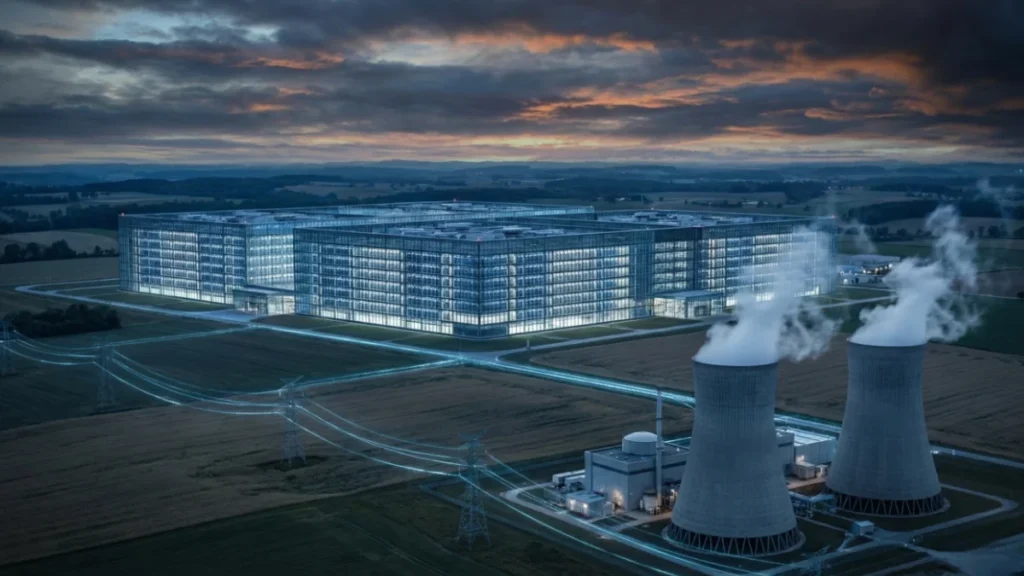
Meta is making a bold energy move to keep its artificial intelligence ambitions running at full speed. The company has signed agreements with three nuclear energy developers—Vistra, TerraPower, and Oklo—to eventually supply power to its massive Prometheus AI supercluster under construction in New Albany, Ohio.
The message is clear: as AI models grow larger and more power-hungry, traditional energy sources may no longer be enough.
Why Meta is betting on nuclear
Prometheus is not just another data center. Announced by Meta CEO Mark Zuckerberg last year, the system is designed to support the company’s most advanced AI work, including efforts that push toward so-called superintelligence. Meta expects the supercluster to come online around 2026.
Running systems of that scale requires enormous amounts of electricity—reliably and around the clock. Nuclear energy, with its steady output and low carbon emissions, is increasingly attractive to companies building the backbone of AI infrastructure.
Inside the energy deals
Meta’s agreements span both existing and future nuclear projects:
- Vistra will receive funding to extend the life and increase the output of nuclear plants in Ohio and Pennsylvania, giving Meta access to near-term capacity.
- TerraPower, backed by Bill Gates, is developing next-generation nuclear reactors that could begin producing power in the early 2030s.
- Oklo plans an advanced nuclear campus in Ohio that Meta says could come online as soon as 2030.
Together, the projects are expected to add up to 6.6 gigawatts of electricity by 2035—more than the total power demand of some U.S. states.
Ohio’s growing role in AI
Ohio has quietly become a hotspot for large-scale data centers, thanks to available land, grid access, and proximity to major population hubs. Meta says its nuclear-backed expansion will create thousands of construction jobs and hundreds of long-term operational roles.
For state and local governments, the promise of high-paying tech jobs and long-term infrastructure investment makes these projects hard to ignore.
Big Tech’s energy problem
Meta isn’t alone in rethinking how to power AI. Amazon and Google have also signaled growing interest in nuclear energy, and all three companies signed a pledge earlier this year supporting a major expansion of global nuclear capacity by 2050.
Earlier this summer, Meta announced a separate 20-year deal to buy nuclear power from Constellation Energy in Illinois starting in 2027, reinforcing the idea that this is a long-term strategy—not a one-off experiment.
The Sam Altman connection
One of Meta’s partners comes with a notable AI industry link. OpenAI CEO Sam Altman is a major investor in Oklo, holding a significant stake in the company. Altman stepped down as Oklo’s board chair earlier this year to avoid conflicts as the startup seeks customers across the tech sector.
The overlap highlights how closely AI leadership and energy infrastructure are becoming intertwined.
What this signals for the future
Nuclear power comes with challenges—long development timelines, regulatory hurdles, and public scrutiny—but Meta’s move suggests the company believes the risks are worth it. As AI systems continue to scale, access to dependable energy could become a defining competitive advantage.
For now, Meta’s nuclear push sends a strong signal to the rest of the industry: the race to build smarter AI may ultimately be decided not just in code, but in kilowatts.