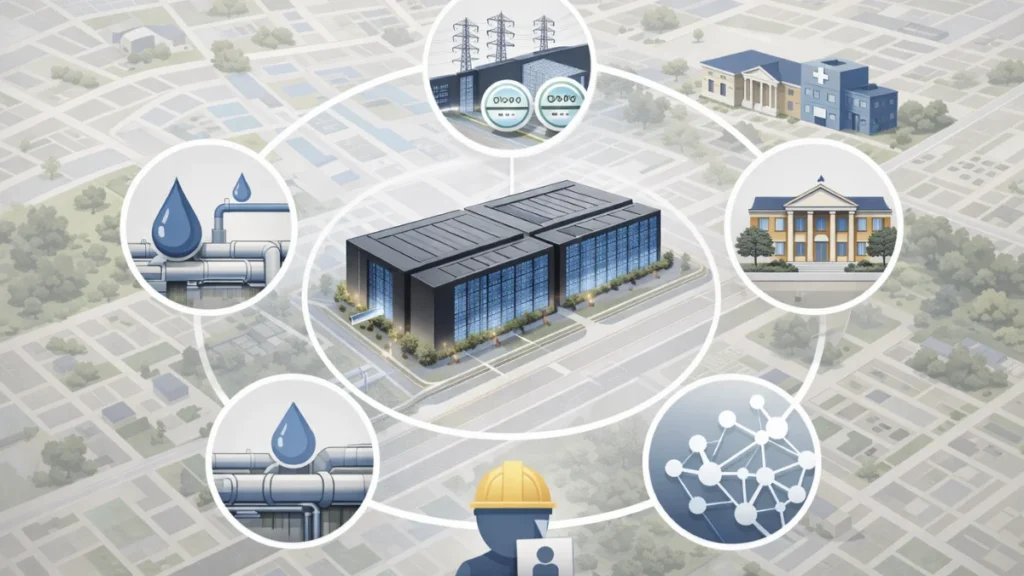
As AI data centers spread across the U.S., local resistance is rising—from higher power bills to fears over water use. Now Microsoft says it has a different approach: build AI infrastructure with communities, not over them.
The company has unveiled a five-point “community-first” framework that reframes data centers as civic infrastructure—responsible for electricity costs, water stewardship, jobs, taxes, and local AI education.
Why Microsoft is changing its playbook
AI infrastructure is booming just as America’s grid shows its age. Data centers are energy-hungry, expensive to cool, and increasingly controversial at the local level. According to the International Energy Agency, U.S. data center electricity demand is expected to more than triple by 2035, colliding with transmission systems that often take a decade to upgrade.
That tension has pushed tech companies into the political spotlight. Microsoft’s message is clear: if AI is going to scale, it can’t do so by shifting costs onto households or municipalities.
Electricity: no passing the bill
The headline promise is blunt. Microsoft says its data centers will not raise residential electricity prices.
Instead, the company plans to work with utilities and regulators to ensure data centers pay rates that fully cover new generation, transmission, and substation upgrades. In practical terms, that means isolating large AI facilities from household ratepayers—even as demand surges.
It’s a notable stance in an industry where critics often accuse hyperscalers of quietly leaning on public infrastructure. Microsoft is also contracting for new power capacity years in advance, aiming to expand supply rather than squeeze existing grids.
Water: cutting usage, then giving more back
Water has become the second flashpoint. Data centers need aggressive cooling, and in hot or fast-growing regions, that can spark community pushback.
Microsoft says it will reduce water-use intensity across its owned data center fleet by 40% by 2030, relying on closed-loop liquid cooling systems that recycle coolant instead of consuming potable water. Some newer facilities no longer require drinking water for cooling at all.
Beyond efficiency, the company says it will “replenish” more water than it uses—through local projects like leak detection, recycled-water systems, and wetland restoration. The key detail: replenishment is measured locally, not offset somewhere else on paper.
Jobs: keeping AI work local
Data centers bring thousands of construction jobs and hundreds of permanent technical roles—but those benefits don’t always stay local.
Microsoft is trying to change that by investing in apprenticeship pipelines and community college programs tied directly to its facilities. A new partnership with North America’s Building Trades Unions focuses on skilled trades, while the company’s Datacenter Academy trains residents for operations roles once construction ends.
The timing matters. LinkedIn data shows U.S. data center–related job postings rose sharply in 2025, even as the construction industry faces a deep skilled-labor shortage.
Taxes: the quiet economic impact
Unlike flashy job announcements, property taxes rarely make headlines—but they may be the most durable benefit.
Microsoft says it will pay full local property taxes and won’t ask for special rate reductions. In long-running data center regions like Quincy, Washington, that approach has translated into expanded hospital facilities, upgraded schools, and rising local revenues over time.
For communities worried about hosting massive facilities, that steady tax base can outweigh short-term disruption—if the company sticks to its word.
AI skills for the communities powering AI
The final pillar focuses on who gets access to AI itself.
Microsoft plans to roll out free, age-appropriate AI education in data center communities, partnering with schools, colleges, libraries, and local nonprofits. Libraries will act as neighborhood AI learning hubs, offering public access to AI tools and certifications.
The idea is straightforward: if a town is helping power the AI economy, its residents shouldn’t be last in line to benefit from it.
The bigger picture
This isn’t just a sustainability pledge—it’s a political and economic bet. AI infrastructure can’t scale indefinitely if every new data center sparks local opposition.
Microsoft is positioning itself as the “responsible” hyperscaler, arguing that long-term AI growth depends on community trust as much as technical innovation. Whether rivals follow—or regulators push harder—will determine if this model becomes the norm or remains an exception.
Conclusion
AI data centers are becoming as consequential as power plants or highways. Microsoft’s community-first strategy suggests the next phase of AI won’t be won just with chips and models—but with electricity bills, water meters, and town hall meetings.