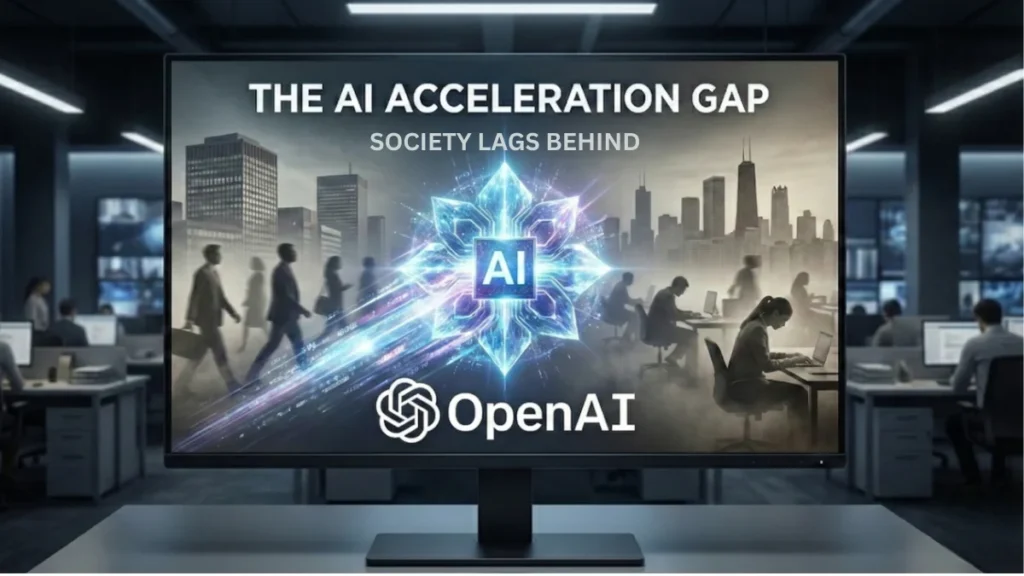
Artificial intelligence has entered a strange new phase. The technology is advancing at breakneck speed, yet much of the world is barely tapping into its real power. This growing mismatch — between what AI systems can do and how little value most people, companies, and governments are extracting from them — is quickly becoming one of the most important questions in tech.
Inside OpenAI, this problem has a name: capability overhang. And if it’s not managed carefully, it could define who wins and who falls behind in the AI-driven economy.
AI’s Power Is Racing Ahead of Its Use
When ChatGPT launched three years ago, it was built to answer questions and assist with basic tasks. What followed surprised almost everyone. Millions of users quickly pushed the system far beyond its original intent — using it to write code, automate work, brainstorm businesses, and even support research.
Fast forward to today, and frontier AI models can reason across complex problems, carry out multi-step actions, and generate work that rivals skilled professionals. Yet for many users, AI remains an occasional tool — not a daily engine of productivity.
That gap is widening.
The ‘Power User’ Divide
Internal usage patterns point to a stark imbalance. A relatively small group of “power users” now consumes vastly more AI compute than the average person — not because they’re online more, but because they apply AI across many parts of their work.
They don’t just ask questions. They delegate thinking.
The result: dramatically higher output, faster iteration, and more economically valuable work. In effect, AI is amplifying individual capability — but only for those who know how to wield it.
Why This Isn’t Just a Tech Problem
Capability overhang isn’t only about productivity hacks or smarter software. It has real economic consequences.
AI is widely expected to fuel major gains — from faster scientific discovery to cheaper healthcare and stronger economic growth. But those benefits won’t spread evenly by default. Without broad access and practical adoption, AI risks deepening existing inequalities between workers, companies, and even countries.
History offers a familiar pattern. The computer revolution didn’t lift everyone at once — it rewarded early adopters first. AI may follow the same path, only faster.
OpenAI’s Bet: Access, Truth, and Empowerment
OpenAI says closing the gap requires more than better models. Its approach rests on three pillars.
First is transparency — publishing data and research to help policymakers and businesses understand how AI is actually affecting jobs and productivity, not just how it might.
Second is access. AI’s usefulness scales with compute, which is why OpenAI continues to support free and low-cost entry points, alongside developer APIs and government partnerships. The idea is simple: no one should be locked out of the intelligence economy by default.
Third is self-empowerment. Rather than prescribing narrow use cases, OpenAI designs tools meant to be adapted — by families managing budgets, small businesses exploring ideas, or founders building entirely new markets.
As computer scientist Alan Kay once put it, the future isn’t predicted — it’s invented. AI’s most transformative uses may come from people experimenting, not institutions planning.
What Happens If the Gap Keeps Growing
If capability overhang persists, AI could become a quiet divider — boosting output for a minority while leaving others watching from the sidelines. But if the gap narrows, the upside is enormous.
Wider adoption could raise productivity across the board, lower costs in critical sectors, and give individuals tools once reserved for large organizations.
The Intelligence Age, it turns out, won’t be defined by how smart machines become — but by how many people learn to use them well.
Conclusion
AI is already powerful enough to reshape economies.
The real question now is who learns to unlock it — and how fast.