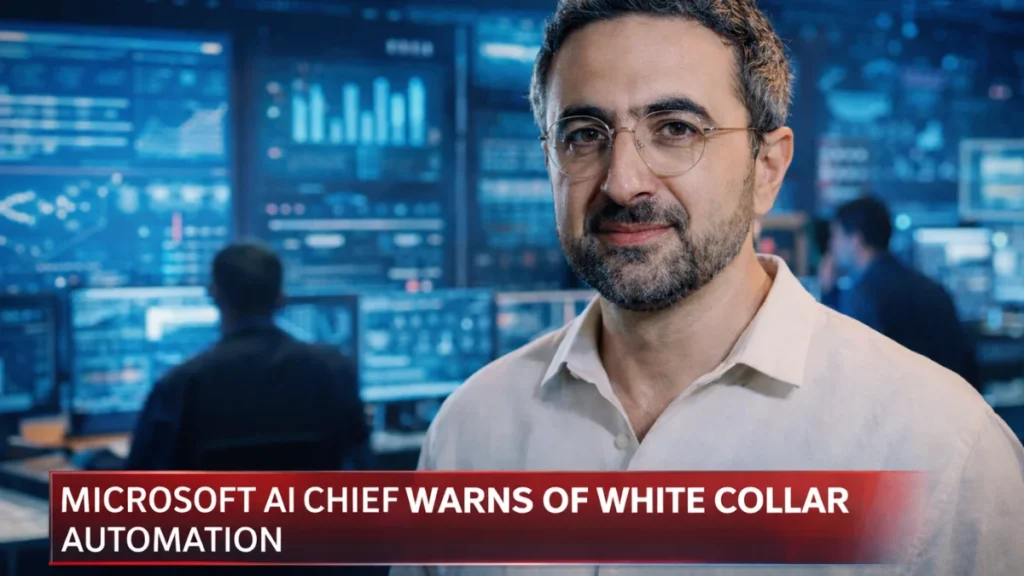
Microsoft’s AI leadership just made one of the boldest automation predictions yet.
Mustafa Suleyman, CEO of Microsoft AI, said this week that most computer-based white-collar tasks — including work done by accountants, lawyers, and other knowledge professionals — could be automated within the next 12 to 18 months. Speaking during an interview with the Financial Times, Suleyman suggested that AI agents capable of managing complex, multi-step workflows across organizations may arrive within two to three years.
It’s an aggressive timeline. And it lands at a moment when Microsoft is dramatically scaling its AI ambitions.
The $140 Billion Bet
The comments come as Microsoft plans to spend as much as $140 billion building out large-scale AI infrastructure, including gigawatt-capacity data centers designed to support advanced model training and deployment. The move signals a strategic push to expand Microsoft’s in-house AI capabilities and reduce long-term dependence on OpenAI.
The scale of that investment underscores how seriously Microsoft is treating the next phase of AI — not just as a feature inside software, but as an operational engine capable of running entire workflows.
If Suleyman is right, AI won’t just assist knowledge workers. It will execute tasks end-to-end.
CEO of Microsoft AI Mustafa Suleyman joins FT editor Roula Khalaf to explain why most of the tasks accountants, lawyers and other professionals currently undertake will be fully automated by AI within the next 12 to 18 months https://t.co/yYKzS7NIOP pic.twitter.com/HvA6Q7KgIc
— Financial Times (@FT) February 12, 2026
From Assistant to Operator
The shift he’s describing goes beyond chatbots or drafting tools.
AI agents — systems that can plan, execute, and adapt across multiple steps — are increasingly being tested inside enterprise environments. Think contract analysis that routes approvals automatically. Financial reports compiled, checked, and formatted without human intervention. Customer onboarding flows coordinated across departments by software.
The underlying technology is advancing quickly. The bigger question is whether organizations are ready to hand over responsibility.
Not Everyone Is Buying It
Professional communities aren’t exactly cheering.
Lawyers point to liability risks and regulatory obligations that can’t easily be outsourced to software. Accountants cite compliance standards and audit accountability that demand human oversight. And corporate leaders know that even if AI can technically perform a task, trust and governance frameworks move much slower.
There’s also the memory of past predictions. AI leaders have repeatedly forecast rapid labor disruption over the past decade. Progress has been real — but incremental.
Automation rarely unfolds in straight lines.
Why the Timeline Matters
The 12-to-18-month claim is what makes this different.
That’s not “eventually.” That’s budget-cycle territory. That’s within the lifespan of most enterprise planning roadmaps.
If accurate, companies would need to rethink hiring strategies, internal training programs, and risk management policies almost immediately. Entire professional skill sets could shift toward oversight, interpretation, and client strategy — while routine digital work fades into the background.
But if the timeline proves optimistic, it risks becoming another headline-grabbing forecast that overshoots reality.
The Strategic Angle
There’s another layer here.
Microsoft’s growing AI independence matters strategically. For years, its AI strategy has been closely linked with OpenAI. Expanding its own infrastructure and model ecosystem gives the company more control over pricing, deployment, and long-term roadmap decisions.
In other words, automation predictions aren’t just philosophical. They’re tied to platform economics.
The faster enterprises adopt AI agents, the deeper Microsoft embeds itself into corporate operations.
What Happens Next?
The coming months will likely determine whether AI agents evolve into autonomous operators or remain highly capable assistants.
Watch for expanded AI features inside Microsoft 365, deeper enterprise integrations, and early case studies of departments replacing manual workflows with agent systems. Also watch regulators. Automation in law, finance, and compliance won’t scale without clear accountability rules.
Suleyman’s forecast may prove ambitious. But it signals something undeniable: major tech players now see white-collar automation not as a distant possibility — but as an imminent milestone.
And whether that milestone arrives in 18 months or five years, the race toward it is accelerating.
Conclusion
Microsoft isn’t talking about incremental AI upgrades anymore. It’s talking about replacing core digital work — fast. Whether businesses and regulators move at the same speed is the real question.