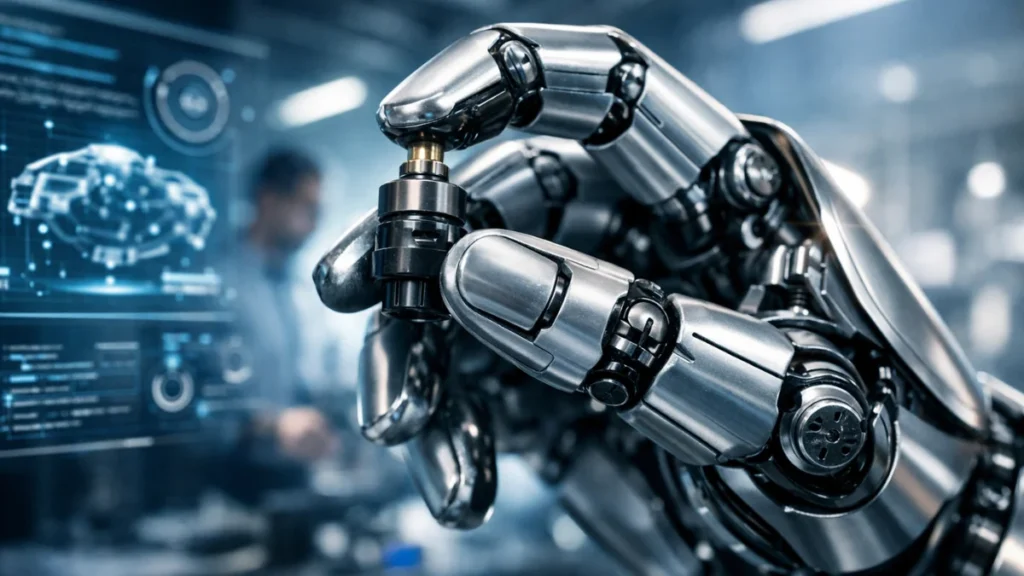
The race to build a commercially viable humanoid robot is increasingly coming down to one thing: the hands.
Figure AI has revealed a seventh-generation robotic hand for its Figure 03 platform, just months after introducing the robot itself. Founder Brett Adcock called it some of the best engineering he’s seen, signaling how central dexterity has become to the company’s roadmap.
While full technical specifications haven’t been released, both the teaser and details from Figure’s official materials point to a deeper strategy: solve manipulation at scale, not just mobility.
What Just Happened
In a video shared on X, Adcock said the company has been working for three years toward approaching human-hand parity. Despite being on its third-generation humanoid platform, Figure is already on its seventh-generation hand — underscoring how complex robotic manipulation remains.
Based on the teaser and Figure’s positioning of Figure 03 as a commercially deployable system, the new hand includes:
- A rotating thumb for improved opposition
- Higher degrees of freedom for more precise grip control
- Identical-length fingers to simplify manufacturing
- Enhanced mechanics for delicate object handling
The identical finger design is a notable departure from strict human anatomical mimicry. It suggests the company is prioritizing manufacturability, modularity, and scalability over pure biological replication.
Figure’s official site emphasizes that Figure 03 is built for real-world industrial environments — particularly logistics and manufacturing workflows — where consistent, repeatable manipulation is critical.
I've been waiting 3 years to show you this
— Brett Adcock (@adcock_brett) February 13, 2026
We just launched our 3rd-gen humanoid, but we’re already on our 7th-gen hand
Our team has quietly worked for years to approach parity with a human hand
Excited to share a sneak peek of some of the best engineering I’ve ever seen pic.twitter.com/jsADxDXjeu
Why This Matters
Walking robots are impressive. Working robots are valuable.
Dexterity has long been the bottleneck in humanoid robotics. Locomotion, balance, and perception have improved dramatically in recent years thanks to advances in AI and control systems. But fine motor skills — grasp planning, force control, tactile feedback — remain significantly harder.
For companies aiming to deploy humanoids in warehouses, factories, or supply chains, the hand is the business case.
A system that can reliably:
- Pick irregular objects
- Handle tools
- Operate machinery interfaces
- Perform repetitive tasks without failure
is far more commercially meaningful than one that simply demonstrates smooth walking.
Figure’s rapid iteration on its hand suggests it sees manipulation — not movement — as the gating factor for revenue-scale deployment.
Expert Analysis
The most important signal here isn’t the rotating thumb. It’s iteration velocity.
Being on a seventh-generation hand while only on a third-generation robot body indicates where engineering cycles are being concentrated. That’s consistent with decades of robotics research: manipulation demands constant refinement in actuation, sensing, durability, and control software.
The uniform finger-length design also reveals a manufacturing mindset. Identical components reduce tooling complexity, simplify assembly, and lower per-unit costs. That’s critical if the company intends to scale production rather than remain in demo mode.
In short, this appears to be engineering optimized for production — not just performance.
Comparisons quickly surfaced with Optimus from Tesla, which has previously demonstrated multi-finger dexterity in public demos.
Those demonstrations proved advanced manipulation is technically possible. The harder question across the industry is reliability and scalability.
More degrees of freedom can enable better dexterity — but also increase mechanical complexity, failure points, and control demands. Every humanoid company is navigating the same trade-off:
- Human-like capability
- Cost efficiency
- Industrial durability
Figure’s latest hand suggests it is attempting to balance all three.
What Happens Next
The teaser creates anticipation, but the next phase will be measured in data, not videos.
Key milestones to watch:
- Continuous-operation testing in industrial environments
- Durability benchmarks
- Integration with AI-based manipulation models
- Pilot deployments with enterprise partners
If Figure can demonstrate reliable, high-uptime performance in real workflows, it strengthens its case as a serious contender in the humanoid commercialization race.
Final Take
Humanoid robotics has moved beyond spectacle.
The companies that win won’t be those that walk most naturally — but those that manipulate most reliably. By accelerating hand development ahead of full-body iterations, Figure is betting that dexterity determines viability.
Whether this seventh-generation hand truly approaches human-level performance remains to be seen. But the strategic focus is clear: in robotics, the future may well be decided at the fingertips.