A new rendering engine aims to fix what still feels off in AI video conversations
Even as AI generated video has improved, something subtle keeps breaking the illusion. The lips may sync. The lighting may look natural. But the person on screen does not quite feel present.
San Francisco based Tavus is betting that gap is emotional, not visual.
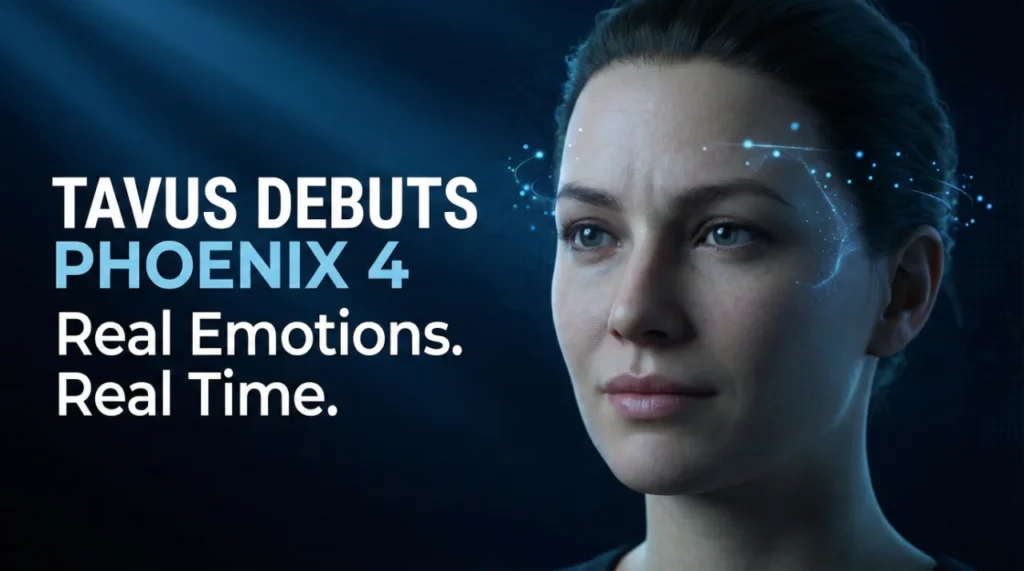
The company on Wednesday introduced Phoenix 4, a real time human rendering model designed to generate full facial behavior with what it describes as emotional intelligence. The system renders head and shoulders video at 40 frames per second in 1080p, while simultaneously interpreting speech context and producing responsive facial expressions, micro movements, and head motion.
The ambition is straightforward. Make AI video agents feel less like animated puppets and more like attentive participants.
Why this release
Real time conversational AI has accelerated over the past year. Startups and incumbents alike are racing to build digital agents for healthcare intake, tutoring, sales, support, and internal enterprise workflows. Latency has dropped. Speech recognition has improved. Large language models handle nuance better than they did even 18 months ago.
But video remains the weakest link.
Many current “live avatar” systems animate only the mouth region while replaying pre recorded head footage. Others mirror audio waves to basic facial movements. Emotional range is often locked to a default expression. Switching tone can require swapping the entire avatar asset.
Asynchronous video generation tools such as OpenAI’s Sora or Google’s Veo focus on prompt based scene creation, not live interaction. Real time systems have a different challenge. They must interpret speech, generate facial motion, and render video faster than conversation unfolds.
Tavus argues Phoenix 4 closes that behavioral gap.
What technically changed
Phoenix 4 is positioned as the fourth generation in Tavus’ rendering stack. Earlier versions moved from NeRF based modeling to 3D Gaussian splatting to improve performance and break the real time barrier. Phoenix 3 expanded generation beyond the mouth to the entire face.
The new model shifts focus from visual realism to behavioral realism.
Instead of mapping audio directly to mouth motion, Phoenix 4 uses a streaming audio feature extractor and a long term memory module to interpret both timing and conversational meaning. A diffusion based motion generator then produces stable facial movement over time, rather than reacting frame by frame. The rendered output controls head pose, eye gaze, eyebrows, cheeks, lips, and blinks in coordination.
The model supports more than ten emotional states including happiness, sadness, anger, fear, curiosity, and surprise. Developers can explicitly tag emotions through prompts or allow the system to infer tone contextually. When paired with Tavus’ Raven 1 perception model, emotional responses can be informed by user tone and facial cues.
In practical terms, that means the avatar can nod while listening, show concern during a sensitive exchange, or shift expression mid conversation without snapping between presets.
The company says the full pipeline maintains 40 fps at 1080p, which if sustained under production load would place it above several competitors that operate at lower resolutions or frame rates.
How this fits into real workflows
The strongest argument for Phoenix 4 is not cosmetic. It is behavioral.
In healthcare intake or therapy simulations, perceived empathy can influence patient disclosure. In remote tutoring, visible attentiveness can affect engagement. In sales or customer support, a static smiling avatar during a complaint erodes credibility.
If the system reliably adjusts facial expression during silence and listening states, that could reduce the uncanny effect that often undermines trust in digital agents.
However, real world deployment will depend on more than frame rate. Enterprise buyers will want to evaluate stability over long sessions, infrastructure costs for continuous streaming, and integration with existing conversational stacks.
Phoenix 4 operates alongside Sparrow 1 for conversational timing and Raven 1 for perception, forming a multi model architecture. That layered system may improve realism, but it also adds complexity for teams integrating APIs into production environments.
Competitive pressure in the avatar market
The live avatar space is crowded. Companies including Synthesia, HeyGen, and Anam have built platforms for video agents and synthetic presenters. Most prioritize ease of content creation or marketing use cases rather than high fidelity conversational realism.
Tavus’ differentiation claim centers on full head generation, real time emotion control, and active listening behavior.
If those features perform as described, Phoenix 4 could appeal to enterprise teams building high stakes interactions where perceived presence matters. That said, published comparison tables rarely capture edge case behavior under bandwidth constraints or multi user concurrency.
Market adoption will likely hinge on how well the system scales beyond controlled demos.
Pricing and access realities
Tavus has made Phoenix 4 available through its platform, APIs, PALs, and an updated stock replica library. Custom replicas can also be trained.
The company has not publicly detailed pricing tiers in the launch announcement. For enterprise buyers, cost per streaming minute and GPU requirements will be central to evaluating viability. Real time HD diffusion based rendering is computationally intensive, and infrastructure economics could shape which verticals adopt first.
Without transparent benchmarks on resource usage, buyers will need pilot deployments to assess operational overhead.
Infrastructure implications
Running diffusion based generation in real time is non trivial. The company references distillation methods and causal architectures to reduce latency while maintaining quality. That suggests heavy optimization behind the scenes.
Still, sustained 1080p rendering at 40 fps across concurrent sessions will test cloud provisioning strategies. Enterprises deploying customer facing agents at scale will want clarity on throughput limits, regional availability, and failover behavior.
Security and compliance will also matter, particularly in healthcare and financial services environments where recorded conversations may contain sensitive information.
Where this could realistically go next
If Phoenix 4 performs reliably outside staged demos, it pushes the avatar market toward a new baseline. Emotional responsiveness during listening states may become expected rather than premium.
But this category has repeatedly shown that small artifacts can break user trust. Micro expression accuracy, eye contact stability, and latency under fluctuating network conditions will determine whether behavioral realism holds up in the wild.
I will be watching how early enterprise customers measure outcomes. Do engagement rates improve in tutoring pilots. Do healthcare systems report higher completion rates. Do support interactions show measurable lift.
If the answer is yes, emotional rendering may shift from novelty to infrastructure layer in conversational AI stacks.
If not, the industry may learn that presence is harder to quantify than to demo.