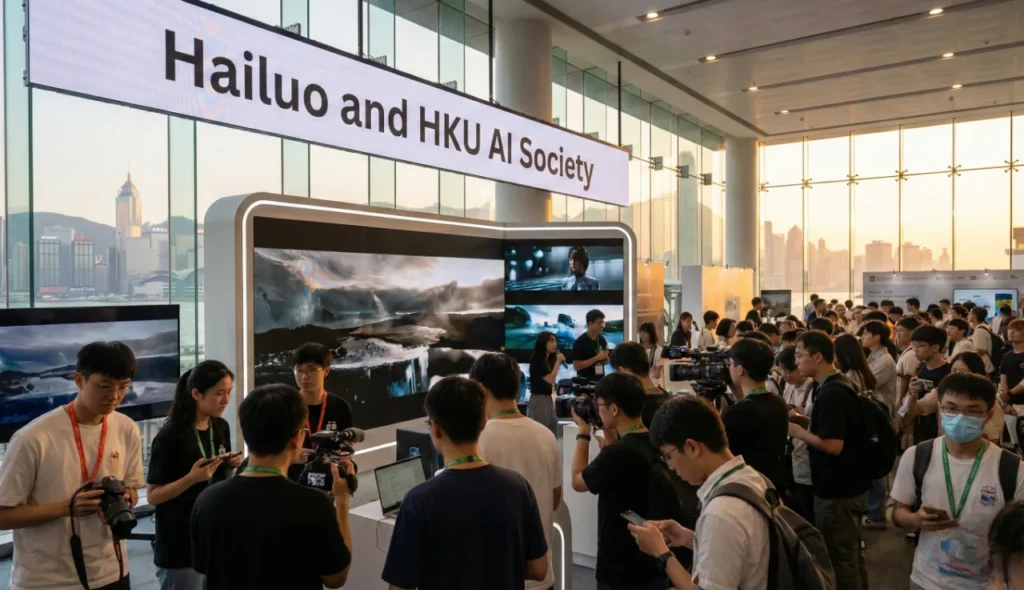
Hailuo AI, the video generation platform developed by Chinese AI company MiniMax, is partnering with the HKU AI Society for a two day public event at The University of Hong Kong on February 26 and 27.
The event, announced today, centers on hands on demonstrations of Hailuo’s AI video generation system, workshops on creating short AI films, and discussions with commercial creators using generative tools. On the surface, it is a campus activation. Strategically, it reflects how Chinese AI firms are accelerating international visibility and developer engagement amid intensifying global competition in generative media.
Hailuo’s appearance in Hong Kong comes as AI video systems from the United States and China race to capture creative professionals, startups, and advertising agencies seeking lower cost production pipelines.
From Model Demos to Market Positioning
🇭🇰Hailuo x HKU AI Society Open Day
— Hailuo AI (MiniMax) (@Hailuo_AI) February 20, 2026
Join HKU AI Society and Hailuo for a 2-day immersive experience at The University of Hong Kong where technology meets art!
Try Hailuo's cutting-edge video generation at the booth, create your first AI film in a hands-on workshop, and hear from… pic.twitter.com/dAAgvqo1Of
Hailuo AI allows users to generate short videos from text prompts. In simple terms, a user describes a scene, and the model synthesizes moving images that match that description. Underneath that simplicity sits a large scale diffusion model trained on video data, similar in architectural lineage to systems developed by companies such as OpenAI and Runway.
Text to video generation remains computationally expensive. It requires large clusters of graphics processing units and significant optimization to maintain visual coherence across frames. That technical barrier has limited the number of serious global players.
By staging an open campus showcase rather than a closed industry demo, MiniMax appears to be pursuing developer and creator mindshare in parallel with enterprise ambitions. University partnerships often signal talent recruitment pipelines and early community building, particularly in regions where regulatory frameworks are still evolving.
Hong Kong offers a unique bridge. It operates under a distinct legal and financial system compared with mainland China, while remaining closely tied to Chinese technology ecosystems. Hosting the event at HKU gives Hailuo visibility among international students and cross border investors who track AI capability development in Asia.
Creative Economy as Entry Point
The promotional materials emphasize art, film creation, and commercial creativity rather than infrastructure or enterprise APIs. That positioning is deliberate.
Generative video has immediate appeal in advertising, social media marketing, e commerce content, and independent filmmaking. For non technical users, AI video tools can compress production timelines from weeks to hours. That is the plain language version. Economically, it lowers marginal production costs and redistributes creative leverage toward individuals and small teams.
For startups and agencies, the question is less about novelty and more about workflow integration. Can these models produce consistent characters, maintain brand aesthetics, and scale across campaigns? That is where competitive differentiation emerges.
US based systems such as OpenAI’s Sora, which remains limited in access, have captured attention for cinematic fidelity. Runway has focused heavily on creator tools and editing control. Chinese platforms including Hailuo operate in a parallel innovation cycle, often moving quickly in consumer accessibility.
The HKU event suggests Hailuo is leaning into practical demonstration rather than benchmark claims. Live booths and workshops test not just model capability but usability. If attendees can produce short films within hours, that lowers psychological adoption barriers.
Infrastructure Power and Regional Signaling
Behind any video generation platform sits compute infrastructure. Training and inference require large GPU fleets and stable supply chains. China’s access to advanced chips has been constrained by US export controls in recent years, forcing domestic firms to optimize architectures and rely more heavily on locally available hardware.
Public demonstrations in Hong Kong therefore carry a subtle signal. They imply confidence in deployment readiness and cross border operability. While the event itself is not a policy announcement, it occurs against a backdrop of tightening global AI governance.
Hong Kong regulators have taken a comparatively open stance on AI experimentation, focusing on risk management rather than outright restriction. That regulatory flexibility makes the city an attractive testing ground for public facing AI tools.
For industry operators, the question is whether Hailuo intends to expand more aggressively into Southeast Asia or other international markets. The company has not publicly detailed expansion plans in this announcement. Absent that information, analysts will watch whether similar campus or developer events appear outside Greater China.
Differentiation
It is important to distinguish between a marketing activation and a structural shift.
This HKU event does not represent a new product launch, funding round, or regulatory milestone. It does not introduce a novel model architecture or publish performance metrics. Instead, it reflects ecosystem cultivation.
What makes it noteworthy is timing. Global AI video competition is intensifying, and user familiarity often precedes enterprise contracts. The first tools creatives experiment with in school frequently shape procurement decisions later.
If Hailuo builds loyalty among emerging filmmakers and designers in Hong Kong, it establishes a foothold in a globally connected creative hub. That could influence advertising agencies, cross border brands, and regional media companies evaluating AI production pipelines.
At the same time, visibility invites scrutiny. Generative video raises familiar concerns around copyright, synthetic media misuse, and deepfake risks. The event description does not reference governance safeguards. As adoption grows, questions around training data provenance and content moderation will likely follow.
What to Watch Next
Several signals will determine whether this activation is incremental or strategic.
First, distribution. Will Hailuo expand API access or enterprise partnerships in the region following the event? Second, capability disclosures. If the company publishes technical papers or benchmark comparisons, it would indicate a push for research credibility beyond consumer awareness. Third, regulatory engagement. Public workshops on responsible AI use would suggest sensitivity to governance dynamics.
For now, the HKU showcase positions Hailuo at the intersection of education, creativity, and infrastructure ambition.
In the crowded AI video field, brand familiarity among developers and creators may prove as consequential as model quality. If MiniMax converts campus curiosity into long term ecosystem adoption, it strengthens its competitive posture in a market where attention often precedes revenue.
The next phase will reveal whether this is a regional outreach effort or the early layer of a broader international expansion strategy.