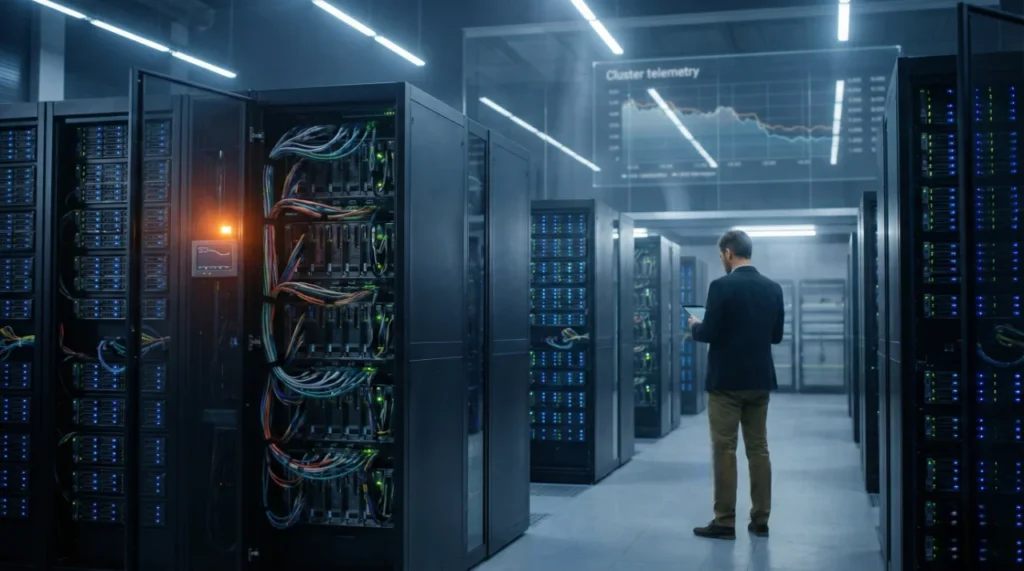
AI progress is no longer limited by model ideas. It is limited by whether massive GPU clusters can run reliably without silently breaking.
That is the structural shift now underway. As training clusters stretch into thousands of GPUs, hardware instability has become a direct constraint on AI economics. Meta’s decision to open-source GPU Cluster Monitoring (GCM) is not a tooling update. It is a signal that infrastructure reliability is becoming a competitive advantage in the AI race.
The next AI bottleneck is not model design. It is cluster health.
Key Summary
- AI training clusters now run on thousands of GPUs, and a single degraded card can quietly corrupt an entire training run.
- Meta is open-sourcing GCM, a system designed to detect “silent” GPU failures before they waste millions in compute spend.
- Training runs at frontier labs often involve 4,000+ GPUs, where even minor hardware instability compounds quickly.
- As compute budgets rise into the billions annually across hyperscalers, hardware reliability becomes a direct capital efficiency issue.
- Companies with better monitoring reduce wasted training time, lower retraining costs, and accelerate model iteration cycles.
- This shift favors vertically integrated AI players and increases pressure on smaller labs renting compute capacity.
Infrastructure Is Becoming the Scarce Asset
For years, the narrative around AI competition centered on model architecture and dataset scale. That framing is now incomplete.
As models move toward trillion-parameter territory, training clusters routinely exceed 4,000 GPUs. At that scale, the probability of hardware degradation is no longer marginal. It is statistical inevitability.
The structural shift is simple: compute reliability now directly shapes model performance, training timelines, and capital burn.
Meta’s open-sourcing of GCM through Meta AI Research formalizes what large labs already know internally. Standard monitoring systems built for web applications do not detect the kind of subtle GPU slowdowns that poison gradients without triggering outright failure alerts.
When a single GPU underperforms inside a synchronized training job, it can drag the entire cluster. That is not a software inconvenience. It is capital inefficiency at scale.
Why This Is Happening Now
Two structural forces converged.
- Cluster scale. The largest AI training jobs now consume tens of thousands of GPU-days per run. If even 1% of GPUs degrade silently, the cost impact multiplies quickly.
- Capital discipline. After two years of aggressive AI infrastructure spending, investors are beginning to scrutinize compute ROI more closely. Hyperscalers are spending tens of billions annually on data centers. Reliability is no longer operational housekeeping. It is a board-level concern.
When GPU utilization drops due to silent throttling, organizations are effectively burning high-value silicon without realizing it. Monitoring tools like GCM attempt to surface that invisible waste.
This is infrastructure economics maturing.
Quiet Rise of Observability as a Competitive Moat
GCM’s deeper integration with Slurm-based HPC environments is not accidental. High-performance training clusters operate under orchestration systems where job-level attribution matters.
The structural insight here is subtle but powerful, the AI race is shifting from model-only differentiation toward systems engineering differentiation.
The companies best positioned in this shift are:
- Vertically integrated hyperscalers that control hardware procurement, networking, and monitoring.
- Labs that can modify their orchestration stack and telemetry pipelines.
- Enterprises with internal HPC expertise.
Those exposed are smaller startups dependent on rented GPU capacity. They may not have visibility into node-level degradation inside shared clusters.
Reliability is becoming asymmetric power.
Compute Economics Are Getting Tighter
To an everyday reader, this may sound technical. But the economic logic is straightforward.
Training frontier models can cost tens of millions per run. If hardware instability forces retraining or introduces subtle model degradation, that cost doubles quickly.
A “silent” failure is particularly damaging because it may not crash a job outright. It may produce suboptimal gradients that only reveal themselves weeks later in model evaluation.
That delay compounds capital waste.
OpenTelemetry (OTLP) integration inside GCM suggests another structural theme: AI infrastructure is merging with modern cloud observability standards. That lowers friction for hyperscalers but raises expectations for everyone else.
Monitoring sophistication is now table stakes.
Regulatory Undercurrents
While hardware monitoring itself is not a regulatory headline, reliability intersects with compliance.
As governments evaluate AI system accountability, auditability will matter. If model training pipelines lack traceability into hardware instability, questions of reproducibility and safety emerge.
Regulators in the U.S. and EU are increasingly focused on systemic risk in large-scale AI systems. Infrastructure opacity could become a compliance liability.
Better monitoring reduces that exposure.
Counterargument: This Is Just Good Engineering
One credible counterpoint is that this is simply operational hygiene. Every large-scale computing system requires monitoring. There is no structural shift here, just maturity.
There is truth in that.
However, the difference lies in scale and capital intensity. Traditional distributed systems failures are inconvenient. Frontier AI training failures are extraordinarily expensive.
When compute clusters represent billions in capital expenditure, incremental efficiency improvements become macro-significant.
This is not just engineering refinement. It is capital protection.
Second-Order Effects
Expect three downstream impacts.
First, talent concentration in infrastructure engineering will intensify. The most valuable AI engineers may increasingly be systems specialists rather than pure model researchers.
Second, vendor consolidation could accelerate. Enterprises may favor infrastructure providers with integrated monitoring guarantees.
Third, open-source observability layers like GCM could standardize expectations across the industry, raising the minimum bar for cluster management.
In effect, reliability becomes a reputational metric.
Next Coming Month
Over the next year, three structural developments are likely:
- Hyperscalers will expand internal reliability tooling beyond open-source baselines.
- Enterprises deploying AI at scale will demand deeper telemetry visibility from cloud providers.
- Compute procurement decisions will increasingly weigh operational transparency alongside raw performance.
If AI infrastructure budgets remain elevated, reliability spending will rise with them.
The only scenario that weakens this thesis is a sudden slowdown in frontier model scaling. If parameter growth plateaus, cluster scale pressures ease. But current capital allocation trends do not suggest that pause is imminent.