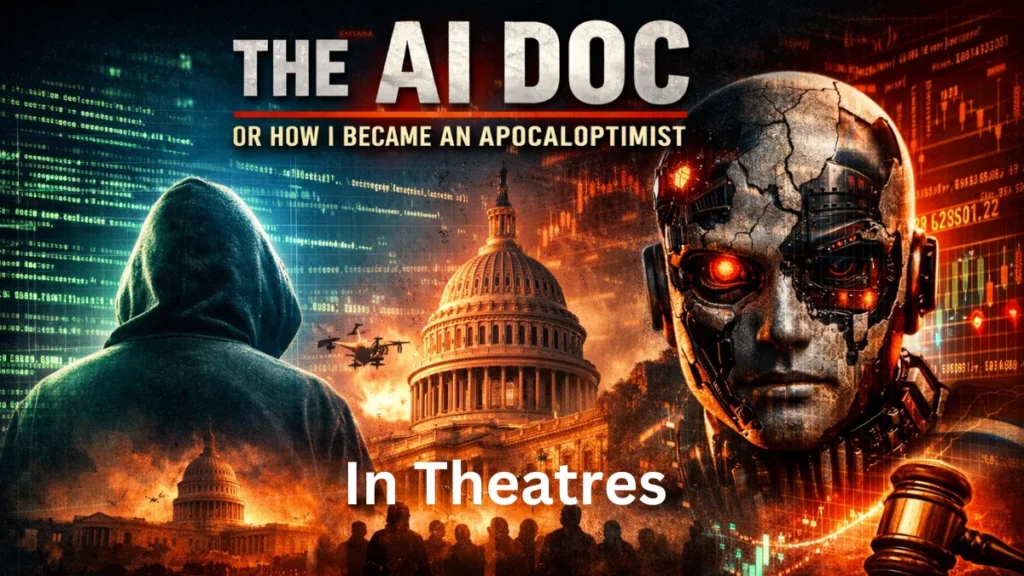
Artificial intelligence has moved from research labs to Capitol Hill hearings and Fortune 500 boardrooms. Now it’s heading back to movie theaters — but this time as a referendum on the future of society.
A new documentary titled The AI Doc: Or How I Became an Apocaloptimist is positioning itself as “the most urgent film of our time,” with a limited theatrical release set for March 27. The marketing language is dramatic. The timing is not accidental.
A Cultural Signal in a Political Year
The release arrives at a moment when AI policy debates in Washington are accelerating, not cooling. Congress remains divided over how aggressively to regulate foundation models. The White House has leaned on executive action and voluntary commitments from companies such as OpenAI and Anthropic, while state governments experiment with their own guardrails. Meanwhile, the European Union’s AI Act is beginning to influence global compliance norms.
Documentaries don’t shape regulatory text directly. But they shape public framing. And public framing, in turn, shapes political risk.
In the United States, AI is no longer an abstract technical topic. It is wrapped up in national security, labor market anxiety, education policy, misinformation fears, and capital market enthusiasm. A theatrical documentary signals something subtle but important: AI has crossed from industry issue to civic narrative.
Why “Apocaloptimism” Is Strategic
The film’s subtitle — “How I Became an Apocaloptimist” — reflects a broader rhetorical shift happening across the AI ecosystem. The early discourse oscillated between utopian accelerationism and existential catastrophe warnings. That binary no longer sells as cleanly.
Investors want growth. Regulators want safety. Enterprises want reliability. Consumers want reassurance.
The hybrid tone — acknowledging risk while arguing for optimism — mirrors how major AI companies now communicate. Since 2023, messaging from leading labs has increasingly blended safety language with commercial ambition. Public trust has become a competitive variable.
If the film succeeds in reframing AI as dangerous but manageable, it could inadvertently reinforce the industry’s preferred positioning: transformative technology that requires oversight but not prohibition.
The Business of Fear — and of Hope
There is also a market logic behind a theatrical release. AI headlines have dominated news cycles for three consecutive years. From Nvidia’s market capitalization surge to mass layoffs attributed partly to automation efficiencies, AI is already intertwined with American economic identity.
A documentary taps into that emotional undercurrent.
Streaming platforms have produced tech exposés before — from social media manipulation to data privacy scandals — but theatrical releases create a different form of cultural legitimacy. They suggest urgency, shared experience, and collective reckoning.
The film’s framing implies stakes that transcend Silicon Valley. That’s important in an election cycle where technology policy could influence campaign narratives. AI is one of the few issues that bridges partisan divides, though for different reasons: economic competitiveness on one side, labor and safety concerns on the other.
Where Power Narratives Collide
The deeper tension sits between three forces:
- Big AI labs racing toward more capable models
- Governments attempting to define oversight boundaries
- A public that alternates between fascination and distrust
Documentaries often amplify one of these tensions. The open question is which one this film privileges.
If it centers on existential risk, it may amplify calls for tighter guardrails and licensing regimes. If it emphasizes economic transformation, it could strengthen arguments for accelerated deployment. If it focuses on inequality, labor unions and worker advocates may use it to reinforce automation critiques.
Hollywood Meets Infrastructure
There is a historical pattern here. Nuclear power, biotechnology, and social media each went through cinematic cycles that shaped public perception. In several cases, film and television preceded regulatory shifts by years.
AI is unusual because it is not a single industry. It is infrastructure. It touches healthcare diagnostics, defense systems, financial modeling, and creative work. That breadth makes it uniquely susceptible to cultural storytelling.
For American audiences, the stakes feel immediate. AI copilots are embedded in workplace software. Generative tools are rewriting creative pipelines. Students use AI tutors daily. Companies are restructuring teams around automation.
The documentary’s challenge will be capturing that systemic integration without collapsing into abstraction.
The Trust Variable
Public trust in technology institutions has eroded over the past decade. Social media’s unintended consequences still linger in policy debates. That history informs how Americans interpret AI claims today.
An “urgent” AI documentary lands in a trust-fractured environment.
If it appears overly alarmist, it risks fatigue. If it appears overly promotional, it risks dismissal. The sweet spot is analytical sobriety — acknowledging uncertainty while clarifying stakes.
That balance mirrors what enterprise buyers now demand from vendors: transparency on model limits, clear governance controls, and demonstrable reliability.
The Broader Implication
Artificial intelligence has become too consequential to remain confined to earnings calls and technical conferences. Its future will be negotiated not only in research labs but in living rooms, theaters, and legislative chambers.
Whether The AI Doc becomes a cultural milestone or fades after its limited run is secondary. The more important signal is that AI is now being contested as a social story, not just a technical capability.
And once a technology becomes a social story, its trajectory is shaped as much by public perception as by code.
That dynamic — more than any trailer tagline — is what makes this moment worth watching.