A growing number of AI companies are talking about education. Fewer are handing educators the steering wheel.
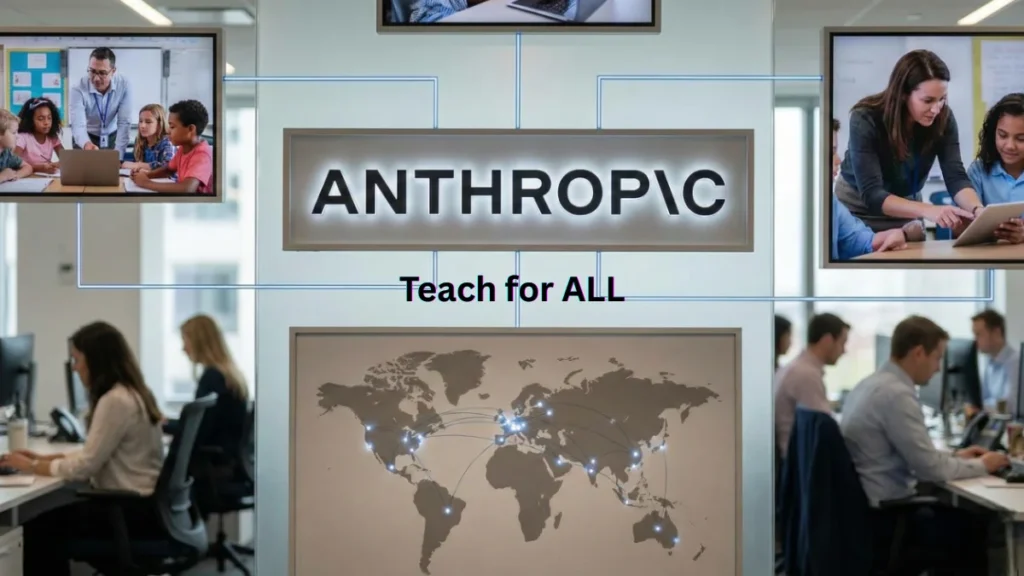
That’s what makes the new partnership between Anthropic and Teach For All stand out. The two organizations have launched a global AI training initiative aimed at educators across 63 countries—positioning teachers not as end users of AI, but as active contributors shaping how it’s built and used in classrooms.
The program, called the AI Literacy & Creator Collective, will give more than 100,000 teachers and alumni across Teach For All’s network hands-on access to Claude, Anthropic’s AI assistant. Together, they serve classrooms reaching over 1.5 million students worldwide, many in under-resourced communities where access to new technology typically arrives late—if at all.
Why this move matters
Most education technology follows a familiar pattern: tools are developed centrally, then rolled out globally with limited local input. This initiative flips that dynamic.
Teachers in the collective are encouraged to experiment with Claude, build classroom tools, and share real-time feedback with Anthropic’s product teams. The goal isn’t just AI literacy—it’s co-creation.
“For AI to make education more equitable, teachers need to help shape how it’s designed,” said Wendy Kopp, underscoring the idea that educators should influence AI development, not merely adapt to it.
From theory to classroom reality
Early examples suggest this isn’t just a philosophical shift.
In Liberia, a teacher with no prior AI experience used Claude after attending live training sessions. Within weeks, she had created an interactive climate education curriculum tailored to local schools. In Bangladesh, another teacher built a gamified math app—with leaderboards, rewards, and challenges—for middle school students struggling with basic numeracy.
These aren’t generic templates. They’re tools designed by teachers who know their students best, using AI as a collaborator rather than a replacement.
Inside the AI Literacy & Creator Collective
The initiative runs through three connected tracks:
- AI Fluency Learning Series: A six-session live program focused on practical AI use in education. More than 500 educators joined the first cohort in late 2025.
- Claude Connect: A global, always-on community where educators across 60+ countries share prompts, experiments, and lessons learned.
- Claude Lab: An advanced program offering select educators access to Claude Pro, monthly office hours with Anthropic teams, and a direct line into product feedback. More than 200 educators applied within days of launch.
The structure is designed to scale learning while keeping feedback grounded in real classrooms.
Part of a broader education strategy
The partnership builds on Anthropic’s expanding footprint in education. The company has already worked with governments and institutions on AI education pilots, including national-level programs in Europe and large-scale collaborations across Africa.
What’s different here is the emphasis on grassroots insight. Instead of focusing solely on policy or top-down curricula, Anthropic is using this network to observe how AI functions in diverse, real-world learning environments.
What happens next
The collective is expected to expand through 2026, with additional cohorts and deeper experimentation planned. For Teach For All’s network, the value goes beyond tools—it’s about shared learning around responsible AI use, data ethics, and long-term sustainability.
For Anthropic, the payoff is equally clear: direct exposure to how educators actually use AI when given freedom, context, and support.
Conclusion
This isn’t AI being “rolled out” to schools. It’s AI being built alongside teachers.
If the model works, it could offer a blueprint for how emerging technologies enter education—starting with trust, local knowledge, and collaboration, rather than software alone.