For most companies experimenting with AI, the friction is no longer generating text. The harder problem is getting models to understand massive context, follow instructions reliably, and interact with the messy reality of existing software.
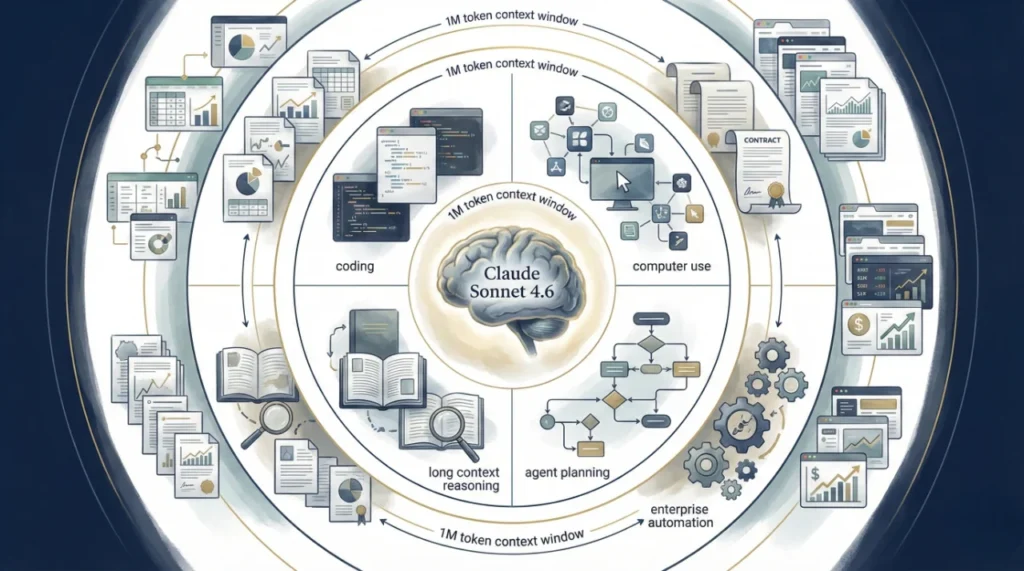
That is the backdrop for Claude Sonnet 4.6, released Tuesday by Anthropic. The company describes it as a full upgrade to its widely used Sonnet tier, improving coding, long context reasoning, agent planning, computer use, and knowledge work, while keeping pricing unchanged.
In practical terms, this release is less about dramatic intelligence leaps and more about operational dependability. That is what makes it consequential.
Mid tier model closing the Opus gap
Anthropic has historically separated its Sonnet models from its more advanced Opus line. Sonnet aimed for balanced performance at lower cost. Opus targeted deeper reasoning at higher prices.
With Sonnet 4.6, that line becomes less rigid.
In internal testing within Claude Code, early users reportedly preferred Sonnet 4.6 over Sonnet 4.5 about 70 percent of the time. More notably, users also favored it over Claude Opus 4.5 in a majority of comparisons. If that preference holds in broader production use, it reshapes buying decisions.
Teams that previously escalated complex tasks to an Opus model may now remain within the lower cost Sonnet tier.
Pricing stays at three dollars per million input tokens and fifteen dollars per million output tokens, matching Sonnet 4.5. In a market where upgrades often introduce pricing adjustments, maintaining cost signals competitive intent.
Significance of a 1 million token window
The most visible technical shift is the 1 million token context window, currently in beta.
That scale allows entire codebases, extended contracts, or large research archives to sit inside a single prompt. Large context sizes are no longer rare among frontier labs. What matters is whether the model can reason effectively across that breadth.
Anthropic says Sonnet 4.6 does. In internal evaluations such as Vending Bench Arena, a simulated business competition, the model reportedly demonstrated long horizon planning by investing heavily in early capacity and later pivoting toward profitability.
Benchmarks are not production guarantees. But they suggest how the system handles sustained reasoning rather than isolated requests.
For enterprise teams, the more practical test will be whether the model maintains coherence across long sessions in legal review, engineering projects, or financial modeling.
Computer use becomes more practical
Anthropic has invested heavily in computer use, allowing AI systems to interact with software through virtual mouse clicks and keyboard inputs rather than direct APIs.
When the company first introduced a general purpose computer using model in late 2024, it described the capability as experimental and sometimes error prone.
Sonnet 4.6 marks measurable progress. On OSWorld, a benchmark that evaluates AI interaction with real applications such as browsers and office tools, Anthropic reports steady gains over sixteen months.
Safety improvements also matter here. Browser based agents can be vulnerable to prompt injection attacks hidden inside web pages. According to Anthropic, Sonnet 4.6 shows stronger resistance compared to Sonnet 4.5 and performs similarly to Opus 4.6 in safety testing.
The opportunity is clear. Organizations with legacy systems that lack APIs could rely on AI to operate software as a human would. The limitation is equally clear. The model still trails highly skilled human operators and will require careful oversight in sensitive environments.
Developer feedback that affects workflow
Performance claims become meaningful when they change daily experience.
Early developers reported that Sonnet 4.6 reads surrounding context more carefully before modifying code, reduces duplication, and follows instructions more consistently. Users also described fewer hallucinated success claims and less unnecessary complexity.
That restraint matters. Overengineering from AI systems can create technical debt rather than reduce it. A model that produces cleaner, minimal changes may save real engineering hours.
In frontend development and financial analysis, early customers reported reaching production quality outputs in fewer iteration cycles. That efficiency, if replicated broadly, could lower operational costs even without dramatic performance breakthroughs.
Platform level updates aimed at enterprise
The release also includes several platform updates on the Claude Developer Platform. Sonnet 4.6 supports adaptive thinking, extended thinking, and context compaction in beta, which summarizes older conversation content as sessions grow longer.
On the API, web search and fetch tools now automatically write and execute filtering code to keep only relevant content in context. Code execution, memory, programmatic tool calling, and tool search are generally available.
Inside Excel, Claude now supports MCP connectors. That allows integration with financial data providers such as S&P Global, LSEG, PitchBook, Moody’s, and FactSet.
For finance teams that operate primarily inside spreadsheets, reducing tab switching and manual copy workflows lowers friction. That signals a focus on embedding AI directly inside existing enterprise habits rather than forcing new interfaces.
Market positioning in a competitive cycle
The broader AI model market remains intensely competitive. Frontier labs continue expanding context sizes, improving reasoning benchmarks, and adjusting pricing structures.
Sonnet 4.6 appears designed to compress performance tiers without erasing differentiation entirely. Anthropic maintains that Opus 4.6 remains stronger for the most demanding reasoning tasks such as large scale refactoring and complex multi agent coordination.
That positioning prevents internal overlap while expanding Sonnet adoption. It also reflects a shift in enterprise expectations. Companies increasingly want dependable performance at sustainable cost rather than maximum theoretical intelligence.
Adoption reality
For free and Pro users, Sonnet 4.6 becomes the default model in Claude. That ensures rapid exposure across individual developers and smaller teams.
Enterprise deployment will move more deliberately. Large context windows increase memory demands. Computer use introduces additional security surfaces. Even with improved instruction fidelity, long session drift remains an industry wide challenge.
Organizations adopting Sonnet 4.6 in production will still need evaluation pipelines, monitoring tools, and fallback strategies.
The upgrade reduces friction. It does not eliminate operational responsibility.
Why the timing matters
This release arrives as enterprises shift from experimentation toward deeper integration of AI systems.
The question is no longer what a model can demonstrate in isolation. The question is whether it can support economically valuable office work consistently at scale.
Claude Sonnet 4.6 does not redefine the frontier. It tightens reliability, expands usable context, and improves automation pathways without increasing cost.
If a mid tier model can handle most real world business tasks, pricing hierarchies across the industry may begin to compress.
The next phase will reveal whether organizations standardize on Sonnet 4.6 as their default operational layer or continue reserving higher tier models for specialized work. That adoption pattern will determine how durable this shift truly is.