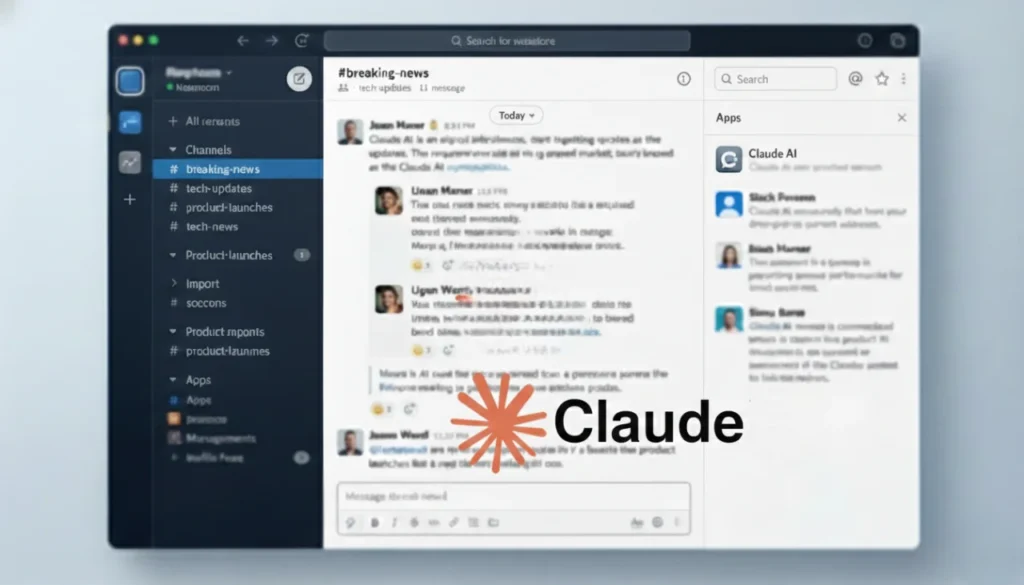
Claude AI is moving deeper into everyday work. Anthropic has launched a native Slack connector for paid Claude users, allowing teams to search conversations, prepare for meetings, and send messages without ever leaving the AI interface. It’s a quiet release, but one with big implications for how knowledge work actually gets done.
The update is available to Claude Pro subscribers at $20 a month and users on Anthropic’s higher-tier Max plan. Instead of copying messages back and forth between tools, Claude now sits directly on top of one of the most widely used workplace platforms in the U.S.
From Chatbot to Workplace Operator
For the past year, Anthropic has steadily repositioned Claude from a general-purpose chatbot into something closer to a work companion. This Slack connector is the clearest step yet in that direction.
With the integration enabled, Claude can search across Slack channels, summarize ongoing projects, pull context for upcoming meetings, and draft or send messages back into Slack on a user’s behalf. In practice, that means a product manager can ask Claude for the latest updates across multiple channels, then immediately post a follow-up message—without switching tabs or breaking focus.
This kind of functionality has been technically possible before through third-party tools or custom automations. What’s different here is that it’s built directly into Claude’s core experience, with Anthropic controlling the full workflow.
Why Anthropic Is Prioritizing Integrations Over Models
The timing of the release raised some eyebrows. In recent weeks, online speculation swirled around the possibility of a new major Claude model—often referred to as “Sonnet 5”—dropping in early February. That didn’t happen. Instead, Anthropic shipped a product feature.
For some users, that was a letdown. For others, it was revealing.
Model improvements matter, but for enterprise and professional users, utility often matters more. Anthropic’s existing models already rank at or near the top in coding, reasoning, and long-context tasks. The Slack connector suggests the company believes the next competitive frontier isn’t just smarter models—it’s tighter integration into real workflows.
Industry insiders would recognize this as a strategic shift. Once models reach a certain quality threshold, distribution and daily usefulness become the differentiators. Slack, used by millions of teams across the U.S., is one of the most valuable surfaces an AI assistant can occupy.
How This Changes Day-to-Day Work
For teams that live inside Slack, the impact could be meaningful.
Instead of scanning dozens of channels or threads, Claude can act as a contextual filter—surfacing what matters and ignoring what doesn’t. Meeting prep becomes faster. Catching up after time off becomes less painful. Routine communication gets streamlined.
There’s also a subtle but important productivity gain: fewer context switches. Research consistently shows that jumping between tools drains focus. By letting users stay inside a single conversational flow, Anthropic is betting that Claude becomes less of a destination app and more of an invisible layer over work.
Why This News Matters
This isn’t just a feature update—it’s a signal.
For businesses, it points toward AI assistants becoming embedded infrastructure rather than optional tools. If Claude can reliably understand workplace context and act on it, it reduces friction across teams without requiring everyone to change how they work.
For employees, it raises new expectations. AI is no longer just for drafting emails or writing code snippets; it’s starting to manage information flow itself.
For the broader AI market, it increases pressure on competitors. Any serious workplace AI now needs deep integrations with collaboration tools, not just a good chat interface.
Looking Ahead
Over the next year or two, expect this pattern to accelerate.
Anthropic will likely expand beyond Slack into other enterprise platforms—documents, project management tools, and internal knowledge bases. As these integrations deepen, the line between “AI assistant” and “digital coworker” will blur.
There are risks, of course. Privacy, data access, and over-automation will remain concerns, especially for regulated industries. Teams will need clear controls over what AI can see and do.
But the opportunity is clear. The companies that win won’t just build the smartest models. They’ll build the ones that quietly make work easier, faster, and less fragmented.
Anthropic’s Slack connector may not be flashy. But it’s exactly the kind of move that signals where practical AI is headed next.