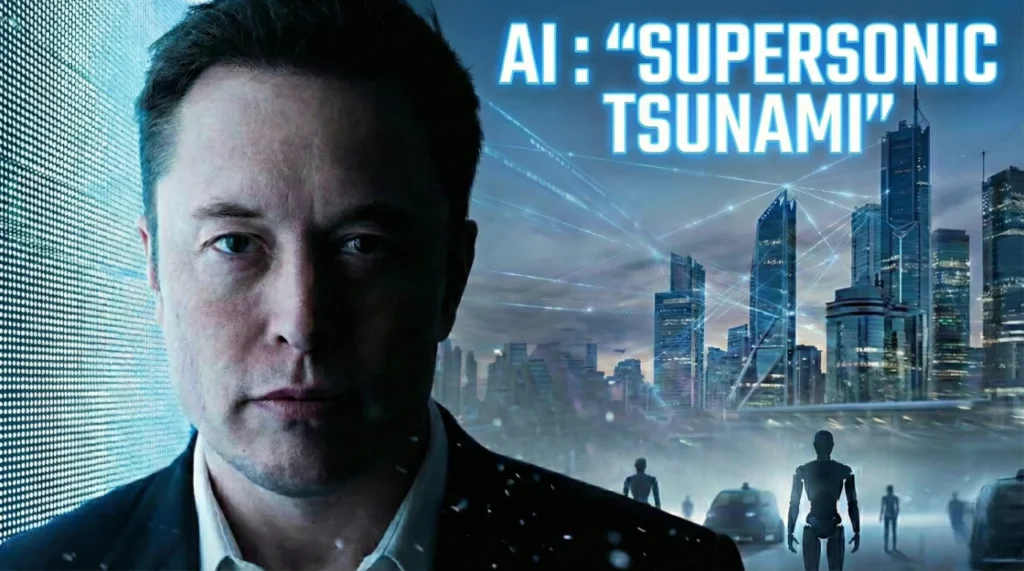
Elon Musk isn’t warning about artificial intelligence anymore. He’s declaring the outcome.
In a recent interview circulating widely online, Elon Musk described AI as a “supersonic tsunami” and argued that companies run entirely by machines will soon outperform any business that still relies on human decision-making.
The claim is stark: once AI systems and humanoid robots reach scale, human-led corporations won’t just be less efficient—they’ll be obsolete.
From Human Organizations to Machine-Run Firms
Musk’s argument isn’t about sentient machines or sci-fi takeovers. It’s about speed, cost, and coordination.
He compared today’s workforce to an earlier era when entire buildings of people were employed to perform calculations—jobs that vanished once spreadsheets arrived. In Musk’s view, humans now occupy a similar role inside modern companies: useful, but increasingly slow.
“Keeping people in the loop,” Musk suggested, won’t make AI safer or smarter. It will simply make companies less competitive.
ELON MUSK: "I call AI the supersonic tsunami. What's going to happen is when you have humanoid robots at scale, they will make products & provide services far more efficiently than human corporations. AI corporations will outperform any corporations that have people in the loop." pic.twitter.com/rkn54sbAxC
— DogeDesigner (@cb_doge) February 6, 2026
Why Humanoid Robots Change the Equation
Software alone isn’t the endgame. Physical automation is.
Musk pointed to humanoid robots—especially Tesla’s Optimus—as the missing piece that allows AI systems to fully replace human labor. Once robots can manufacture, transport, repair, and operate infrastructure, companies no longer need large workforces to function.
At that point, businesses become closer to autonomous systems than traditional organizations: AI handles planning and optimization, robots execute tasks, and humans step back into ownership or oversight roles.
Silicon Valley Is Quietly Moving This Way
Musk’s comments may sound extreme, but the underlying idea is already circulating across tech circles.
AI-first startups are increasingly designed with minimal staffing. Customer support, marketing, analytics, logistics, and even product iteration are being automated. The long-term vision—rarely stated so bluntly—is companies that scale without hiring.
That shift is especially attractive in an era of rising labor costs and global competition. AI doesn’t strike, negotiate, or burn out. It just runs.
Space, Power, and Musk’s Bigger AI Bet
Musk also tied his outlook to the infrastructure required to sustain next-generation AI.
He has previously suggested that future AI systems may need energy sources beyond Earth’s limits, hinting at space-based compute powered by continuous solar energy. Those ambitions align with the growing footprint of xAI and Musk’s broader ecosystem, including SpaceX.
Some online claims about combined trillion-dollar valuations and orbital data centers remain unverified, but the strategic direction is clear: scale first, regulate later.
The Uncomfortable Question No One Wants to Answer
If Musk is right, the challenge isn’t whether AI will replace jobs—it’s what replaces employment itself as the foundation of the economy.
Automation promises cheaper goods and faster innovation. It also threatens to outpace governments’ ability to retrain workers or redesign social safety nets. That tension—between efficiency and stability—is where this debate is heading next.
Conclusion
Musk isn’t predicting a distant future. He’s describing a business model already taking shape.
In a world optimized for speed, humans may no longer be the competitive advantage. They may be the bottleneck.