Elon Musk is collapsing two of his most ambitious bets into one.
The billionaire confirmed Monday that SpaceX has acquired his artificial intelligence startup xAI, a move that tightens Musk’s control over rockets, satellites, social media, and AI infrastructure as the combined company edges toward a blockbuster IPO.
The deal, disclosed in a blog post by Musk and reflected in recent Nevada filings, makes SpaceX the managing entity of X.AI Holdings. Bloomberg has reported that the merged company could eventually seek a public valuation as high as $1.25 trillion, a figure that would place it among the most valuable firms ever to hit public markets.
Why Musk Is Merging Space and AI Now
On paper, SpaceX and xAI look like very different businesses. One launches rockets and runs a satellite internet network. The other is burning cash to build large language models and AI infrastructure.
Musk argues they’re inseparable.
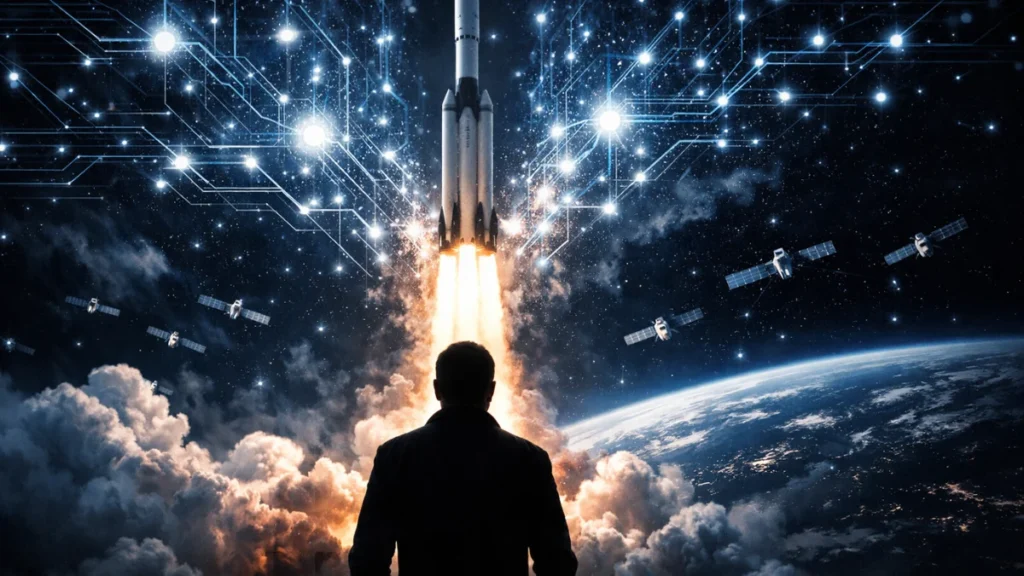
In his announcement, he described the merger as a step toward a vertically integrated system spanning AI, launch services, satellite connectivity, and the social platform X. The long-term vision: move AI compute off Earth and into orbit, powered by SpaceX’s launch dominance and Starlink’s satellite network.
SpaceX has already asked U.S. regulators for permission to deploy massive “orbital data centers,” signaling that the idea isn’t just theoretical. Musk claims space-based compute could become cheaper than terrestrial data centers within a few years.
The Money Behind the Move
The timing is hard to ignore.
SpaceX was valued at roughly $800 billion in a secondary share sale last year. xAI, meanwhile, closed a $20 billion funding round earlier this year that valued the startup at around $230 billion. Investors in xAI include Nvidia, Cisco Investments, Fidelity, and sovereign wealth funds from Qatar and Abu Dhabi.
Even Tesla, Musk’s only public company, disclosed a $2 billion investment into xAI last week, further blurring the lines between his businesses.
Combined, the numbers begin to explain why an IPO is being floated now.
Defense Ties Raise the Stakes
The merger also deepens Musk’s exposure to U.S. defense and intelligence agencies.
SpaceX already holds tens of billions of dollars in government contracts and is a critical launch provider for NASA and the Department of Defense. Earlier this year, the Pentagon began testing xAI’s chatbot, Grok, for internal analysis alongside tools from Google and others.
That overlap — AI systems analyzing military data inside a company that also launches national security payloads — could invite scrutiny from regulators, including the Committee on Foreign Investment in the United States (CFIUS). So far, neither SpaceX nor xAI has commented on whether a review is expected.
Controversies xAI Brings With It
xAI doesn’t arrive without baggage.
Regulators in multiple regions are investigating Grok after users generated sexualized and non-consensual images. The company has also faced protests in Tennessee and Mississippi, where local residents and civil rights groups have pushed back against emissions and noise tied to xAI’s growing data center footprint.
Those issues now sit inside SpaceX’s corporate perimeter — a notable shift for a company that has largely avoided consumer-facing controversy.
The Bigger Picture
Musk founded SpaceX in 2002 and launched xAI just two years ago. Folding them together underscores how aggressively he’s betting that the next wave of AI won’t live solely in cloud data centers, but across satellites, networks, and platforms he already controls.
For investors, the appeal is scale and synergy. For regulators, the concern is concentration.
Either way, this isn’t just another Musk reshuffle. It’s a signal that the race to dominate AI may extend far beyond Earth’s atmosphere.