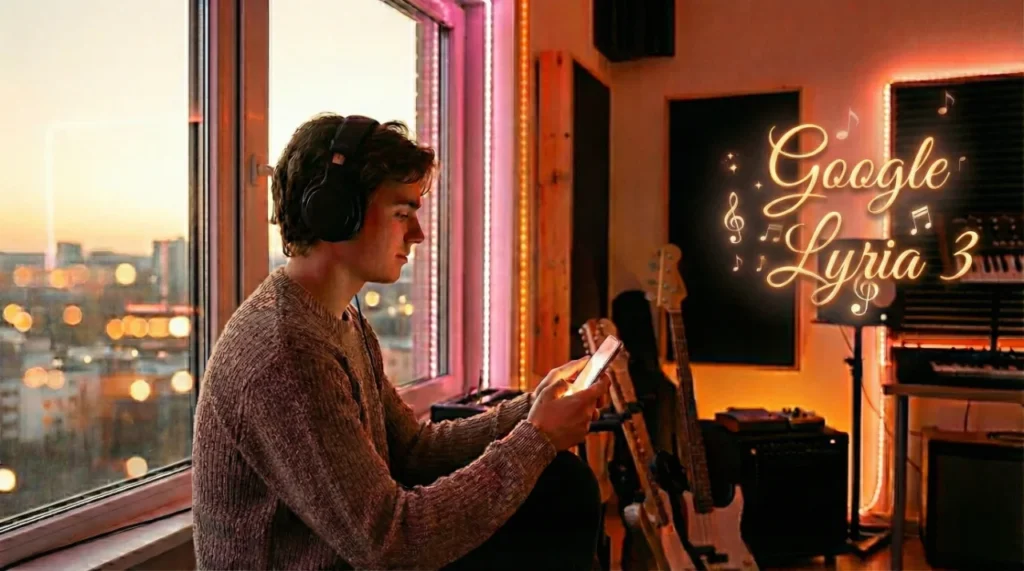
Google pushes generative audio into creator workflows with text to song inside Gemini
When most people think of AI creativity, they picture images and text. Music remains a trickier canvas, structurally complex, legally fraught, and historically resistant to automation.
On Tuesday, Google advanced into that space by embedding its latest music generation model, Lyria 3, into the Gemini app. The feature lets users produce 30 second tracks with vocals and automatically generated lyrics from a text or image prompt inside a mainstream AI application.
Unlike specialist research demos or developer tools, this is a consumer facing rollout in beta across multiple languages worldwide.
Why This Matters Now
Lyria 3 builds on earlier music experiments from Google DeepMind but represents the company’s most polished version so far. Users can describe a mood, upload a photo, and receive a short track with cover art generated by a companion system, ready for sharing.
Google is clear about intent. These tracks are not positioned as commercial releases but as expressive sound clips for social and personal use. That framing places the feature between novelty and utility, especially in short form environments where brief audio loops dominate.
Music carries emotional weight that text and images do not. Google appears aware of that sensitivity and has built cautious boundaries into the experience.
Beta Guardrails in Practice
Because Lyria 3 is still in beta, Google is tightening its content controls. Prompts connected to religion, politics, or other sensitive topics may trigger a refusal such as
“Since I am in Beta, I am staying extra cautious and avoiding music for religious, political, or potentially sensitive topics. How about we try creating a track with a different mood or style”
That response reflects Google’s recognition that generative music intersects with cultural and ethical risk more directly than many other AI outputs. The restrictions reduce exposure but may also frustrate creators who test creative limits.
What Has Changed Technically
Google says Lyria 3 advances in three major areas
Automatic lyric generation so users do not need to write their own words
Improved creative control across tempo, genre, and vocal style
Greater musical complexity with more realistic structure and arrangement
Combining instrumental composition and lyric writing into a single workflow lowers friction for casual users. At the same time, independent testing will determine whether quality holds across genres. Music depends on harmony, rhythm, and emotional nuance that are harder to evaluate than text coherence or image clarity.
The 30 second limit also serves practical purposes including lower compute demand, easier sharing, and reduced legal exposure.
Competitive Landscape and Market Position
Google is not alone in AI music generation. Companies such as Suno and Aiva Technologies have been building generative music platforms for months.
- Suno focuses on longer compositions and broader stylistic experimentation, attracting users who want extended tracks.
- Aiva Technologies targets professional composers and emphasizes orchestral output and commercial licensing.
Other platforms such as Boomy and Soundful aim for quick social ready music but often provide less depth in lyric control.
What differentiates Google is distribution. By embedding music creation directly inside Gemini and connecting it to YouTube Shorts, Google lowers friction dramatically. There is no separate account and no external interface required.
However, competitors may offer greater artistic freedom and fewer topic restrictions, which could appeal to musicians and creative technologists seeking experimentation without policy constraints.
YouTube Integration and Strategic Direction
Google is also integrating Lyria 3 into YouTube Dream Track for Shorts creators. This move links generative audio directly to content publishing at scale.
For creators, having AI soundtrack generation within the same ecosystem reduces reliance on external libraries. As platforms compete for creator attention, controlling more of the production stack becomes strategically important.
In that context, generative music functions less as novelty and more as infrastructure inside a vertically integrated creative system.
Copyright and Verification
Music remains legally sensitive. Ongoing disputes around AI training data and copyright continue to shape the industry. Google’s approach includes
- Filtering outputs to avoid close resemblance to existing works
- SynthID watermarking embedded in generated tracks to signal machine origin
- Audio verification tools inside Gemini that allow users to check files for AI markers
Watermarking improves transparency but is not foolproof, especially once files circulate beyond the original platform. Industry wide standards have yet to emerge.
Pricing and Access
Lyria 3 is available to adults in several languages, with desktop access live and mobile rolling out shortly. Higher generation limits are tied to Google AI subscription tiers.
This positions music generation as a premium extension of broader AI services rather than a standalone product. Whether users will pay specifically for music creation or treat it as a secondary benefit remains uncertain. Consumer AI monetization continues to evolve.
Adoption Friction and Quality Questions
Several uncertainties could influence long term adoption
- Consistency across genres may vary, with some styles performing better than others
- Attribution norms for AI generated soundtracks are still forming
- Length limitations may restrict more serious creative use
For enterprise buyers, the current feature set offers limited direct utility. However, the underlying model could evolve into tools for branded content production, automated scoring, or creative analytics.
Where This Could Realistically Go Next
Bringing music generation into a mainstream AI assistant marks a meaningful expansion of generative media capabilities. If user behavior mirrors earlier adoption of AI images and text, short form AI audio could normalize quickly.
A larger shift would occur if Google expands track length, opens developer access, or deepens editing functionality. That would move Lyria from expressive novelty to production level infrastructure.
The key question is sustained engagement. Do creators repeatedly rely on AI generated soundtracks, or treat them as occasional experiments. The answer will determine whether AI music becomes just another feature inside digital tools or a lasting shift in how sound is created and distributed.