AI assistants already answer questions. Now, Google and Shopify want them to buy things for you too.
At the National Retail Federation’s Big Show in New York, the two companies quietly introduced something that could reshape online shopping: the Universal Commerce Protocol, an open standard designed to let AI agents move from product discovery all the way to checkout—without breaking the web into a maze of incompatible systems.
The pitch is simple: if AI is going to shop on our behalf, it needs a common language to talk to retailers, inventory systems, and payment providers. That’s what Google and Shopify say they’ve built.
From browsing to buying—inside the chat
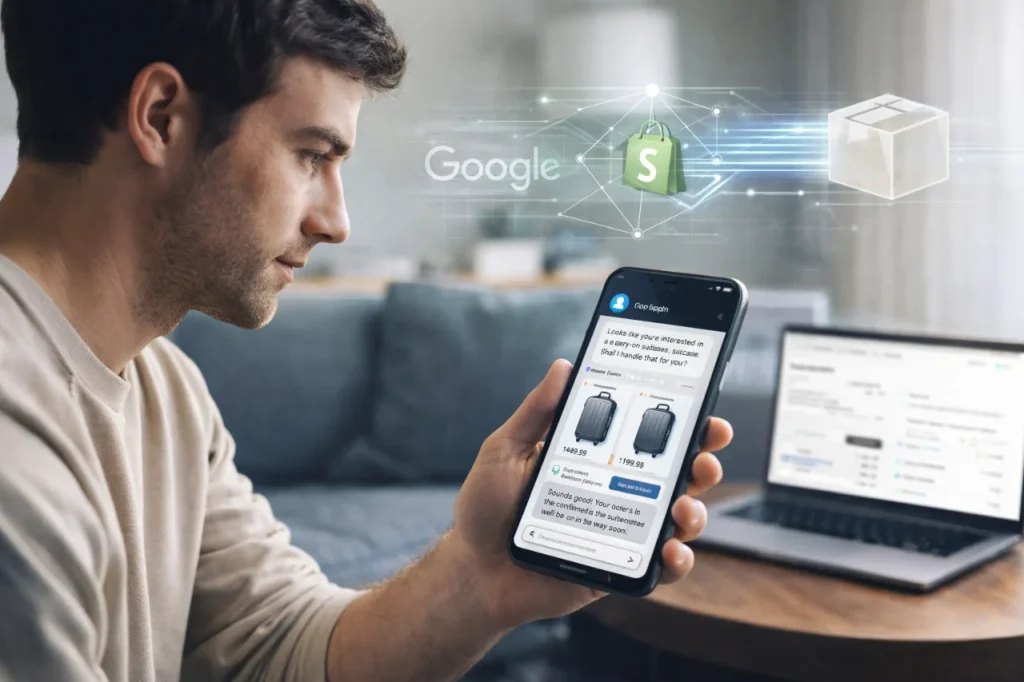
In a live demo, Google showed its Gemini assistant searching for a carry-on suitcase. The AI compared options, selected a product from Monos, and completed the purchase directly inside the conversation. Shipping and payment details were pre-filled. No redirected tabs. No checkout pages.
It felt less like e-commerce as we know it—and more like messaging a hyper-efficient personal shopper.
That flow is the core promise of the Universal Commerce Protocol: turning AI chat interfaces into transactional spaces, not just recommendation engines.
AI agents will be a big part of how we shop in the not-so-distant future.
— Sundar Pichai (@sundarpichai) January 11, 2026
To help lay the groundwork, we partnered with Shopify, Etsy, Wayfair, Target and Walmart to create the Universal Commerce Protocol, a new open standard for agents and systems to talk to each other across… pic.twitter.com/8gDxDWjF9q
Why Shopify is all in
For Shopify, the protocol is both a shield and a sword.
As AI platforms move closer to the transaction layer, merchants risk being disintermediated—reduced to inventory providers while platforms own the customer. Shopify’s answer is to make its merchants “agent-ready” while keeping them in control.
Under the protocol, retailers remain the merchant of record. They handle pricing, fulfilment, and customer relationships. The AI agent acts as a facilitator, not a storefront owner.
Shopify CEO Tobias Lütke described the move as laying the groundwork for “agentic commerce,” where software agents transact at scale on behalf of humans.
Big retailers are already testing it
Google says the protocol is being developed with input from major retail players including Target, Walmart, and Etsy.
That matters. Standards only work if enough of the ecosystem adopts them. By pulling in large retailers early, Google and Shopify are trying to avoid the fate of many well-intentioned but unused “open” initiatives.
The real shift: commerce without clicks
Zoom out, and the protocol hints at a bigger change.
If AI agents become trusted buyers, the classic e-commerce funnel—search results, product pages, carts—could collapse into a single conversational step. Shopping becomes something that happens inside AI systems, not websites.
That’s powerful. It’s also unsettling.
Critics warn that AI-driven commerce could enable deeply personalised pricing or push consumers toward choices optimised for platforms rather than people. Others question how much personal data an AI needs to shop “well,” and where that data ultimately flows.
Google says the protocol is designed to preserve merchant control and transparency. Privacy advocates aren’t fully convinced—yet.
What happens next
The Universal Commerce Protocol is live, but it’s still early.
Developers need to build on it. Merchants need to trust it. And consumers need to decide whether they’re comfortable letting AI handle their purchases.
What’s clear is that Google and Shopify are betting on a future where shopping isn’t something you do—it’s something your AI does for you.
Whether that future feels liberating or invasive will depend on how these systems are used, governed, and regulated.
Conclusion
AI shopping is moving from demo to infrastructure. And once the pipes are in place, there’s no going back.