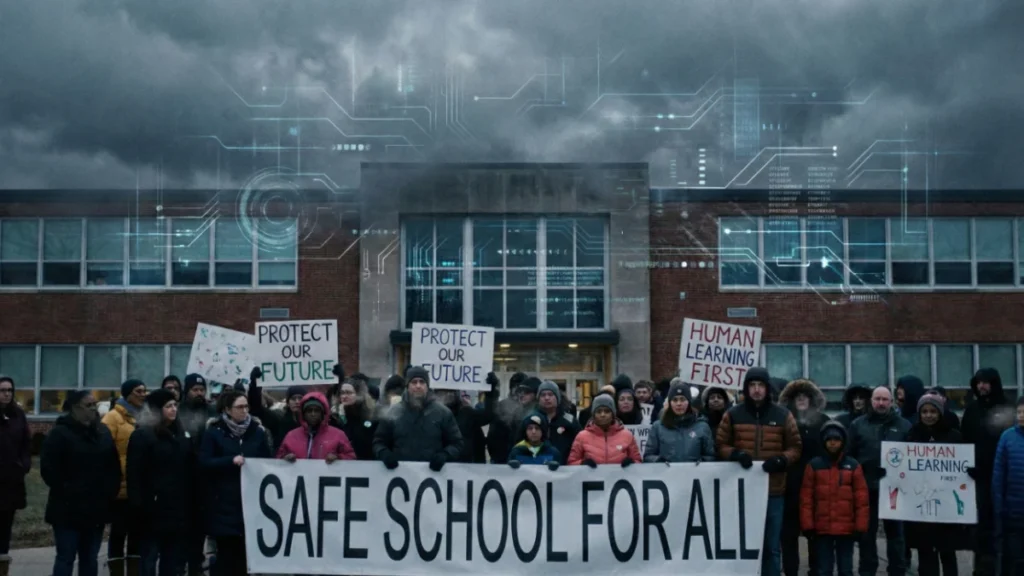
Illinois is stepping into two of education’s most contentious debates—immigration enforcement and artificial intelligence—with a slate of new laws that take effect this year, drawing clear boundaries around who schools can question, what data they can share, and how far AI is allowed to go in the classroom.
Illinois lawmakers are making it clear: schools are not immigration checkpoints, and artificial intelligence won’t be replacing teachers anytime soon.
A set of education laws now taking effect across the state tackles two issues that dominated national headlines in 2025—immigrant rights and AI in education. Together, the measures position Illinois as one of the more assertive states responding to federal immigration shifts and the rapid spread of generative AI tools in schools.
Immigration protections move front and center
The legislative push gained urgency after Donald Trump began his second term and the Department of Homeland Security rolled back a policy that had limited immigration enforcement near schools and other “sensitive locations.”
In response, Illinois officials moved quickly. State education leaders urged districts to prepare clear protocols for handling requests from federal immigration authorities—while lawmakers worked to tighten protections.
One of the most significant changes comes from House Bill 3247. The law bars schools from discouraging enrollment or participation based on a student’s—or their family’s—immigration status. It also prohibits schools from collecting or sharing immigration or citizenship information unless explicitly required by state or federal law.
Starting July 1, districts that violate those rules can face civil lawsuits, adding real financial risk to noncompliance.
For immigrant advocates, the message is simple: public education in Illinois is not conditional on legal status.
Scholarships expand beyond citizenship
Another law widens access to publicly funded scholarships.
House Bill 460 extends eligibility for scholarship programs run by local governments to students who meet Illinois residency requirements, regardless of citizenship or immigration status. The state had already opened its major financial aid programs to noncitizens; this change pushes that policy further into county and municipal programs.
AI gets limits—at least in college classrooms
While immigration laws focus on protection, Illinois’ AI legislation is about restraint.
House Bill 1859 targets community colleges, requiring that courses be taught by qualified human instructors. Colleges are explicitly barred from using AI systems as the sole source of instruction.
Faculty can still use AI as a teaching aid—but not as a stand-in for an instructor.
Lawmakers framed the move as a guardrail, not a rejection of technology, at a time when AI tools are increasingly capable of generating lectures, assignments, and assessments.
K–12 schools get guidance, not mandates
For elementary and high schools, the state took a lighter touch.
Senate Bill 1920 directs the Illinois State Board of Education to publish statewide guidance on AI use in K–12 classrooms by July 1. The guidance is expected to cover how AI works, how it can support teaching, and the risks it poses to student data privacy and equity—particularly for vulnerable student populations.
Smaller changes with real impact
Other education laws arriving this year may fly under the radar but could affect families directly. One allows seventh- and eighth-grade students to earn high school credit for advanced coursework. Another requires schools to inform parents of students with disabilities that they can bring third-party advocates to IEP meetings.
Why it matters
As states across the U.S. wrestle with immigration enforcement in schools and the role of AI in education, Illinois is drawing firm lines early. The approach—protect students first, regulate technology carefully—could influence how other states respond to the same pressures in the months ahead.