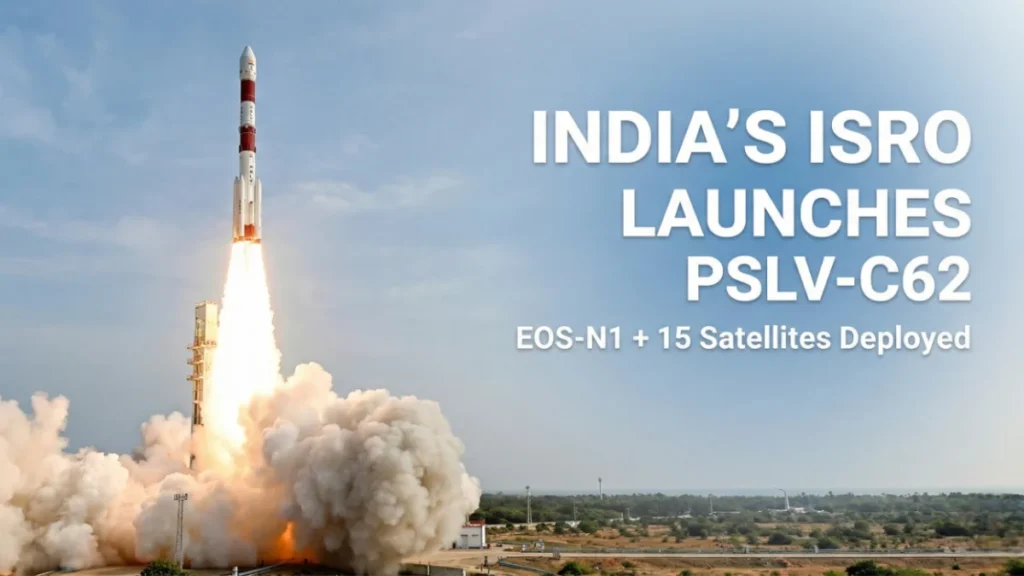
India’s space program added another clean win to its record on Monday as the Indian Space Research Organisation successfully launched the PSLV-C62 mission from Sriharikota, placing its primary Earth-observation satellite, EOS-N1, into orbit along with 15 additional payloads from India and abroad.
The launch took place at 10:18:30 IST from the First Launch Pad at Satish Dhawan Space Centre, using the PSLV-DL configuration—a variant known for its flexibility and steady performance. Within minutes, ISRO confirmed that all satellites were deployed into Sun Synchronous Orbit, a demanding trajectory prized for Earth imaging and scientific missions.
A Mission Built for Precision
PSLV-C62 wasn’t flashy—but that’s exactly the point. ISRO’s Polar Satellite Launch Vehicle has built its reputation on consistency, and this mission leaned fully into that strength. The rocket executed a near-textbook ascent, with each stage firing as planned and satellite separation occurring in a carefully timed sequence.
At the center of the mission was EOS-N1, the latest addition to India’s Earth observation fleet. Operating in Sun Synchronous Orbit, the satellite is designed to deliver repeatable, high-quality imagery for applications ranging from environmental monitoring to land-use analysis and disaster response.
Launch Day for PSLV-C62 / EOS-N1 Mission.
— ISRO (@isro) January 12, 2026
🔴 Live coverage from 09:45 IST
🚀 Liftoff at 10:18:30 IST
Livestream link: https://t.co/fMiIFTUGpf
For more information Visit:https://t.co/3ijojDaYB2
#PSLVC62 #EOSN1 #ISRO #NSIL
Rideshare, the ISRO Way
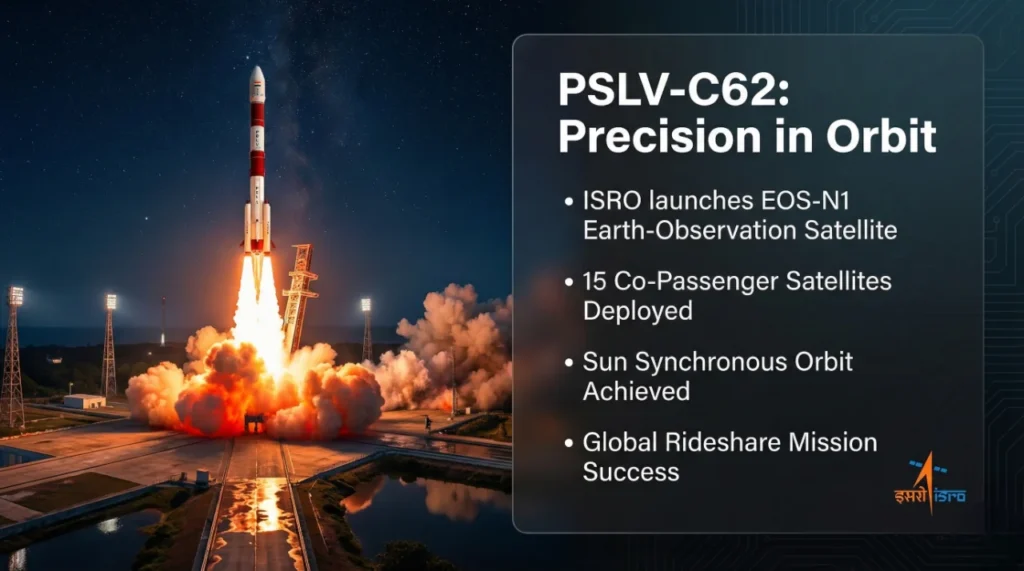
Beyond EOS-N1, the launch highlighted ISRO’s growing role as a global rideshare provider. The mission carried 15 co-passenger satellites, a mix of domestic research payloads and international technology demonstrators.
Among them was Anvesha, a hyperspectral satellite developed under India’s defence research ecosystem, and Spain’s Kestrel Initial Technology Demonstrator (KID)—a compact re-entry vehicle expected to perform a controlled splashdown in the South Pacific Ocean later in its mission profile.
For international customers, PSLV’s appeal is straightforward: predictable schedules, competitive pricing, and a launch record that minimizes risk.
Why This Launch Matters
In an era where launch delays and cost overruns are increasingly common, PSLV-C62 is a reminder that reliability still counts. While newer rockets chase reusability and massive payloads, PSLV has quietly carved out a niche as a dependable workhorse for small and medium satellites.
That matters not just for India, but for universities, startups, and national agencies worldwide that need affordable access to orbit—without betting their mission on experimental hardware.
Signals for the Global Space Market
PSLV-C62 also reflects a broader shift in the space economy. Demand for Earth-observation data continues to rise, driven by climate monitoring, agriculture, urban planning, and national security. At the same time, small satellite operators are looking for launch partners who can bundle missions efficiently.
ISRO, through its commercial arm NSIL, is positioning PSLV as exactly that kind of platform—less hype, more execution.
What Comes Next
With EOS-N1 now in orbit, ISRO will begin post-launch checks and data calibration before transitioning the satellite into full operational service. The performance of the Kestrel KID re-entry experiment will also be closely watched, as interest grows globally in atmospheric re-entry and recovery technologies.
For ISRO, PSLV-C62 isn’t a turning point—it’s confirmation. The agency’s launch strategy is working, and the global market is paying attention.
Conclusion
PSLV-C62 didn’t try to steal headlines. It delivered something more valuable: proof that quiet, repeatable success still wins in space.