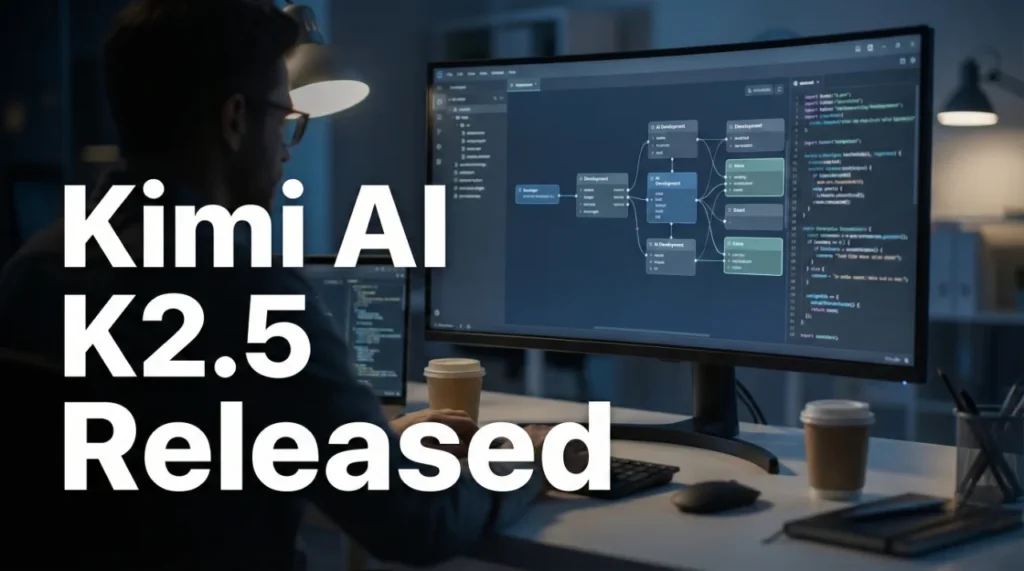
Kimi AI quietly announced the arrival of Kimi K2.5, the post was short, playful, and easy to scroll past. Two phrases did all the work: Aesthetic Coding and Agent Swarm.
That’s not marketing fluff. It’s a signal.
Behind those words is a clear change in how AI-assisted development is being positioned — not as a faster autocomplete tool, but as a system that thinks in structure, collaboration, and intent.
Let’s unpack why this release matters.
Kimi K2.5 has arrived! 🥝
— Kimi.ai (@Kimi_Moonshot) January 27, 2026
Here are 2 things to know: Aesthetic Coding x Agent Swarm. pic.twitter.com/cqfrlaTrZF
The Problem Kimi Is Actually Solving
For the past few years, AI coding tools have chased the same goal: speed. Faster suggestions. Longer code blocks. Bigger context windows.
But developers — especially experienced ones — are running into a different problem:
- Code works, but it’s messy
- Logic passes tests, but structure is brittle
- AI-generated output lacks taste, hierarchy, and restraint
In short, function without form.
Kimi K2.5 appears to target that gap directly.
What “Aesthetic Coding” Really Means
“Aesthetic Coding” isn’t about pretty syntax or clever variable names. It’s about design-level judgment.
In practice, this points to an AI that:
- Understands architectural balance, not just correctness
- Prefers readable, maintainable patterns over brute-force logic
- Produces code that looks like it was written by someone who expects another human to maintain it
That’s a subtle but important shift. It suggests Kimi isn’t optimizing for demo output — it’s optimizing for long-term code health, something most AI tools still struggle with.
For teams working on real products, that difference is everything.
Agent Swarm: Moving Past the “Single Brain” Model
The second phrase — Agent Swarm — is where things get more interesting.
Most AI coding assistants behave like one very smart developer sitting next to you. Kimi K2.5 hints at something closer to a team:
- One agent reasons about structure
- Another focuses on implementation
- Another checks for edge cases or inconsistencies
Instead of one model trying to do everything at once, tasks are divided, evaluated, and refined collaboratively.
This mirrors how real software teams work — and it opens the door to more reliable outputs, especially for complex systems.
Why This Matters Beyond Kimi
This update reflects a broader shift happening across AI development:
We’re moving away from “How fast can the model respond?”
Toward “How well does the system think?”
If Kimi K2.5 delivers on these ideas, it raises expectations for every AI coding platform. Developers won’t settle for code that merely runs. They’ll expect code that makes sense, scales cleanly, and respects engineering discipline.
That changes how AI tools are evaluated — and who adopts them.
The Long-Term Implications
If aesthetic judgment and multi-agent reasoning become standard:
- Junior developers may learn better habits by default
- Senior engineers could offload architectural exploration, not just boilerplate
- AI shifts from “assistant” to “collaborative system”
And importantly, this reduces the friction between human developers and AI output — a key barrier that still exists today.
The Quiet Signal in a Short Post
The Kimi K2.5 announcement didn’t come with benchmarks, leaderboards, or hype charts. That’s intentional.
It’s positioning Kimi not as the loudest model in the room, but as one focused on how software is actually built.
If that philosophy holds up in real-world use, this release may be remembered less as a version number — and more as a change in direction for AI-assisted development.
Sometimes, the biggest shifts don’t arrive with noise. They arrive with better judgment.