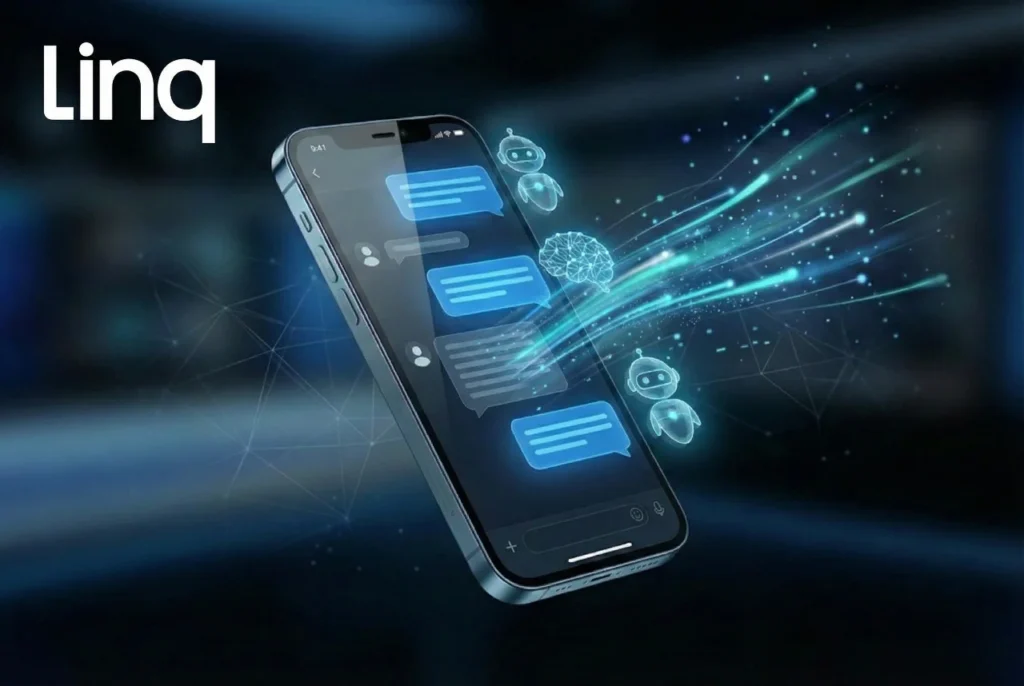
Linq didn’t stumble into AI—it was pulled there by customer demand.
The Birmingham, Alabama–based startup has raised $20 million in Series A funding after discovering that its messaging infrastructure, originally built for sales teams, could quietly become a backbone for the next generation of AI assistants—ones that live where users already are: inside their messaging apps.
The round was led by TQ Ventures, with participation from Mucker Capital and angel investors. Linq did not disclose its valuation.
A pivot hiding in plain sight
Linq began life as a digital business card company. Over time, it evolved into a lead-capture and messaging tool for sales teams. But something unexpected happened when customers started asking for more natural conversations with their users.
Not better automation. Not flashier dashboards.
They wanted messages that felt real.
Traditional business texts—often gray or green, clearly automated—create instant distance. Linq’s customers wanted to communicate inside iMessage, using the same blue bubbles, emojis, group chats, and voice notes people associate with personal conversations.
That insight led Linq to launch a messaging API in early 2025 that allows businesses to communicate natively within iMessage and RCS, rather than through bolted-on SMS layers.
Within months, usage accelerated.
The AI assistant spark
The real shift came when AI companies started knocking.
One of the earliest was an AI assistant called Poke, designed to live entirely inside iMessage—handling tasks, answering questions, and managing calendars without a standalone app. When Poke launched publicly and quickly went viral, Linq saw demand surge almost overnight.
Suddenly, startups building AI agents weren’t asking for sales messaging tools. They wanted infrastructure—something that could let AI interact with users inside iMessage, RCS, and even SMS.
That forced a strategic decision.
From feature to infrastructure
Linq could have stayed focused on its steady B2B revenue stream. Instead, it chose to reposition itself as an infrastructure layer for messaging-native AI.
The bet: people don’t want more apps.
Consumers already spend much of their digital lives inside messaging platforms. If AI is good enough, Linq’s leadership argues, it doesn’t need a new interface—just access to the one users already trust.
Since making that shift, the company says its customer base grew 132% quarter over quarter, with average customer accounts expanding by more than a third. AI agents built on Linq’s platform now reach over 130,000 monthly active users and collectively send tens of millions of messages each month.
Retention, the company claims, has followed suit.
Why investors are paying attention
For investors, Linq’s appeal isn’t just growth—it’s positioning.
Messaging has long been fragmented: SMS here, iMessage there, RCS slowly emerging. Linq is trying to abstract that complexity away, giving developers a single way to reach users across channels without forcing downloads or new workflows.
That makes the company less of an app and more of a layer—one that sits quietly beneath conversational AI products.
TQ Ventures, which led the round, framed the opportunity as enabling “AI-to-human communication as frictionless as texting a friend.”
The risks beneath the surface
Linq’s momentum doesn’t come without constraints.
Much of its current traction depends on Apple’s ecosystem, which the company doesn’t control. Platform policy changes—especially around AI agents—could reshape what’s possible inside iMessage.
There’s also the global picture. While iMessage dominates in the U.S., much of the world lives on WhatsApp, Telegram, Signal, and WeChat. Linq says its roadmap already extends beyond messaging into voice, email, Slack, and other communication layers.
But expansion across platforms means navigating different rules, expectations, and technical limits.
The bigger signal
Linq’s $20 million raise is less about messaging—and more about distribution.
As AI assistants become more capable, the bottleneck is no longer intelligence. It’s access. Linq is betting that the most powerful place to deploy AI isn’t another icon on a home screen, but the same chat thread people already open dozens of times a day.
If that shift holds, the future of AI may arrive quietly—one blue bubble at a time.