AI chat tools have become fast, capable, and widely adopted. What they have not become is persistent.
Most systems still forget who you are the moment a session ends. Preferences disappear. Context resets. Professionals start over.
Manus is trying to change that.
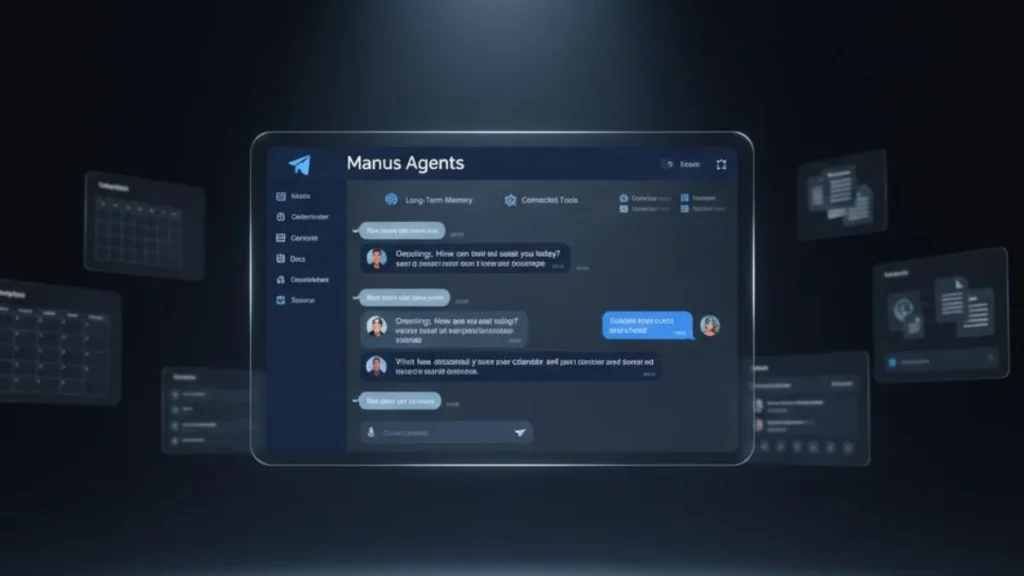
This week, the company introduced Manus Agents, a version of its AI embedded directly inside chat with long term memory, connected productivity tools, and Telegram integration. The release signals a shift in positioning from creative assistant to ongoing digital operator.
The difference is continuity.
Memory That Carries Across Sessions
The core update is persistent memory. Manus says its agents can remember tone, stylistic preferences, and working habits over time.
That matters for professionals who repeatedly refine prompts to match brand voice, slide formatting, or writing structure. Instead of restating instructions, the system is designed to internalize them.
Several major players including OpenAI and Google have introduced variations of memory inside their AI systems. Adoption has been cautious. Users want personalization, but they also want control.
For Manus, the challenge will be balancing context retention with transparency. Users will expect visibility into what is stored and how it can be edited or erased.
Memory increases usefulness. It also increases responsibility.
Introducing Manus Agents — your personal Manus, now inside your chats.
— Manus (@ManusAI) February 16, 2026
👉🏻Long-term memory. Remembers your style, tone, and preferences.
👉🏻Full Manus power. Create videos, slides, websites, images from one message.
👉🏻Your tools, connected. Gmail, Calendar, Notion, and more.… pic.twitter.com/QVro5O9qP3
Telegram Becomes Part of the Workflow Layer
Beyond Gmail, Calendar, and Notion, Manus has confirmed Telegram integration as part of its connected ecosystem.
This is a notable move.
Email integration is common across AI tools. Messaging integration is less standard and more operationally complex. By connecting to Telegram, Manus positions its agent closer to real time communication rather than static document production.
In practical terms, this could allow users to trigger tasks from Telegram conversations, receive generated outputs inside chat, or coordinate deliverables without leaving messaging threads.
The company has not detailed the full scope of Telegram functionality, including permission controls or enterprise compliance standards. Those details will matter for teams operating in regulated environments.
Still, the strategic direction is clear. Manus wants its agent embedded where conversations already happen.
From Prompt To Deliverable In One Step
Manus continues to emphasize its ability to generate videos, slides, websites, and images from a single instruction.
The technical claim is not new. What changes with Agents is execution continuity.
Instead of generating an isolated asset, the agent can theoretically remember prior preferences, connect to tools, and distribute or log outputs across systems.
That positions Manus inside a broader industry shift.
The first wave of generative AI focused on creation speed. The second wave is focused on integration and execution.
Professionals are no longer impressed by output alone. They want systems that reduce switching costs between apps.
Competitive Landscape Is Tightening
The field is crowded.
Microsoft is embedding AI into its productivity suite. Google is expanding AI across Workspace. OpenAI continues to layer memory and tool use inside ChatGPT.
Manus is taking a different angle. It began as a creation focused system and is now layering workflow connectivity on top.
That approach may appeal to founders, product managers, and creators who want fewer fragmented tools. Enterprise buyers, however, will evaluate stability, compliance readiness, and vendor durability before adopting deeply integrated agents.
The market no longer rewards novelty alone.
Execution Risk Is Real
Persistent AI agents connected to messaging platforms introduce real operational questions.
How is memory stored
How can users edit or delete stored context
How are Telegram permissions scoped
What happens when automated actions fail
The industry has already seen ambitious agent demonstrations struggle under real world complexity. Multi step execution often breaks at edge cases.
If Manus can deliver reliability alongside integration, it strengthens its position. If not, it risks being perceived as another ambitious but fragile layer.
Trust will determine adoption.
Why The Timing Matters
AI adoption has matured over the past year.
Early excitement centered on faster writing and creative output. Now the conversation is shifting toward workflow compression. Professionals want fewer steps, fewer tabs, fewer repeated prompts.
Telegram integration suggests Manus is aligning itself with conversational infrastructure rather than browser isolated productivity.
That is strategically smart.
Messaging platforms increasingly function as lightweight operating systems for distributed teams. Embedding AI into that layer brings it closer to daily execution rather than occasional drafting.
But messaging also raises expectations around responsiveness and accuracy. Errors feel more visible inside communication channels than inside private draft tools.
What I Will Be Watching Next
The promise of Manus Agents is clear. Persistent memory plus connected execution inside chat.
The open question is durability.
Does memory meaningfully improve results over weeks of usage
Does Telegram integration operate smoothly under active team conditions
Does the company provide clear governance controls for sensitive environments
This launch reflects a broader shift in AI product design. Chat is no longer just an interface for answers. It is becoming a potential control layer for work.
Whether Manus can turn that ambition into dependable infrastructure will determine how far this release goes.
For now, the direction is unmistakable. AI agents are moving from content tools to workflow participants.