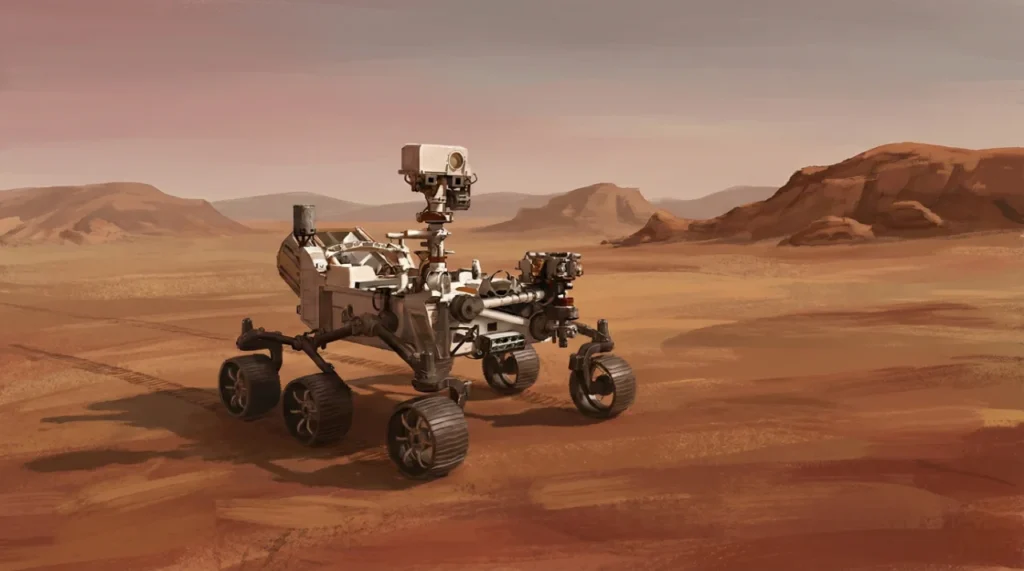
NASA’s Perseverance rover has successfully completed the first AI-planned drives on Mars, marking a milestone in the use of artificial intelligence for autonomous space exploration. The rover executed routes generated with the help of generative AI in December after engineers reviewed, tested, and approved the plans on Earth.
The test demonstrated that AI-assisted planning can sharply reduce the time required to move a rover across the Martian surface, a process traditionally slowed by the roughly 20-minute communication delay between Earth and Mars. NASA officials said the approach could allow future missions to travel farther and conduct more scientific work within the same mission lifespans.
In the slow, methodical world of planetary exploration, December 2025 may come to be seen as a quiet turning point.
On December 8 and again on December 10, Perseverance rolled across Mars following paths that no human directly mapped point by point. Instead, those routes were initially generated by a generative AI system, then refined and validated by engineers before being sent to the rover. The total distance—456 meters—was modest by rover standards. The significance lay elsewhere.
For the first time, artificial intelligence did not merely analyze Martian data after the fact. It helped decide how a robot should move on another planet.
On December 8, the Perseverance rover safely trundled across the surface of Mars.
— Anthropic (@AnthropicAI) January 30, 2026
This was the first AI-planned drive on another planet. And it was planned by Claude. pic.twitter.com/kVbdKWibuP
Why rover movement has always been a bottleneck
Driving a rover on Mars is far more complex than it appears from images sent back to Earth.
Because commands cannot be sent in real time, engineers at Jet Propulsion Laboratory must plan each drive in advance, accounting for rocks, slopes, sand traps, and the rover’s mechanical limits. That planning often takes days for movements measured in tens of meters. The caution is deliberate: a single miscalculation can end a mission worth billions of dollars.
This careful process has long constrained how much science rovers can accomplish. Every hour spent planning a drive is an hour not spent analyzing samples, exploring new terrain, or responding to unexpected discoveries.
What AI changed in this test
For this experiment, JPL engineers supplied a generative AI model—Claude, developed by Anthropic—with high-resolution orbital imagery, elevation data, and rover performance constraints. The system generated candidate routes that met NASA’s safety requirements.
Crucially, the AI was not given free rein. Engineers reviewed the proposed paths, made adjustments, and tested them in simulation before uploading the commands. Perseverance then executed the drives without incident.
Vandi Verma, who leads autonomy research at JPL, described the effort as a first-of-its-kind demonstration of AI working within tightly controlled operational boundaries rather than replacing human judgment.
Less about autonomy, more about tempo
The importance of the test is not that AI “drove” on Mars. It didn’t.
The real breakthrough is speed.
If AI can reliably compress days of route planning into hours, missions gain something more valuable than novelty: time. Faster planning means more frequent drives, greater flexibility, and the ability to reach more scientifically interesting locations before hardware degrades or funding windows close.
NASA Administrator Jared Isaacman said the approach could enable future missions to go farther while making better use of limited mission lifespans—a practical benefit in an era of rising launch and operations costs.
A preview of future exploration
The implications extend well beyond Perseverance.
As missions venture farther from Earth—to the Moon’s south pole, near-Earth asteroids, or eventually Mars with human crews—communication delays will increasingly limit Earth-based control. Systems that can plan, assess risk, and adapt locally will become essential infrastructure, not experimental add-ons.
This test also highlights a broader trend in how AI is being deployed in high-risk environments. Rather than acting as an independent decision-maker, the system was constrained by decades of engineering knowledge and safety rules. That combination—large models guided by hard operational limits—is where AI becomes useful rather than reckless.
A small drive with long consequences
There were no dramatic discoveries announced alongside the test. No new images of ancient riverbeds or tantalizing chemical signatures.
Instead, Perseverance simply moved—quietly, safely, and efficiently—along a path first proposed by a machine.
In space exploration, that is often how real change begins. Not with spectacle, but with a new capability proving it can be trusted. December’s AI-planned drive may look minor on a map of Mars, but it signals a shift in how future missions will think, move, and explore.
Mars did not just take another step forward.
It took its first steps planned with artificial intelligence.