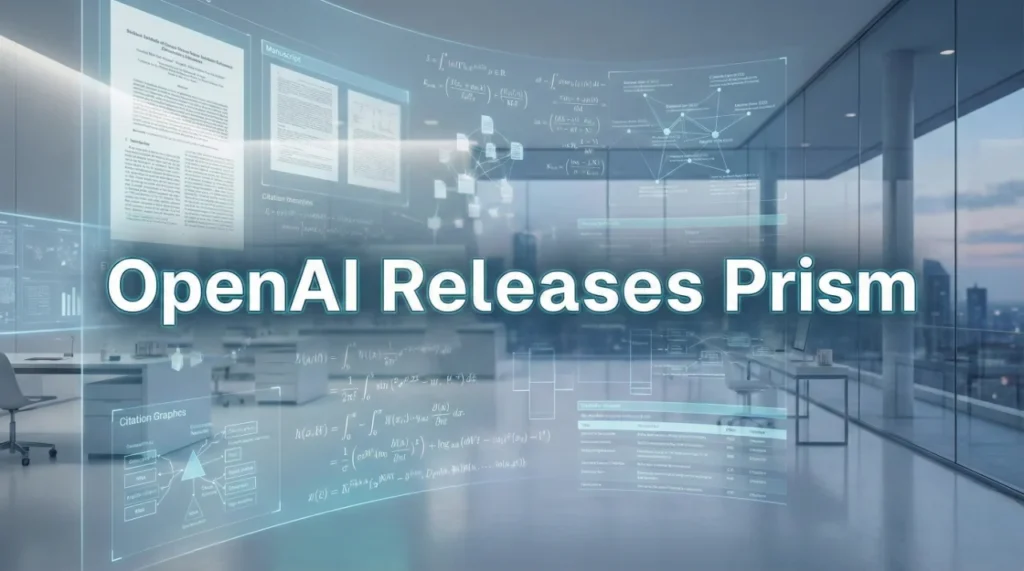
OpenAI has launched Prism, a new AI-native workspace designed to modernize how scientists write, collaborate, and prepare research for publication. At first glance, it looks like a productivity upgrade. In reality, Prism points to something deeper: a long-overdue rethink of the invisible workflows that quietly shape scientific progress.
For all the breakthroughs science delivers—from lifesaving medicines to climate models—the way research is actually written and coordinated has barely evolved. Behind every polished journal paper is a familiar grind: juggling LaTeX files, chasing down citations, emailing drafts back and forth, and switching endlessly between tools that don’t talk to each other. Innovation has surged in laboratories and data centers, yet the daily mechanics of scientific work have remained stubbornly old-fashioned.
The Hidden Bottleneck in Modern Science
Scientific progress is often described as a race for better models, faster experiments, or more powerful computers. Less attention is paid to the unglamorous middle layer—drafting, revising, coordinating, and validating research before it ever reaches peer review.
Most researchers still work across a patchwork of tools: a LaTeX editor here, PDFs there, a reference manager in another window, and an AI chatbot sitting off to the side with no real awareness of the project as a whole. Each context switch breaks focus. Each manual merge introduces friction. Over time, these inefficiencies quietly slow the pace of discovery.
AI has already shown it can accelerate reasoning in areas like mathematics, biology, and data analysis. What it hasn’t fully touched—until now—is the workflow glue that holds research together.
What Prism Changes—and Why It’s Different
Prism isn’t positioned as “AI that helps you write sentences faster.” Its ambition is structural. The platform brings drafting, equations, citations, figures, and collaboration into a single cloud-based, LaTeX-native environment, with advanced AI embedded directly inside the document itself.
Instead of copying text into a chat window and pasting revisions back, researchers work with an AI that understands the paper as a whole—its structure, its references, its mathematical logic, and how each part connects. The system can reason about equations in context, refactor sections without breaking citations, and even convert hand-drawn equations or diagrams into clean LaTeX.
That may sound incremental, but in practice it removes hours of mechanical labor from every paper. More importantly, it keeps researchers mentally “inside” the problem they’re solving, rather than managing the tools around it.
Collaboration Without the Usual Pain
Scientific writing is rarely a solo act. Papers evolve through conversations with co-authors, students, advisors, and reviewers—often spread across time zones and institutions. Yet collaboration tools in academia have lagged behind those used in modern software teams.
Prism leans into real-time collaboration with no seat limits, no local installations, and no version-control gymnastics. Everyone works in the same environment, seeing changes as they happen. The result isn’t just convenience; it’s fewer errors, fewer conflicts, and faster consensus.
For large, interdisciplinary teams—now common in fields like AI, genomics, and climate science—that reduction in friction could be transformative.
Access Matters More Than Features
One of Prism’s most striking choices isn’t technical—it’s economic. The platform is free to use, with unlimited projects and collaborators for anyone with a personal ChatGPT account. In a research world often divided by institutional budgets and software licenses, that matters.
Graduate students, independent researchers, and scientists at underfunded institutions gain access to the same high-quality tools as those at elite labs. That kind of leveling doesn’t just feel fair; it has practical consequences for who gets to contribute to scientific discourse and whose ideas reach publication.
More advanced capabilities will eventually live behind paid plans, but the core message is clear: participation shouldn’t depend on procurement approvals.
Why This Moment Is Different
The timing isn’t accidental. In 2025, AI reshaped software development by collapsing the distance between intent and execution. In 2026, science appears poised for a similar inflection point.
The next wave of acceleration won’t come solely from better models or bigger datasets. It will come from reducing the everyday friction that slows researchers down—draft by draft, revision by revision. Prism represents an early but concrete step in that direction.
It doesn’t replace scientific judgment. It doesn’t automate discovery. What it does is clear the underbrush, giving researchers more uninterrupted time to think, argue, and test ideas.
The Bigger Implication
If tools like Prism succeed, the long-term impact may extend beyond productivity. Faster iteration in writing means faster feedback. Better collaboration means stronger papers. Lower barriers mean more voices in the conversation.
Over time, that could subtly change the culture of science itself—making it more open, more iterative, and more responsive to new ideas.
Prism won’t revolutionize science overnight. But by modernizing one of its most neglected layers, it signals where the future is headed, not just smarter machines, but smarter ways for humans to work together to push knowledge forward.