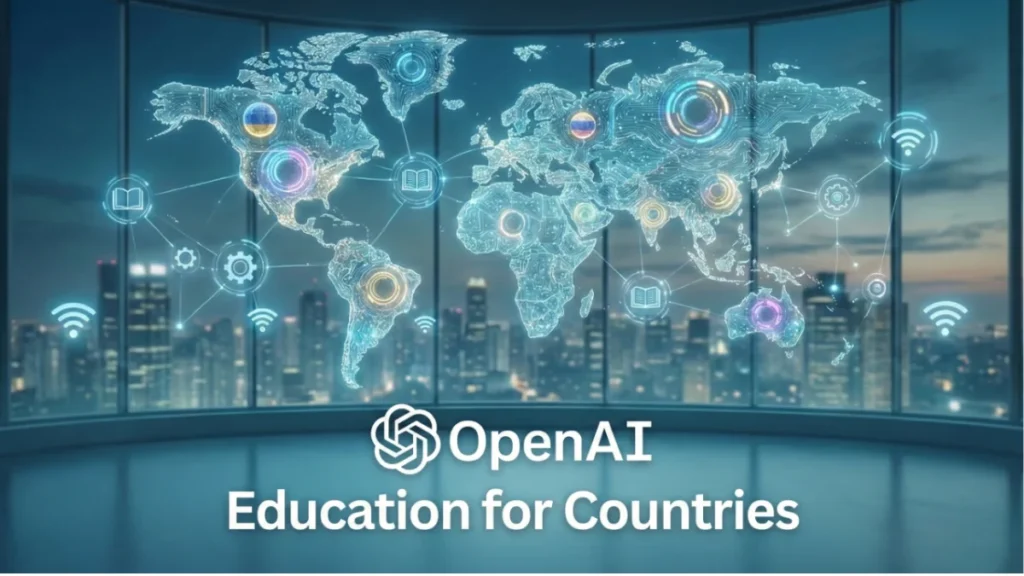
OpenAI is rolling out a new global initiative aimed squarely at governments: Education for Countries, a program designed to embed AI tools directly into national education systems and workforce pipelines.
The move signals a shift in OpenAI’s strategy—from selling AI tools to individuals and enterprises, to helping countries modernize how they teach, train, and reskill entire populations for an AI-driven economy.
Why This Matters
For all the hype around AI, there’s a growing gap between what the technology can do and how people actually use it. Economists often call this a “capability gap”—and education systems are where that gap either closes or widens.
OpenAI is positioning Education for Countries as a way to turn AI from an optional add-on into core infrastructure, much like electricity or the internet once were for schools and universities.
What OpenAI Is Offering Governments
Unlike smaller pilot programs, this initiative is designed to scale nationally. Participating countries get access to:
- AI learning tools, including ChatGPT Edu and OpenAI’s latest models, customized to local curricula
- Teacher and student training, tied to national workforce priorities
- AI certifications, meant to signal real-world job readiness
- Large-scale research, tracking how AI affects learning outcomes and teacher productivity
The pitch is simple: don’t just introduce AI—measure it, govern it, and align it with economic goals.
The First Countries In
OpenAI’s first cohort spans Europe, the Middle East, Central Asia, and the Caribbean. Participating governments include Estonia, Greece, Italy (via its national university consortium), Jordan, Kazakhstan, Slovakia, Trinidad and Tobago, and the United Arab Emirates.
That geographic spread hints at OpenAI’s broader ambition: this isn’t a Silicon Valley experiment. It’s a global policy play.
Estonia as the Test Case
Estonia is already acting as a proof point.
The country has deployed ChatGPT Edu nationwide across public universities and secondary schools, reaching more than 30,000 students and educators in its first year, according to OpenAI. What’s notable isn’t just the scale—it’s the scrutiny.
Estonian researchers, working with international academic partners, are running long-term studies to track how AI tools actually change learning, not just test scores but productivity, engagement, and classroom dynamics.
That research-first approach could shape how other governments decide whether AI belongs in classrooms—or needs tighter limits.
A Careful Rollout, Not a Free-for-All
OpenAI says national deployments follow a phased model. Teachers are trained first. University students get access before younger learners. High school use starts with tightly controlled pilots, aligned with local curricula and safety standards.
The company is also working with child-safety and education groups to build age-appropriate safeguards and AI literacy materials, acknowledging growing concerns about how generative AI affects young users.
A Bigger Bet on Workforce Readiness
Education for Countries also doubles as a workforce strategy.
As AI reshapes jobs faster than traditional retraining systems can adapt, OpenAI is pitching standardized AI certifications as a bridge between education and employment—giving employers clearer signals about who can actually work with AI tools, not just talk about them.
What Happens Next
OpenAI says more countries will join the program in 2026. If adoption accelerates, Education for Countries could become a blueprint for how AI moves from consumer tech into public systems—quietly, structurally, and at national scale.
For OpenAI, the message is clear: the future of AI adoption may depend less on apps and more on classrooms.
Conclusion
This isn’t just about smarter homework help. It’s about who controls the skills pipeline in an AI-shaped economy—and OpenAI wants a seat at that table.