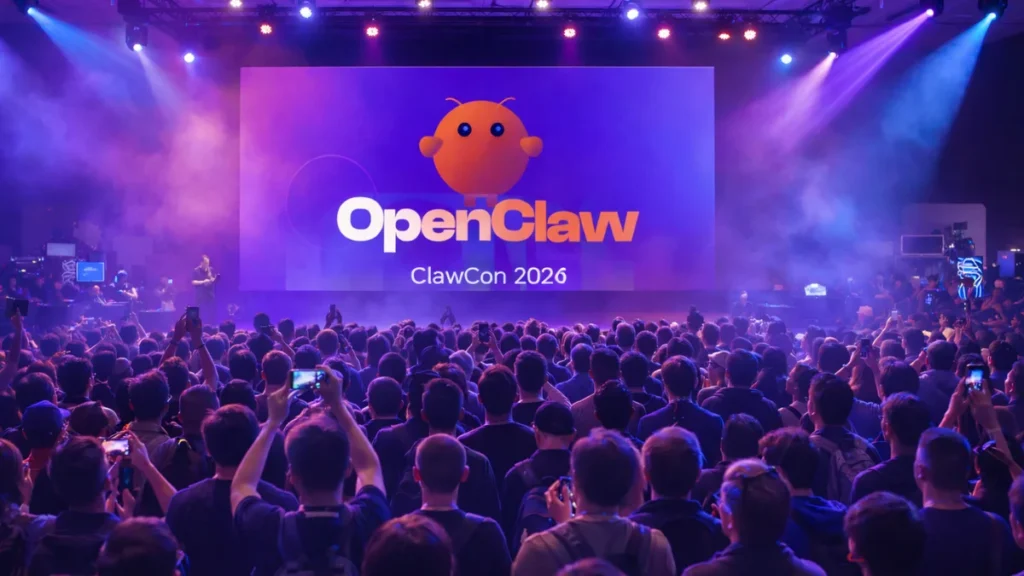
San Francisco saw something unusual this week: a developer conference that felt less like a corporate product launch and more like a grassroots rally. ClawCon, the first major gathering around the open-source AI agent OpenClaw, drew more than 750 people eager to prove that powerful AI doesn’t have to live in the cloud—or belong to a tech giant.
The event mattered not because of flashy announcements, but because it signaled a growing shift in how developers and businesses are thinking about AI ownership, security, and control.
A Different Kind of AI Crowd
ClawCon didn’t look or feel like the polished conferences typically hosted by Big Tech. Attendees came to show, not just listen. Laptop demos ran side by side with physical robots. Developers swapped notes on agent workflows while others showcased chat rooms where autonomous agents coordinated tasks in real time.
The common thread: everything ran locally. OpenClaw is designed to operate on personal laptops or private servers, handling everyday tasks like managing inboxes, booking travel, or controlling apps through messaging platforms—without sending sensitive data to a remote cloud.
That design choice has become the project’s calling card. In an era where AI tools increasingly depend on centralized infrastructure, OpenClaw’s local-first approach is resonating with a community wary of data exposure, vendor lock-in, and opaque systems.
How OpenClaw Reached This Moment
OpenClaw didn’t emerge from a corporate lab. It grew the old-fashioned open-source way: fast iterations, community contributions, and a focus on solving practical problems. Over time, the project gained traction among developers who wanted more autonomy over their AI tools.
That momentum was on full display at ClawCon. The project recently crossed 100,000 stars on GitHub, a milestone that places it among the most watched open-source AI projects in the world. For seasoned engineers, that number is more than vanity—it reflects sustained engagement and trust from a global developer base.
The timing also matters. As enterprises reassess how much data they’re comfortable sending to third-party AI services, locally run agents are no longer a niche idea. They’re becoming a strategic alternative.
Security and Ecosystem, Not Just Features
One of the most closely watched moments at ClawCon wasn’t a new capability demo, but an organizational announcement. Project founder Steinberger confirmed a dedicated security hire—an acknowledgment that scale brings responsibility.
At the same time, OpenClaw introduced ClawHub, a curated space for sharing vetted plugins. For open-source veterans, this move speaks volumes. Plugin ecosystems can be both a strength and a vulnerability. By adding moderation and verification, the project is signaling that it wants growth without chaos.
This is the kind of detail insiders notice. It’s not about flashy AI tricks; it’s about building infrastructure that can support real-world use without falling apart under scrutiny.
Why This News Matters
For developers, OpenClaw represents a credible path toward AI tools they can fully inspect, modify, and run on their own terms. That’s a sharp contrast to closed systems where model behavior, data handling, and long-term costs remain largely out of their control.
For businesses, especially small and mid-sized ones, local AI agents offer a way to automate workflows without introducing new compliance risks. Running agents on internal servers can simplify data governance and reduce reliance on external vendors.
For the broader tech ecosystem, ClawCon’s turnout challenges a prevailing assumption: that meaningful AI innovation must be driven by billion-dollar platforms. The crowd in San Francisco suggested otherwise.
Reading Between the Lines
What stood out wasn’t just the attendance count, but the diversity of use cases. Physical robots, productivity agents, and messaging-based controls all pointed to a community experimenting beyond simple chat interfaces.
There’s also a cultural signal here. The informal atmosphere—complete with sponsor-funded pizza and lobster rolls—felt intentional. It reinforced the idea that this is a builder-led movement, not a polished marketing exercise.
That distinction matters. Open-source projects often struggle when popularity outpaces governance. By prioritizing security roles and a controlled plugin hub early, OpenClaw appears to be learning from past mistakes made by other fast-growing platforms.
What Comes Next
OpenClaw’s trajectory will hinge on whether it can maintain its local-first philosophy while scaling responsibly. Success could accelerate a broader trend toward decentralized AI tools, especially as regulatory scrutiny around data usage intensifies.
There are risks. Running AI locally still demands technical expertise, and performance can lag behind cloud-based systems with massive compute resources. Skeptics will argue that convenience will always win.
But ClawCon suggested a counterpoint: for a growing segment of users, control, transparency, and trust are worth the trade-offs.
If that sentiment continues to spread, OpenClaw may be remembered not just for its code, but for helping redefine what “mainstream” AI looks like.