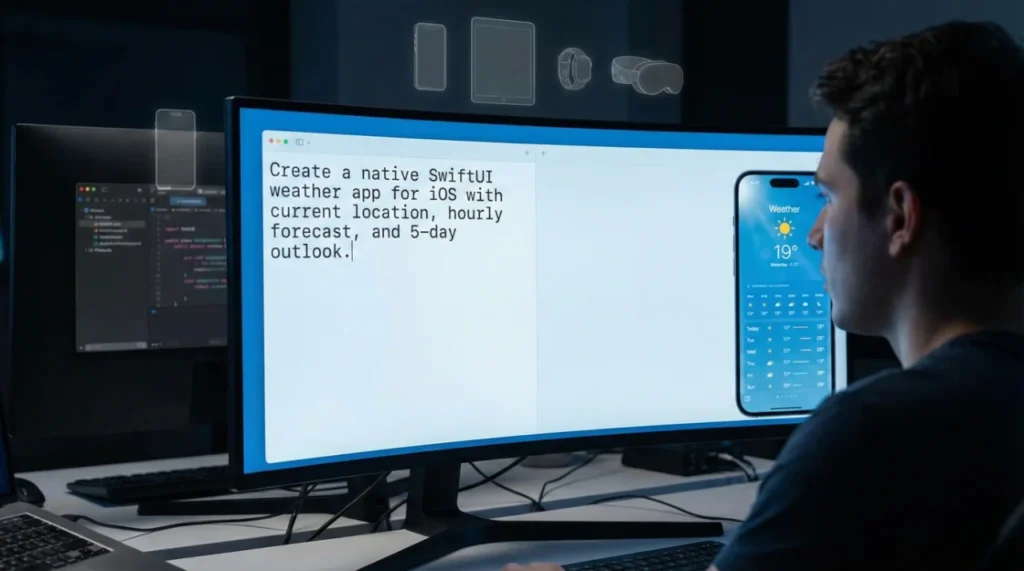
Rork Max, the new AI app builder from startup Rork, launched this week with a bold claim: generate and ship native Apple apps from a single natural language prompt. Announced on X on February 19, the web-based tool promises to turn plain English descriptions into SwiftUI apps for iPhone, iPad, Apple Watch, Apple TV, and Vision Pro, then install them with one click or submit to the App Store in two.
Rork says Rork Max replaces Xcode entirely. Instead of running Apple’s development environment locally, users type a description into a browser. The system writes Swift code, compiles it on cloud-hosted Macs, streams a live simulator with real-time touch input, and prepares the build for device install or App Store submission.
The core claim is not just code generation. It is production-ready native output at 60 frames per second, with full access to Apple APIs, including AR and 3D frameworks. If it works as advertised, that shifts AI app generation from toy prototypes to something closer to shippable software.
From Cross-Platform to Native Swift
Rork previously focused on cross-platform development. With Rork Max, the company has pivoted to fully native Swift and SwiftUI. That matters.
Cross-platform AI app builders often rely on web wrappers or generic runtimes, which can limit performance and restrict access to Apple’s newest APIs. Rork’s pitch is that native Swift unlocks smoother animations, better battery efficiency, and deeper integration with hardware features such as ARKit, Vision Pro spatial computing, and Apple Watch sensors.
In demos shared by the company, Rork Max generates AR games, 3D worlds, flight tracking dashboards, and consumer utility apps. The company also says early users built tools such as watermark-free TikTok downloaders in under an hour.
Under the hood, Rork Max is powered by Swift, along with Claude Code and Opus 4.6 for AI generation. The company raised $2.8 million to fund development, though it has not disclosed pricing for Rork Max in its launch materials.
Xcode Replacement Claim
Calling any tool an Xcode replacement is a direct challenge to Apple’s developer stack.
Xcode is deeply integrated into Apple’s ecosystem, including code signing, provisioning profiles, simulator environments, and TestFlight distribution. Rork Max claims to abstract all of that into a browser workflow. Users describe the app they want. The system generates SwiftUI code, compiles it on remote Macs, and handles packaging and distribution steps.
If accurate, this lowers the technical barrier significantly. Non-developers or designers could, in theory, ship native Apple apps without ever installing a development environment.
The question is how far that abstraction can go.
For simple utilities, content apps, or AR demos, AI-assisted SwiftUI generation is increasingly viable. But complex production apps with custom networking layers, security requirements, backend integrations, and long-term maintenance demands are a different category.
That is where skepticism enters.
Competitive Landscape
Rork Max enters a crowded AI coding market.
Tools like Replit’s AI agent, GitHub Copilot extensions, and emerging browser-based IDEs already offer code generation. On the Apple-specific side, several no-code and low-code platforms claim App Store deployment. What differentiates Rork is the focus on native Swift from the start, plus the promise of cloud compilation and frictionless publishing.
The competitive question is defensibility. Is the moat the AI model layer, the cloud Mac infrastructure, or workflow design?
Large incumbents can replicate AI code generation features. Cloud-based Mac build farms are also not novel. The potential edge for Rork lies in tightly integrating natural language generation with Apple’s evolving frameworks and managing the compliance and submission pipeline seamlessly.
If Apple itself expands AI-assisted development within Xcode, smaller players like Rork could face immediate pressure.
Product Reality Check
The most important issue is whether Rork Max produces maintainable code.
AI-generated SwiftUI can look correct in demos. But production apps require structured architecture, testing, dependency management, and long-term updates. Developers will want to know:
Does Rork Max expose the generated code fully?
Can teams refactor and extend it?
How does it handle edge cases and App Store review rejections?
What happens when Apple updates APIs?
The company emphasizes one-click installs and two-click App Store submissions. That is compelling for speed. It is less clear how much control advanced teams retain.
Without transparent benchmarks or documented case studies beyond early demos, enterprises may treat this as a rapid prototyping tool rather than a core development platform.
Why Now
Timing is not accidental.
Interest in AI coding agents has surged, and Apple’s ecosystem is expanding with Vision Pro and deeper AR use cases. At the same time, SwiftUI has matured enough to support a broad range of apps with relatively concise code.
Rork is betting that natural language to native app generation is now technically feasible and that developers are ready to trade some control for speed.
Investors will notice the positioning. A $2.8 million raise is modest by AI standards, suggesting early-stage validation rather than aggressive scale. The company needs proof that developers will pay for a browser-based development workflow and trust it with App Store submissions.
Real Bottleneck
Here is the editorial angle that matters most: developer trust.
AI coding tools can generate features. The harder problem is ownership and reliability. If something breaks in production, who debugs it? If App Store review flags privacy issues, who fixes them? If Apple deprecates an API, who updates the architecture?
Rork Max may reduce friction at the front end of development. But the back half of the lifecycle, maintenance, compliance, scaling, security, remains a human responsibility.
For indie developers experimenting with AR or Vision Pro apps, this could be a powerful accelerator. For larger teams with strict code review and compliance requirements, it will need to prove stability over time.
What Comes Next
The next milestone to watch is real-world App Store traction.
If apps built entirely through Rork Max begin ranking, monetizing, or scaling without major quality issues, that will validate the platform’s claim of production readiness. If usage stalls at demo-grade apps, the narrative will shift to rapid prototyping rather than Xcode replacement.
Developers and investors should pay attention to how transparent Rork becomes about pricing, code ownership, and long-term support. Those details will determine whether Rork Max is a short-term AI novelty or the beginning of a new development workflow inside Apple’s ecosystem.