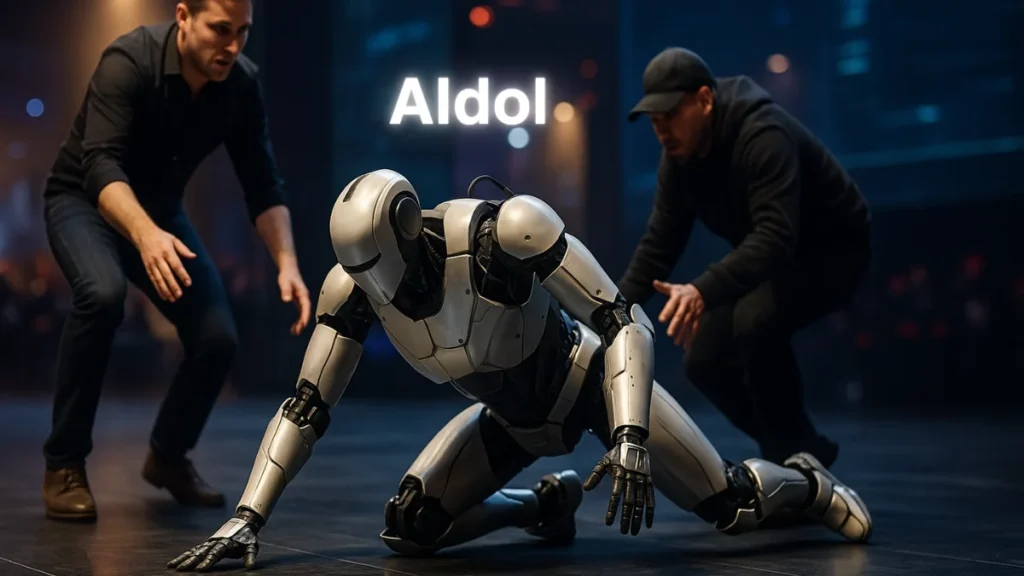
It was supposed to be a showcase of Russian AI might. Instead, it turned into a meme.
During its official debut in Moscow on November 10, a humanoid robot named AIdol—billed as a breakthrough in domestic robotics—took a few steps to the Rocky soundtrack, wobbled, and crashed to the floor. Staff rushed to hide the machine behind a screen as camera phones captured the moment for the internet’s eternal loop.
Key Takeaways
- Russia’s humanoid robot AIdol fell on stage during its Moscow debut.
- Developers blame calibration issues and insist the robot is still in testing.
- The machine is 77% Russian-made, aiming for 93% in future builds.
- The stumble triggered ridicule online—and a reality check for Russia’s AI push.
At its Moscow debut, Russia’s humanoid robot AIdol fell mid-walk, prompting developers to hide it from view. Idol Robotics says the mishap was due to calibration issues, stressing that the AI-powered humanoid remains in testing.
Inside the Fall: A Showcase Turned Spectacle
AIdol’s unveiling was meant to symbolize a leap forward in Russia’s robotics race—a humanoid machine with expressive silicone skin, 19 servomotors, and what its creators call embodied artificial intelligence.
But when the 48-volt robot lost its footing under the stage lights, the symbolism flipped. As it slumped to the floor, pieces scattered, and the handlers—more human than their creation—scrambled to drag it off. Within minutes, clips flooded Russian Telegram channels, then Twitter/X, then Reddit.
By afternoon, “AI-dol flop” was trending.
The Technology Behind the Tumble
According to Vladimir Vitukhin, CEO of Idol Robotics, AIdol’s fall was “a calibration issue” that surfaced mid-demo. He framed it as a teachable moment rather than a failure:
“This is real-time learning, when a good mistake turns into knowledge, and a bad mistake turns into experience.”
The robot, Vitukhin explained, is still in its test phase—a working prototype built from 77 percent domestically sourced components, running on a 48-volt battery that can power up to six hours of operation.
AIdol’s design includes 19 servomotors for facial expressions and “over a dozen basic emotions,” along with hundreds of micro-expressions. Idol’s engineers claim its silicone skin mimics real human texture and muscle firmness—part of what they call “emotional fidelity.”
In short: it’s a complex machine still learning how to stand.
The Bigger Picture: A Global Robotics Reality Check
The spectacle in Moscow wasn’t just a technical glitch—it was a geopolitical metaphor.
Russia’s AI sector has been racing to prove domestic capability amid sanctions and limited access to Western hardware. AIdol was positioned as proof that Russia can build human-like robots from mostly local components.
But the fall underscored what even robotics leaders like Boston Dynamics and Figure know well: balance is brutal. The smallest misalignment in torque, latency, or calibration can topple a multimillion-dollar machine.
“Humanoid robots are incredibly complex systems,” said one robotics engineer quoted in BoingBoing, “and even the most advanced teams fail dozens of times before they succeed.”
Public Reaction: From Pride to Parody
On Russian social platforms, responses veered between sympathy and sarcasm.
“Even our robots want to lie down,” one user wrote on Telegram. Another quipped: “The AI understood the economy.”
Others defended Idol Robotics, arguing that early-stage prototypes are supposed to fail. As one developer posted on VKontakte, “If it didn’t fall, it wouldn’t be learning.”
Still, the optics were rough: a moment meant to project technical dominance instead fed global headlines about a “falling robot.”
Why It Matters
AIdol’s stumble won’t derail Russia’s robotics ambitions—but it exposes the tension between showmanship and engineering reality.
Humanoid robotics remains one of the hardest challenges in modern AI. Success takes years of iteration, enormous capital, and access to precision components—factors Russia’s tech ecosystem continues to chase.
The question now isn’t whether AIdol can stand up again—but whether Russia’s robotics sector can.
Conclusion
AIdol’s fall wasn’t just mechanical—it was symbolic.
Russia tried to prove it could build a homegrown humanoid powered by AI. Instead, it reminded the world how far even advanced nations still are from truly human-like machines.
The next time AIdol walks, the stakes won’t just be about balance—it’ll be about credibility.