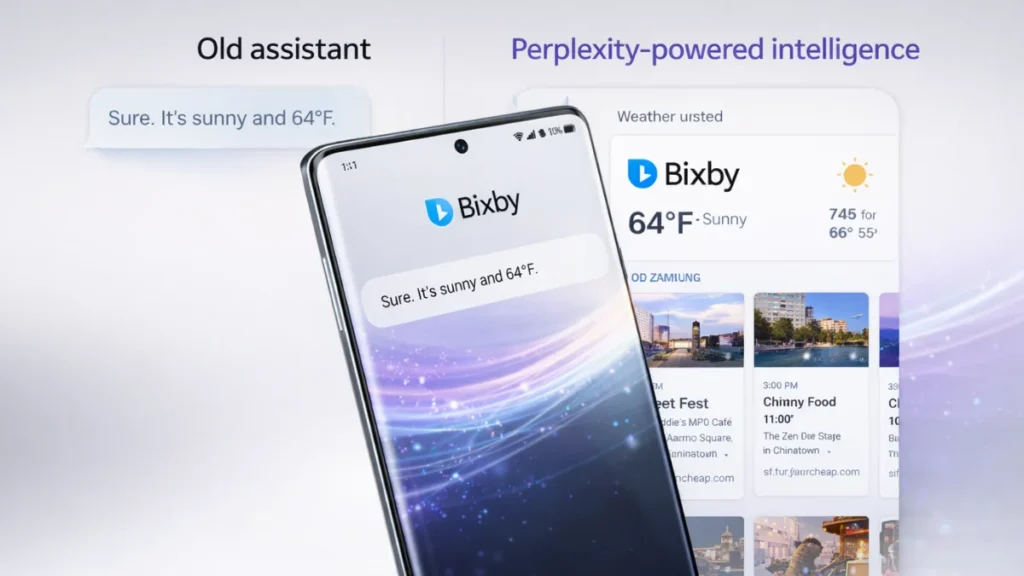
For a long time, Bixby was Samsung’s most stubborn bet: deeply embedded, widely ignored.
Now, that’s starting to change. Samsung is quietly testing a revamped version of Bixby that taps Perplexity AI for answers — a move that gives the assistant something it’s always lacked: real-time intelligence.
The upgrade has appeared in early builds of One UI 8.5, according to beta users and screenshots circulating online. In those examples, Bixby delivers contextual, web-aware responses that look far closer to an AI research assistant than a scripted voice bot.
That’s a meaningful shift.
Instead of trying to outbuild rivals like Gemini with its own models, Samsung appears to be taking a hybrid approach — keeping Bixby as the system-level interface while outsourcing the “thinking” to a specialized AI partner. It’s a strategy that echoes Apple’s recent decision to fold ChatGPT into Siri rather than replace it outright.
The advantage for Samsung is control. Bixby already sits deep inside Galaxy devices, with access to system settings, native apps, and device-level actions that third-party assistants often struggle to reach. Pair that access with Perplexity’s live web retrieval and research-style answers, and Bixby suddenly looks far more capable than its reputation suggests.
This isn’t Samsung’s first time experimenting with Perplexity, either. The company has already integrated Perplexity-powered Bixby features into select smart home products, including connected refrigerators with large touchscreens. On phones, Galaxy users in the U.S. have previously received free Perplexity subscriptions — but only through the standalone app. Native assistant integration is a much bigger leap.
What remains uncertain is how far Samsung plans to push this. The Perplexity-backed responses currently appear limited to beta software, and Samsung hasn’t confirmed whether the upgrade will roll out broadly or arrive as a headline feature on future Galaxy flagships. It’s also unclear whether Perplexity will handle all Bixby queries or only complex, web-dependent ones.
Still, the direction is hard to miss.
As AI assistants shift from novelty features to core smartphone infrastructure, Samsung seems unwilling to surrender that role entirely to Google. Instead, it’s betting that users don’t care who provides the intelligence — as long as the answers are fast, relevant, and actually useful.
Bixby may never become the most loved assistant on Android. But with Perplexity in the loop, it might finally become one people stop turning off.
Conclusion
Samsung isn’t trying to make Bixby famous. It’s trying to make it competent — and that may be the smarter play.