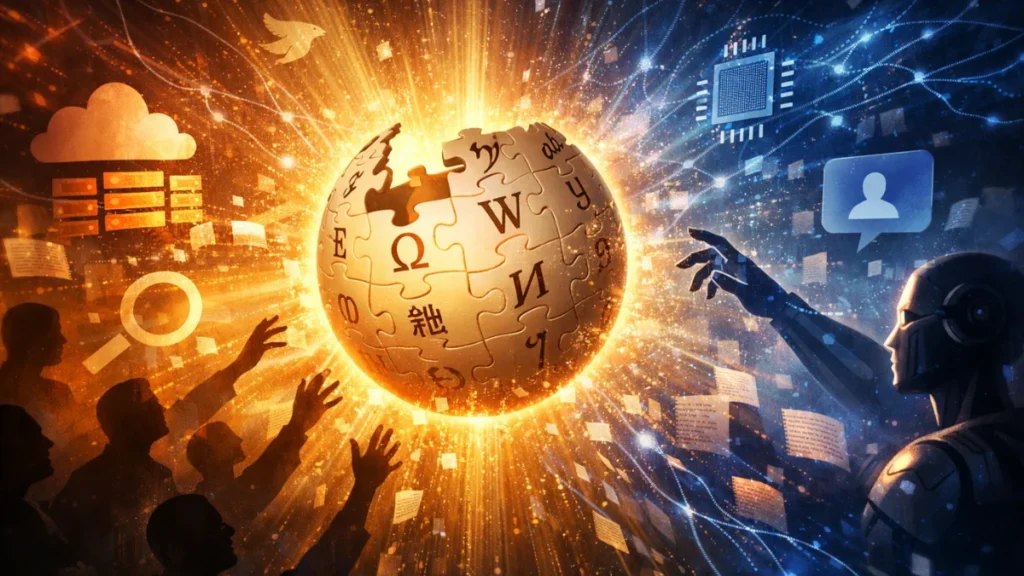
Wikipedia is changing how the AI industry taps into the world’s largest open encyclopedia—and it’s doing it on its own terms.
The Wikimedia Foundation, the nonprofit behind Wikipedia, has confirmed that it has signed paid data-access agreements with a slate of major AI companies, including Amazon, Meta, Microsoft, Mistral AI, and Perplexity.
The deals, finalized over the past year but disclosed publicly this week, give AI developers structured access to Wikipedia’s data through Wikimedia Enterprise—marking a clear pivot away from the long-standing norm of unrestricted web scraping.
From open scraping to paid pipelines
For more than a decade, Wikipedia has been one of the most heavily scraped sites on the internet. Its articles—written, edited, and maintained by human volunteers—have quietly become foundational training material for large language models.
Now, Wikimedia is drawing a line.
Instead of allowing AI companies to pull content indiscriminately, the organization is offering paid, API-based access that delivers cleaner data, predictable updates, and clearer governance. The goal, Wikimedia says, is to ensure that human-curated knowledge is used responsibly—and that the infrastructure supporting it remains sustainable.
“All these organizations are integrating human-governed knowledge into their platforms at scale,” Wikimedia said in its announcement.
Who’s already on board
The newly revealed partners join an existing group that includes Ecosia, Pleias, ProRata, and Google, which became one of Wikimedia Enterprise’s first major customers in 2022.
Collectively, these companies use Wikipedia data to power everything from AI chatbots and search tools to voice assistants and summarization engines. While financial terms were not disclosed, the signal is clear: high-quality, human-reviewed data now carries a price tag in the AI economy.
Why Wikipedia’s move matters right now
The timing isn’t accidental.
As generative AI adoption accelerates, data rights have become one of the industry’s most sensitive fault lines. Media companies, publishers, and online communities are increasingly questioning whether their content should be freely consumed by AI models—or licensed like any other valuable asset.
Wikipedia occupies a unique position in that debate. It remains free for readers, openly editable, and nonprofit-driven. But its decision to formalize paid AI access reflects growing pressure to protect both its content and its servers from industrial-scale scraping.
A Wikimedia spokesperson told CNBC that AI’s long-term future depends on sustaining projects like Wikipedia, which generate the human knowledge models rely on.
The shadow of AI-generated alternatives
The announcement also lands as AI-native knowledge platforms begin to emerge.
Last year, Elon Musk’s AI venture xAI launched “Grokipedia,” an AI-generated alternative built on its Grok language model. Unlike Wikipedia, its entries are created entirely by AI, with no volunteer editors or community review.
The contrast highlights a growing divide: human-verified knowledge versus machine-generated summaries. Wikimedia’s bet is that the former still holds enduring value—even in an AI-first world.
What users will—and won’t—notice
For everyday readers, nothing changes. Wikipedia remains free, open, and community-run.
Behind the scenes, however, the shift could help fund infrastructure, reduce abusive scraping traffic, and give Wikimedia more leverage in how its content shapes future AI systems.
For AI companies, it signals a broader industry trend: the era of “scrape first, ask later” is quietly ending.
Conclusion
Wikipedia isn’t closing itself off from AI—but it is redefining the rules. By turning informal data use into formal partnerships, Wikimedia is asserting that human knowledge has economic value in the age of machines—and that value is no longer optional.