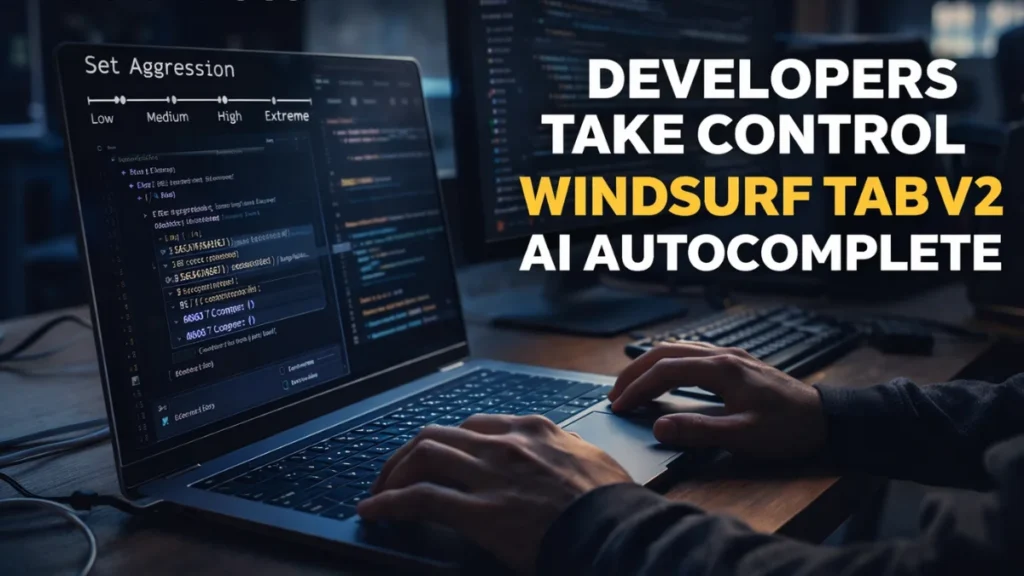
AI coding tools love to brag about accuracy. Windsurf is betting developers care more about momentum.
On February 3, the Windsurf team unveiled Tab v2, a rebuilt version of its AI autocomplete system that, according to internal testing, helps developers accept 25% to 75% more code—without increasing how often suggestions interrupt their flow.
The upgrade isn’t just about better models. It’s about giving developers a say in how bold their AI should be.
Why Tab Needed a Rethink
Autocomplete has been around for decades, from early IDE helpers to modern AI-driven tools. In recent years, large language models have taken over the space, promising smarter and longer suggestions.
But Windsurf says one metric has quietly warped the industry: acceptance rate.
A high accept rate sounds good, but it can be gamed. Predict less often, stick to obvious completions, and your numbers look great—while developers type just as much as before. Windsurf decided that was the wrong incentive.
Instead, Tab v2 focuses on a more practical question: How many keystrokes does this actually save?
Holding prediction frequency steady, the team reworked Tab to generate longer, more useful completions—while keeping rejection rates flat.
The Big Idea: Variable “Aggression”
During customer testing, Windsurf noticed something odd. The same autocomplete behavior would be praised by one developer and dismissed by another.
Some wanted conservative suggestions that never overstepped. Others preferred bold predictions that finished entire blocks of code.
Rather than splitting the difference, Windsurf exposed the tension directly. Tab v2 introduces a variable aggression setting, allowing developers to tune how ambitious the autocomplete should be.
Lower aggression favors shorter, safer suggestions. Higher aggression takes calculated risks—predicting more code per Tab press, with the understanding that not every guess will land.
It’s an unusual move in a market obsessed with defaults, but Windsurf argues it reflects reality: there is no universal “best” autocomplete style.
Fixing When AI Tries Too Hard
Aggression also addresses a familiar frustration with AI coding tools: the urge to “fix” code prematurely.
In many models, the system is rewarded for producing runnable code. That can backfire in autocomplete, where a developer typing def in Python doesn’t necessarily want a full function scaffold shoved into their editor.
Tab v2’s training explicitly penalizes these moments. Windsurf says it reworked both context handling and reinforcement learning rewards to prioritize developer intent, not just syntactic correctness.
Reinforcement Learning, Stress-Tested
Behind the scenes, Tab v2 doubled as a proving ground for Windsurf’s reinforcement learning infrastructure.
Early training runs failed in predictable ways—overly aggressive suggestions, misread intent, and completions that looked impressive but felt wrong in practice. Iteration came from live A/B testing and new evaluation methods designed to reflect what the company calls “developer taste.”
The result, Windsurf claims, is a genuine Pareto improvement: more accepted code without trading off usability.
A Signal for the AI Tooling Market
Tab v2’s launch hints at a broader shift in AI developer tools. Instead of chasing headline benchmarks, Windsurf is optimizing for personalization and control—acknowledging that productivity is subjective.
As AI becomes more embedded in everyday coding, expect more tools to follow this path: fewer rigid defaults, more dials developers can turn themselves.
For Windsurf, the message is clear. The future of autocomplete isn’t just smarter AI—it’s AI that knows when to push, and when to back off.