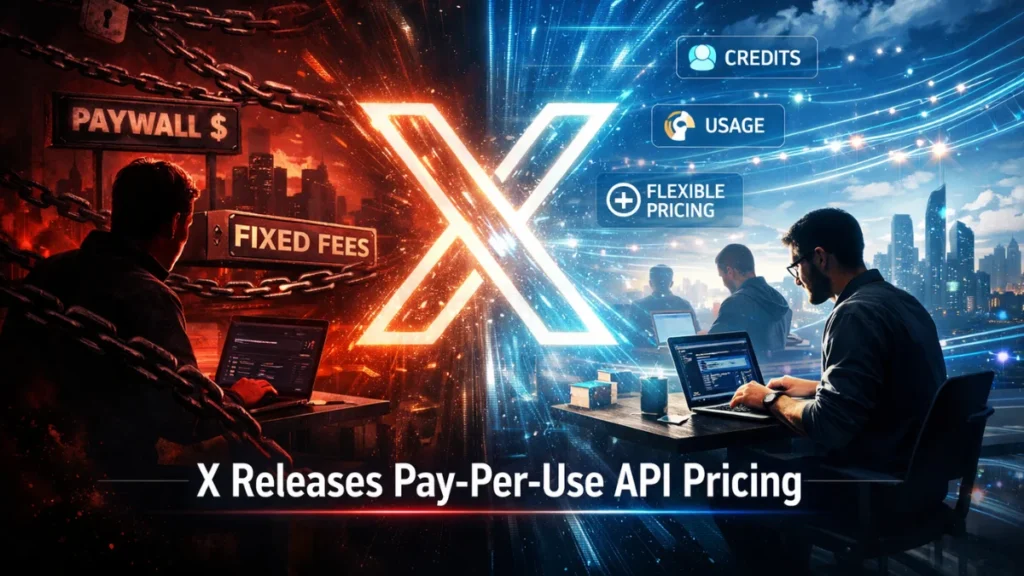
X just rewrote the rules of how developers pay to build on its platform—and the change is more than a pricing tweak. By abandoning rigid subscription tiers in favor of pay-per-use access, the company is signaling a strategic pivot back toward the independent builders and startups that once powered its ecosystem.
For years, X’s API pricing was a point of friction. Now, the company is betting that flexibility, transparency, and lower entry costs will reignite developer interest at a moment when competition for developer mindshare has never been fiercer.
A Clean Break From the Old Model
Until now, developers faced a blunt choice: pay $200 a month for a Basic plan or $5,000 a month for Pro—whether they used the API heavily or barely at all. That structure effectively locked out hobbyists, students, and many early-stage startups.
Under the new system, X has scrapped fixed tiers entirely. Developers now buy usage credits and pay only for what they consume. Fetching a post starts at half a cent. Accessing user profiles or direct messages costs about a penny per request. If an app makes the same request repeatedly, deduplication ensures developers aren’t charged twice.
To avoid surprise bills—a common fear with usage-based pricing—X has added real-time spending dashboards that show costs accumulating as code runs, not weeks later on an invoice.
Legacy free-tier users aren’t being left behind either. They’re receiving a $10 credit voucher, enough to experiment, prototype, or run a small app without reaching for a credit card.
Officially launching X API Pay-Per-Use
— Developers (@XDevelopers) February 6, 2026
The core of X developers are indie builders, early stage products, startups, and hobbyists
It’s time to open up our X API ecosystem and instill a new wave of next generation X apps
We’re so back. https://t.co/FS66GuIYJD
Why X Is Doing This Now
This move didn’t come out of nowhere. Since its acquisition and rebranding, X has struggled to balance monetization with openness. Aggressive API pricing helped drive revenue discipline, but it also hollowed out the developer community that once built analytics tools, bots, research platforms, and creative experiments atop the network.
At the same time, the broader industry has shifted. Usage-based pricing has become the norm across cloud services and AI platforms, largely because it aligns cost with value. Developers expect to start small, scale gradually, and understand exactly what they’re paying for.
By adopting this model, X is effectively acknowledging that the old approach overshot the mark.
An embedded post from the X Developers account framed the change plainly: the core of X’s developer base consists of indie builders, early-stage products, startups, and hobbyists—and the company wants them back.
The xAI Angle Most People Will Miss
The announcement includes a subtle but meaningful incentive tied to xAI, X’s AI arm. For every dollar spent on X API credits, developers can earn up to 20% back as free credits for the Grok API.
This cross-crediting does more than sweeten the deal. It quietly nudges developers toward building applications that blend social data with AI reasoning. Pull posts from X, analyze or summarize them with Grok, and do it at a discount.
From a platform strategy perspective, that’s not accidental. It’s an early attempt to create economic gravity between X’s social graph and its AI ambitions—something few competitors can offer in a single ecosystem.
What Developers Are Reacting To
The immediate response from the developer community has been unusually positive. Several builders described the change as a turning point, with one calling it a “massive day” for the platform and another joking that there’s now “no excuse” not to ship.
That enthusiasm matters. Developers are often the earliest signal of whether a platform is becoming more relevant or fading into the background. When pricing feels fair and experimentation feels safe, innovation tends to follow.
Insiders will also notice something else: features like deduplication and spend tracking aren’t flashy, but they suggest X has learned from past backlash. These tools are specifically designed to prevent the kind of accidental overuse that can sink small teams overnight.
Why This News Matters
This shift directly affects several groups:
- Independent developers and hobbyists, who can now build without committing hundreds or thousands of dollars upfront.
- Startups, which can prototype and test product-market fit before scaling costs.
- Researchers and analysts, who rely on social data but often operate on limited budgets.
- X itself, which regains relevance as a programmable platform rather than just a closed social app.
More broadly, it reflects a recalibration of power. Platforms that price developers out of experimentation often end up with fewer tools, fewer integrations, and less cultural influence. X appears determined not to repeat that mistake.
Future Prospective
If this model holds, expect a slow but steady return of third-party X apps—dashboards, AI-powered assistants, moderation tools, and niche community products that never made sense under flat-fee pricing.
There are risks. Usage-based pricing can still spiral if poorly managed, and trust won’t fully return overnight. Some developers burned by past changes will remain cautious.
But the opportunity is clear. By lowering friction and tying its API economy to AI incentives, X is laying the groundwork for a new generation of applications that treat social data as a real-time input, not a locked archive.
Whether developers fully come back will depend less on today’s announcement and more on consistency. For now, though, X has sent a clear message: building on the platform is no longer reserved for those who can afford a hefty monthly bill.