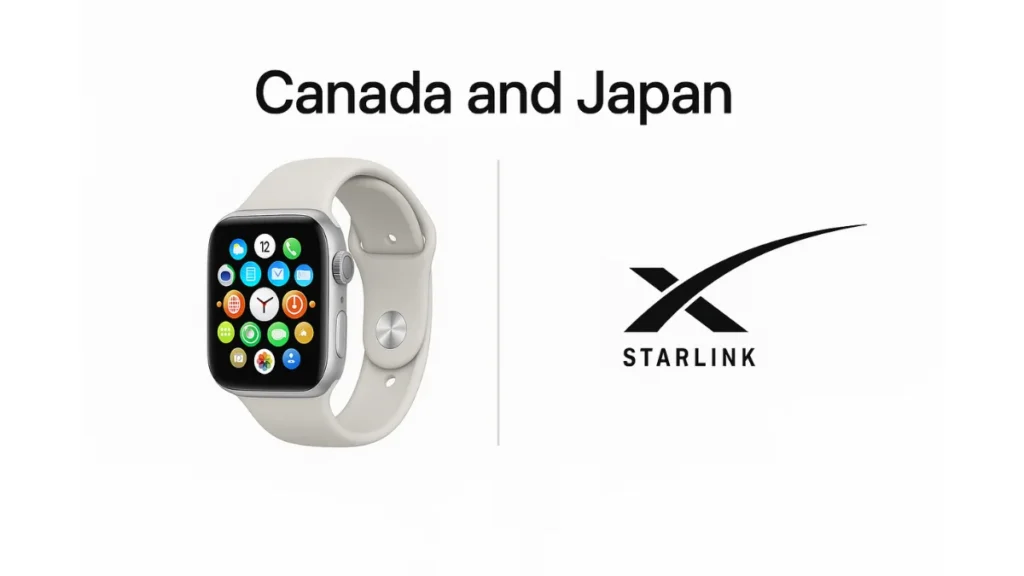
SpaceX just gave the Apple Watch a serious power-up: direct satellite connectivity.
The company’s Starlink service now supports Apple Watch models in Canada and Japan, letting users send texts, make calls, and stay connected even when far beyond mobile coverage — a milestone for wearable tech and off-grid communication.
Key Takeaways
- Starlink adds satellite support for Apple Watches in Canada & Japan.
- Works on Apple Watch Series 11, SE 3, and Ultra 3 models.
- Rogers offers free access until June 2026; KDDI charges ~¥1,000/month.
- Expands Starlink’s Direct-to-Cell program from phones to wearables.
- Signals the rise of satellite-connected consumer tech.
SpaceX’s Starlink now connects Apple Watch users in Canada and Japan directly to satellites, enabling calls and messages beyond mobile range. Rogers offers the service free until 2026; KDDI charges about ¥1,000 per month.
Starlink’s Wearable Leap
For years, SpaceX has promised to make mobile dead zones a relic. Its “Direct-to-Cell” network, powered by low-orbit satellites, already connected smartphones. Now, it’s extending that capability to the wrist.
The new feature supports Apple Watch Series 11, SE (3rd gen), and Ultra 3, and is being rolled out through Rogers Communications in Canada and KDDI’s au network in Japan.
Both carriers are early partners in SpaceX’s plan to merge satellite broadband with consumer devices — no bulky antennas or satellite phones required.
BREAKING: SpaceX’s Cellular Starlink is now available on Apple Watches in Canada and Japan — enabling direct satellite connectivity even beyond mobile coverage.
— Tesla Owners Silicon Valley (@teslaownersSV) November 10, 2025
In partnership with Rogers (Canada) and KDDI au (Japan), the feature supports Apple Watch Series 11, SE 3, and Ultra… pic.twitter.com/hHV76VBXWh
Canada: Rogers Offers Free Access Until 2026
In Canada, Rogers is offering free Starlink-powered connectivity for existing plan users until June 2026. The pilot includes messaging and emergency services that rely on Starlink’s satellite layer when LTE or 5G drop out.
Rogers says the feature will expand to more functions — including limited data and call support — once Starlink’s network integration reaches full operational phase later next year.
“This is about reliability, not luxury,” a Rogers product manager told reporters. “Canadians in remote regions, on the water, or in the mountains shouldn’t lose connection just because there’s no cell tower nearby.”
Japan: KDDI’s “au Starlink Direct” Expands to Wearables
In Japan, KDDI (au) is integrating Starlink connectivity into its Number Share plans for the latest Apple Watches. The satellite tier reportedly costs around ¥1,000 per month and is designed for hikers, rural workers, and disaster-response users who rely on communication in low-coverage zones.
Japan has been an early testbed for Starlink’s smartphone connectivity, and extending it to Apple Watches aligns with the country’s broader national strategy for satellite-enabled emergency networks after several major earthquakes.
The Tech Behind It
Starlink’s “Direct-to-Cell” satellites act like floating cell towers, allowing standard LTE devices to connect directly without new hardware. Each satellite carries a 4G-compatible payload, enabling basic data and text exchange — and soon, full voice integration.
With over 6,000 satellites already in orbit (SpaceX, Oct 2025), the company says its goal is “global cellular continuity.” That means future Apple Watches — and potentially Android wearables — could stay connected virtually anywhere with a clear view of the sky.
This also makes Apple the first major smartwatch brand with live consumer-grade satellite connectivity, leapfrogging Garmin and Samsung, which still rely on paired devices or SOS relay systems.

Why It Matters
For users, this isn’t a gimmick — it’s safety tech. From bush pilots and fishermen in Northern Canada to hikers in Japan’s Alps, the ability to message or call without cell service can be lifesaving.
For SpaceX, it’s a strategic wedge into the trillion-dollar telecom market. By embedding Starlink inside everyday wearables, Elon Musk’s satellite network inches closer to being a default global carrier rather than just an ISP in the sky.
And for Apple? It tightens the company’s emergency-communications narrative, reinforcing its “your lifeline on your wrist” brand promise — even though Starlink, not Apple’s longtime partner Globalstar, is handling the space layer here.
The Bigger Picture
The rollout hints at a future where wearables are independent network nodes, not Bluetooth accessories tethered to phones. Analysts expect broader satellite-wearable integration across Android devices by late 2026, as competitors like AST SpaceMobile and Lynk Global ramp up coverage deals.
Meanwhile, SpaceX continues to secure regulatory approvals in the U.S. and EU for direct-to-device communications — a key hurdle before the service can expand globally.
Conclusion
The Apple Watch just became a real off-grid device. With Starlink bridging the gap between orbit and wrist, SpaceX is turning wearable tech into true satellite communicators — a move that could redefine how we think about “cellular coverage.”