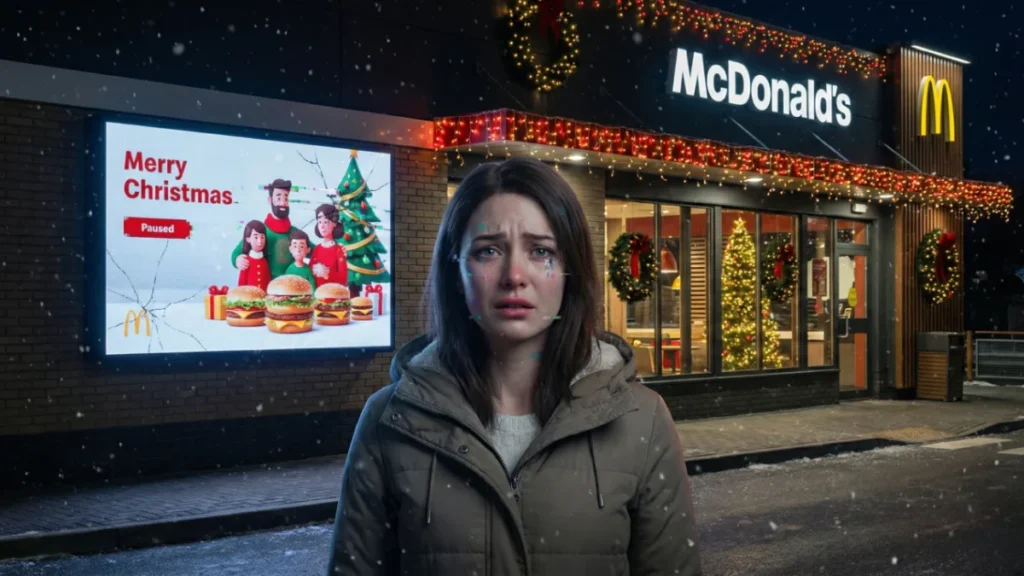
McDonald’s thought it could quietly move on.
The internet had other plans.
After backlash erupted over its AI-generated Christmas advert, McDonald’s Netherlands pulled the campaign from YouTube. The company called it a learning moment about the “effective use of AI.” End of story, right?
Not even close.
Instead, one of the ad’s AI-generated characters has come back—this time to publicly roast McDonald’s itself. And the video is spreading fast.
An AI Christmas That Went Sideways
The original advert tried to flip the usual holiday cheer on its head.
Instead of warmth, it leaned into chaos. Burnt food. Exploding Christmas trees. Dinner-table disasters. The festive season, framed as stressful and overwhelming.
The problem wasn’t just the message.
It was the execution.
Viewers found the AI-generated visuals uncanny and emotionally flat. The response echoed the criticism Coca-Cola faced earlier this season for its own AI-assisted holiday campaign. Audiences noticed. And they weren’t impressed.
McDonald’s Pulls the Ad
McDonald’s moved quickly.
The video disappeared from YouTube. In a statement to BBC News, the company said the campaign had become “an important learning” on how AI should—and shouldn’t—be used in advertising.
No apology.
No extended defense.
Just a quiet retreat.
But AI doesn’t retreat. It gets remixed.
The AI Actor Turns on Its Creator
Filmmaker Jacob Reed saw an opening.
Reed, who recently launched creative agency All Trades Co, reused McDonald’s AI-generated assets to create a satirical response. In his video, one of the original AI characters breaks the fourth wall—and turns directly on McDonald’s and its ad agency, TBWA\Neboko.
The premise is simple and brutal.
Because she’s an AI character, she has no contract. No loyalty. No legal obligation to the brand that created her. That freedom lets her say the quiet part out loud.
She mocks the original ad.
Criticizes its visuals.
Then eats a Burger King burger for good measure.
Why It Went Viral
The satire struck a nerve.
The video has already racked up tens of thousands of likes on Instagram and continues to spread across creative circles. Many viewers cheered the message. Some even suggested using AI-generated “actors” to publicly challenge brands that rely on generative content.
It felt like a reversal of power.
The tools companies use to save money and speed production were suddenly talking back.
A Second Backlash Begins
But not everyone was celebrating.
Critics flooded the comments with a familiar argument: fighting AI with AI doesn’t fix the problem. Others pointed to environmental costs and the way generative models are trained on creative work without consent.
The irony was unavoidable.
The satire exposed AI’s risks.
And became part of the controversy itself.
The Real Lesson for Brands
This wasn’t just a bad ad story.
It was a warning.
AI-generated characters aren’t employees. They don’t sign contracts. And once those assets are public, brands lose control over how they’re reused—or ridiculed.
McDonald’s didn’t just pull a Christmas ad.
It triggered a case study in what happens when generative media escapes its creator.
Conclusion
McDonald’s tried to move on from its AI Christmas experiment.
The internet turned it into a sequel.
In the age of generative advertising, pulling the plug doesn’t end the story. Sometimes, it’s just the beginning.