Local governments rarely move fast. But one South Carolina town just proved they can move smart.
Earlier this month, Mount Pleasant quietly launched Sawyer, an AI-powered virtual assistant designed to answer resident questions 24 hours a day—no hold music, no office-hour limits, no human bottlenecks.
And in its first weeks, the system is already showing why municipal AI may be closer to a tipping point than many expect.
A chatbot built for real civic problems
Sawyer isn’t trying to be clever. It’s trying to be useful.
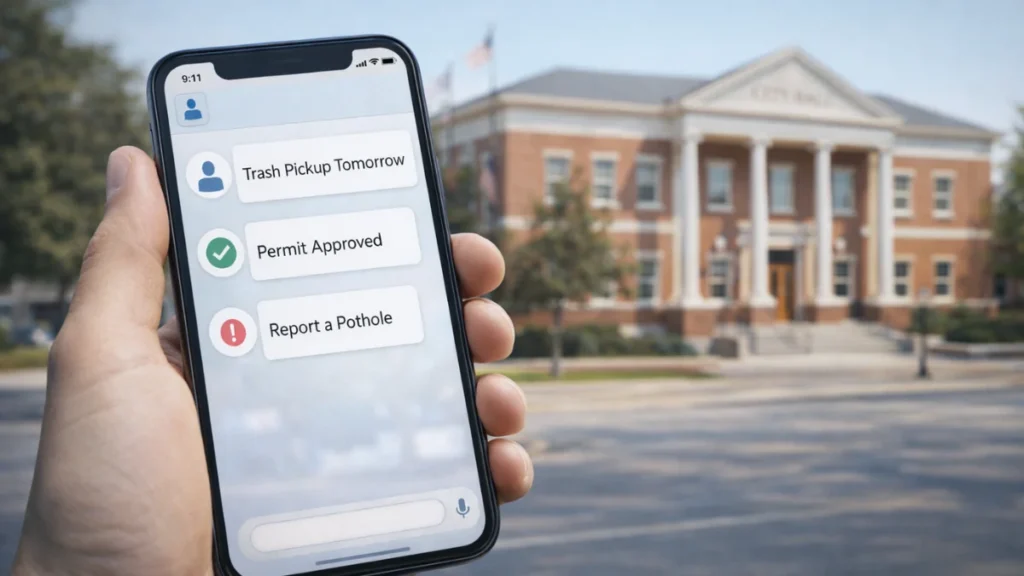
Residents use it to check trash pickup schedules, ask about permits, report potholes, or sort out parking rules—tasks that typically flood town offices with repetitive calls. Since launch, Sawyer has handled 340 questions, most through web chat, with others coming in by phone.
The goal isn’t to replace staff. It’s to remove friction.
Town officials say that when routine questions are offloaded to AI, permit clerks and service teams can move faster on work that actually requires human judgment.
Always on, always multilingual
One detail that stands out: accessibility.
Sawyer supports more than 70 languages and works across text, phone calls, and the town’s website. For a local government, that’s a meaningful leap—especially in communities where language barriers can quietly block access to public services.
Residents can even start a conversation by simply texting “Hello” to a dedicated phone number. No app download. No login. No learning curve.
And when Sawyer doesn’t know the answer, it escalates the request to a real person.
A $30,000 experiment in efficiency
The price tag is modest by government-tech standards: about $30,000 per year, funded through the town’s communications budget.
That’s less than the cost of adding a single full-time role—and far cheaper than large-scale digital transformation projects that often stall before launch.
For Mount Pleasant, Sawyer is less about innovation theater and more about operational math: fewer interruptions, faster turnaround times, and clearer insight into what residents actually need.
The data is the quiet power move
Behind the scenes, Sawyer is doing something humans struggle to do consistently—tracking patterns.
Town officials analyze what questions residents ask most, when they ask them, and where confusion keeps surfacing. That data then shapes future public messaging, website updates, and outreach campaigns.
In other words, the AI doesn’t just answer questions. It tells the town what it’s failing to explain.
Why this matters beyond one town
Mount Pleasant isn’t alone in testing AI, but its approach feels unusually grounded.
Instead of flashy pilots or experimental kiosks, Sawyer solves mundane problems—the kind that quietly define whether residents feel supported or frustrated. That makes it a telling case study for small and mid-sized governments watching AI from the sidelines.
If this model scales, AI may become less about “smart cities” and more about something simpler: governments that respond when people actually need them.
Conclusion
Sawyer isn’t revolutionary tech. That’s the point.
It’s a practical, always-on layer between residents and local government—and a signal that AI’s most immediate impact may show up not in Silicon Valley, but in town halls that finally stop ringing off the hook.