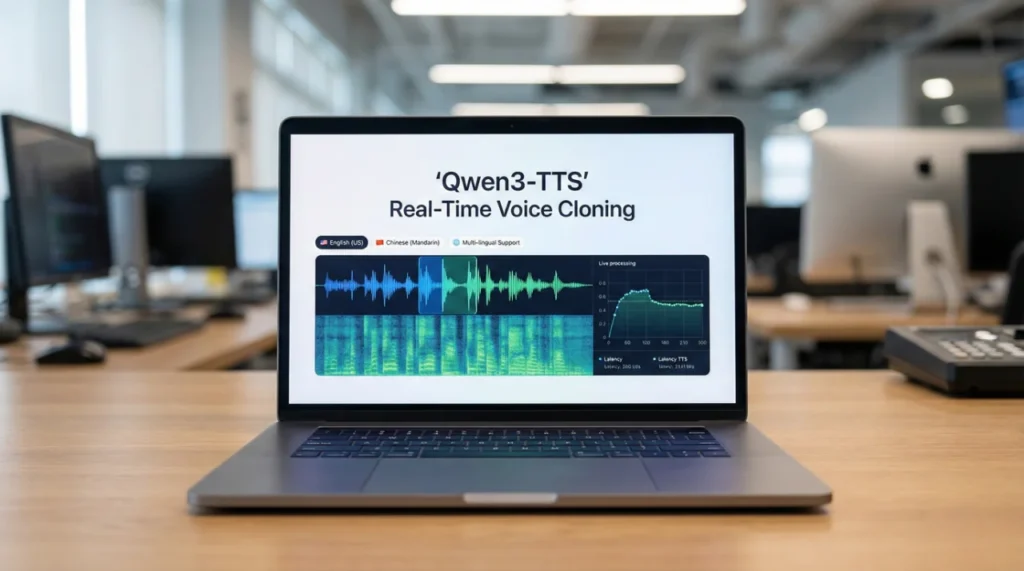
Alibaba has just made a bold move in the fast-heating voice AI race.
The company’s Qwen team has open-sourced Qwen3-TTS, a new family of text-to-speech and voice-cloning models designed for real-time use. The release, made public today, puts production-grade voice technology—often locked behind paid APIs—directly into the hands of developers worldwide.
At a moment when voice is becoming the next interface layer for AI, Alibaba’s timing feels deliberate.
What Qwen3-TTS Actually Ships
Qwen3-TTS isn’t a single model. It’s a full stack.
Alibaba released five models ranging from roughly 0.6B to around 1.7–1.8B parameters, split across Base, CustomVoice, and VoiceDesign variants. Together, they cover everything from standard speech synthesis to custom voice creation and rapid voice cloning.
The models support ten languages, including dialects, and ship with nine preset timbres. Developers can also design new voices using text prompts—describing tone, style, or emotion—without manual audio tuning.
All model weights, inference code, and demos are freely available on GitHub and Hugging Face, making the release fully usable out of the box.
Qwen3-TTS is officially live. We’ve open-sourced the full family—VoiceDesign, CustomVoice, and Base—bringing high quality to the open community.
— Qwen (@Alibaba_Qwen) January 22, 2026
– 5 models (0.6B & 1.8B)
– Free-form voice design & cloning
– Support for 10 languages
– SOTA 12Hz tokenizer for high compression
-… pic.twitter.com/BSWpaYoZWj
Speed Is the Real Story
What stands out most isn’t just openness—it’s latency.
Alibaba claims Qwen3-TTS can run with end-to-end latency as low as 97 milliseconds, fast enough for live conversations, game characters, and embodied agents. That performance is driven by a 12Hz speech tokenizer, which compresses audio efficiently while maintaining natural rhythm and clarity.
In benchmark tests shared by the Qwen team, the models reportedly rival or outperform leading commercial voice systems on speech naturalness and stability [NEEDS VERIFICATION]—a notable claim in a market dominated by closed providers like ElevenLabs.
Why Developers Are Paying Attention
The reaction from builders was immediate.
Voice AI has been one of the least open corners of the generative ecosystem. High-quality speech models typically come with usage caps, restrictive licenses, or pricing that scales quickly. By contrast, Qwen3-TTS can be self-hosted, modified, and deployed without per-call fees.
That matters for startups building voice-first apps, researchers experimenting with conversational agents, and creators producing long-form audio like podcasts or audiobooks.
In short, this lowers the cost—and friction—of experimenting with voice at scale.
The Bigger Signal From Alibaba
This release also reflects a broader strategic pattern.
Alibaba has been steadily positioning the Qwen ecosystem as a serious open alternative to Western AI stacks. By open-sourcing competitive voice technology, it’s signaling that speech—like text models before it—may be heading toward commoditization faster than expected.
For closed vendors, that raises uncomfortable questions about differentiation. For developers, it’s a clear win.
What Comes Next
Expect rapid iteration.
Open-source voice models tend to evolve quickly once the community gets involved—fine-tuning accents, adding emotional control, and optimizing for edge devices. If Qwen3-TTS sees wide adoption, it could become a default backbone for real-time voice apps across regions.
Voice is no longer just a feature. Alibaba is betting it’s infrastructure.
Conclusion
With Qwen3-TTS, Alibaba didn’t just release another AI model—it challenged the idea that high-quality voice must stay closed. And in the race to own the AI interface, that could be a turning point.